Quick question on Baryon spin states

Click For Summary
SUMMARY

The discussion centers on the spin states of baryons, specifically addressing the configurations of quarks in terms of their spin and color charges. It clarifies that baryons consist of two spin-1/2 doublets and a spin-3/2 quadruplet, with the charges of quarks being +2/3e and -1/3e. The necessity for a total antisymmetric wavefunction is emphasized, particularly in relation to the Pauli exclusion principle and the color charge of quarks, which must be antisymmetric to ensure color neutrality in baryons. The conversation references the representation theory of SU(3) to explain the combinations of quarks and their respective symmetries.

PREREQUISITES
  • Understanding of baryon structure and quark model
  • Familiarity with spin states and quantum numbers
  • Knowledge of SU(3) representation theory
  • Basic principles of quantum mechanics, particularly the Pauli exclusion principle
NEXT STEPS
  • Study the implications of the Pauli exclusion principle in quantum systems
  • Explore SU(3) representation theory in detail
  • Learn about baryon classification and the significance of color charge
  • Investigate the role of confinement in particle physics
USEFUL FOR

Particle physicists, theoretical physicists, and students studying quantum mechanics and the quark model will benefit from this discussion, particularly those interested in baryon structure and symmetries in particle interactions.
unscientific
Messages
1,728
Reaction score
13
Things I don't understand:

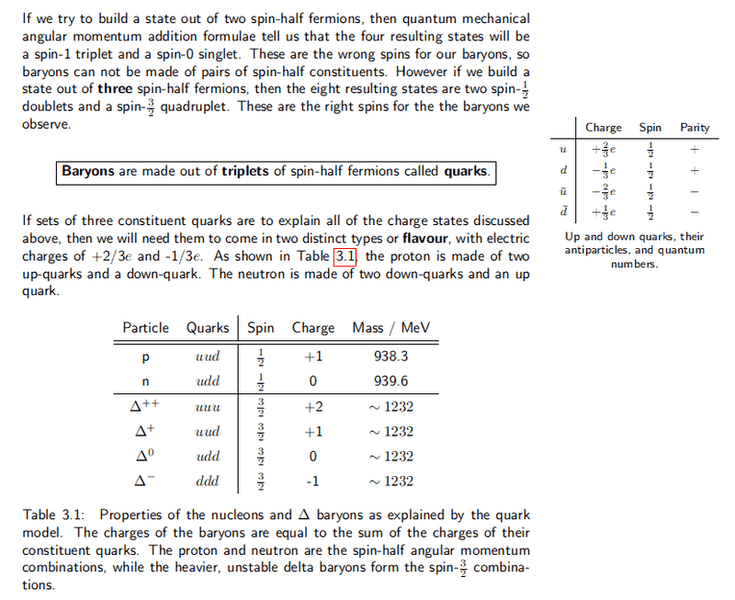
  • What do they mean by "two spin-1/2 doublets and a spin-3/2 quadruplet"?
  • Why do they use the two flavours "+2/3e and -1/3e" ?

20r7m7p.png
 
Physics news on Phys.org
unscientific said:
What do they mean by "two spin-1/2 doublets and a spin-3/2 quadruplet"?
Do you understand the easier case of 2 constituents?
unscientific said:
Why do they use the two flavours "+2/3e and -1/3e" ?
The observed charges go from -1 to +2. The only option to get this from all combinations of two types of quarks is +2/3e and -1/3e as charges. Other numbers just do not work.
 
  • Like
Likes   Reactions: unscientific
mfb said:
Do you understand the easier case of 2 constituents?
The observed charges go from -1 to +2. The only option to get this from all combinations of two types of quarks is +2/3e and -1/3e as charges. Other numbers just do not work.

Just referenced Griffiths book and now I understand. Thanks!
 
Why spin 1/2 uuu and ddd states don't exist?
 
nikkkom said:
Why spin 1/2 uuu and ddd states don't exist?

Pauli exclusion.
 
color : antisymmetric
so spin*flavor = symmetric.
The uuu and ddd belong to the 10-dim irreducible representation of 3*3*3... it is totally symmetric.
However the 2*2*2 = 4 + 2 + 2 for the three spin 1/2 combination, the only totally symmetric irrep is the 4-dimensional one (J=3/2) ... The other two 2-dimensitonal have mixed symmetry.
http://www.physics.umd.edu/courses/Phys741/xji/chapter3.pdf
 
Vanadium 50 said:
Pauli exclusion.

"Naively", in baryon every quark has a different color charge, thus even in uuu or ddd there aren't two quarks with all identical quantum numbers, so Pauli exclusion should not apply here.
 
nikkkom said:
"Naively", in baryon every quark has a different color charge, thus even in uuu or ddd there aren't two quarks with all identical quantum numbers, so Pauli exclusion should not apply here.

As I already said- The color will be antisymmetric, The rest will have to be combined into a symmetric part, so that the whole wavefunction will be totally antisymmetric - that is (not naively saying) Pauli's exclusion principle.
 
nikkkom said:
"Naively", in baryon every quark has a different color charge, thus even in uuu or ddd there aren't two quarks with all identical quantum numbers, so Pauli exclusion should not apply here.

Of course it does. You need a total antisymmetric wavefunction. Color is antisymmetric, so the rest has to be symmetric. uuu and ddd are flavor symmetric, so they also have to be spin-symmetruic,
 
  • #10
Vanadium 50 said:
Of course it does. You need a total antisymmetric wavefunction. Color is antisymmetric, so the rest has to be symmetric. uuu and ddd are flavor symmetric, so they also have to be spin-symmetruic,

Why is colour anti-symmetric for uuu, ddd and sss for ##J^P = \frac{1}{2}^{+}## ?

Is it because for ##J^P = \frac{3}{2}^{+}## we already set colour to be anti-symmetric, so the same colour for ##J^P = \frac{1}{2}^{+}## must be anti-symmetric?
 
  • #11
Color is antisymmetric because particles don't carry naked color.
 
  • #12
Because the singlet (color neutrality) you can achieve from SU(3) corresponds to a totally antisymmetric projection.
 
  • #13
Vanadium 50 said:
Color is antisymmetric because particles don't carry naked color.

ChrisVer said:
Because the singlet (color neutrality) you can achieve from SU(3) corresponds to a totally antisymmetric projection.

Yes, isolated quarks have never been observed, due to quark confinement. But uuu, ddd and sss for ##J^P = \frac{1}{2}^{+}## are not isolated quarks. Since a quark carries colour while an anti-quark carries anti-colour, shouldn't uuu, ddd and sss carry colour? My question is why is the colour anti-symmetric. I'm guessing it's because we already assign it to be anti-symmetric in ##J^P = \frac{3}{2}^{+}##.
 
  • #14
unscientific said:
Yes, isolated quarks have never been observed, due to quark confinement. But uuu, ddd and sss for ##J^P = \frac{1}{2}^{+}## are not isolated quarks. Since a quark carries colour while an anti-quark carries anti-colour, shouldn't uuu, ddd and sss carry colour? My question is why is the colour anti-symmetric. I'm guessing it's because we already assign it to be anti-symmetric in ##J^P = \frac{3}{2}^{+}##.

Confinement has little to do with that. Every hadron is a color singlet/color neutral because of confinement. That's what counts. So even if you want to combine 3 quarks together, you have to do that so that you'll obtain a singlet in the end. You can see that doing that with 2 quarks for example, it's not possible. Doing that with a quark+antiquark in SU(3)_flavor it's possible, and that's why you get the mesons. But here you have SU(3)_color, so you must always look for singlets when you write down quark bound states.

In particular they belong to the the 1-dimensional representation of SU(3)_color , coming from the 3 \otimes 3 \otimes 3 = 10 \oplus 8 \oplus 8 \oplus 1 which is antisymmetric... To illustrate the multiplication imagine you have 1 quark which can have (R,G,B) a 2nd quark with (R,G,B) and a third quark with (RGB) and you want to combine them... Their combination you see gives you the singlet, that's the meaning of the above multiplication and its decomposition into irreducible representations which tells you that there exists a combination that transforms trivially under SU(3)_color transformations...If you do the calculation of this with Young Diagrams, you will see that the singlet corresponds to the antisymmetry, you will have to write it in some form like \epsilon^{abc} C_{1a} C_{2b} C_{3c} with C_{1,2,3~ a} the color of 1,2,3 quarks . So it's not what you assign for any spin/parity state. The color is always antisymmetric so that you won't get colorful bound states that are not observable in nature.

Singlet= transforms trivially , so it's equivalent to being neutral.
 
Last edited:

Similar threads

  • · Replies 1 ·
Replies
1
Views
2K
  • · Replies 7 ·
Replies
7
Views
4K
  • · Replies 4 ·
Replies
4
Views
2K
Replies
7
Views
2K
  • · Replies 3 ·
Replies
3
Views
4K
  • · Replies 9 ·
Replies
9
Views
1K
  • · Replies 2 ·
Replies
2
Views
3K
  • · Replies 2 ·
Replies
2
Views
4K
  • · Replies 4 ·
Replies
4
Views
2K
  • · Replies 3 ·
Replies
3
Views
3K