Quickest Route Between Horizontal Points using the Initial Velocity & Friction

Click For Summary

Discussion Overview

The discussion revolves around finding the quickest route between two horizontal points considering initial velocity and friction. Participants explore mathematical models, parametric curves, and the effects of friction on the trajectory of a particle or vehicle. The scope includes theoretical reasoning, mathematical derivations, and practical applications related to optimal paths in physics.

Discussion Character

  • Exploratory
  • Technical explanation
  • Mathematical reasoning
  • Debate/contested

Main Points Raised

  • Some participants propose using equations from previous posts to find time and radius while incorporating friction into the parametric curve.
  • One participant describes a model where a particle behaves like a bead sliding along a rail, leading to a series of equations involving forces and motion.
  • Another participant suggests simplifying the equations to isolate terms related to the second derivative of the trajectory.
  • Several participants discuss approximating results based on varying friction coefficients and their impact on the optimal path, noting that increased friction requires adjustments to the radius and angle of the path.
  • One participant expresses difficulty in rearranging formulas to solve for specific parameters and seeks an initial approximate solution for a curve.
  • Another participant mentions the goal of finding a traversable path for a vehicle with specific lift-to-drag ratios and initial velocities, emphasizing the importance of minimizing travel time.
  • Some participants explore the relationship between initial velocity, horizontal distance, and the optimal path, suggesting that a cycloid may be the best trajectory under certain conditions.
  • One participant questions whether it is possible to determine the y position of a cusp to calculate travel time with minimal initial velocity.

Areas of Agreement / Disagreement

Participants express various hypotheses and approaches, but no consensus is reached on the optimal method or specific parameters. Multiple competing views remain regarding the effects of friction and the best trajectory to achieve the shortest travel time.

Contextual Notes

Limitations include unresolved mathematical steps and dependencies on specific assumptions regarding initial conditions and friction coefficients. The discussion involves complex equations that may not have straightforward solutions.

Who May Find This Useful

Readers interested in mathematical modeling of motion, optimization problems in physics, and applications involving friction and trajectories may find this discussion relevant.

Devin-M
Messages
1,076
Reaction score
765
re: https://www.physicsforums.com/threads/is-it-possible-to-solve-for-t.996132/post-6421205

https://www.physicsforums.com/threads/is-it-possible-to-solve-for-t.996132/post-6421230

Would it be possible to find t and r via the exact same equations as found in posts #4 and #10, and then find the parametric curve by incorporating the coefficient of friction via (where r is labeled a):
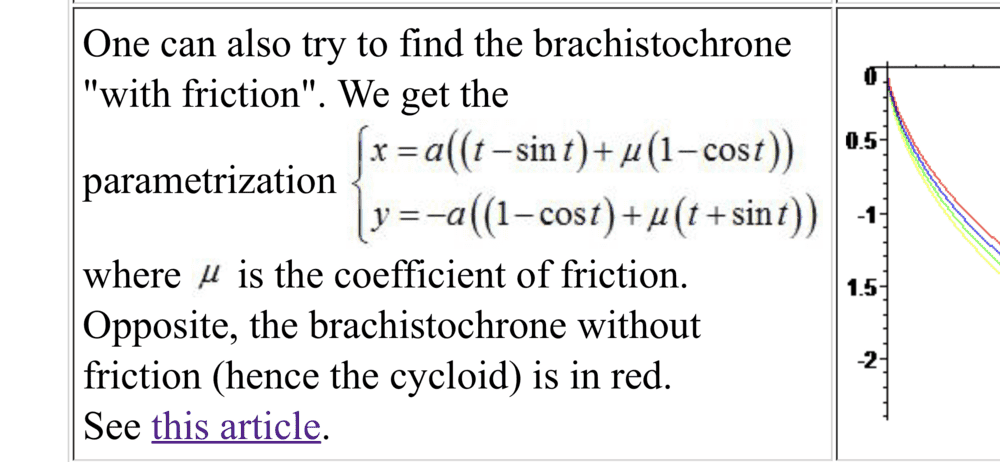
837A2A54-927E-4974-A399-B6D85E0A0A51.png


from:
https://mathcurve.com/courbes2d.gb/brachistochrone/brachistochrone.shtml

@etotheipi
 
Last edited:
Engineering news on Phys.org
This was already explained in the linked article. To summarise, imagine the particle as bead sliding along a rail in the shape of the trajectory. The contact force ##\mathbf{N}## satisfies$$(\mathbf{N} + m\mathbf{g})\cdot \mathbf{n} = \frac{mv^2}{\rho} \mathbf{n}$$If you approximate the RHS to be negligible, then$$\mathbf{F}_{f} = -\mu N \mathbf{t} = -\mu mg\cos{(\theta)} \mathbf{t}$$Apply Newton II tangentially,$$-mg\sin{(\theta)} - \mu mg \cos{(\theta)} = m\ddot{s}$$But ##\cos{(\theta)} = dx/ds## and ##\sin{(\theta)} = dy/ds##, so$$-g \frac{dy}{ds} - \mu g \frac{dx}{ds} = \ddot{s} = \dot{v}$$Now, critical step is to rewrite$$\dot{v} = \frac{dv}{ds} \frac{ds}{dt} = v\frac{dv}{ds} = \frac{1}{2} \frac{d}{ds} \left( v^2 \right)$$so that$$-2g \frac{dy}{ds} - 2\mu g \frac{dx}{ds} = \frac{d(v^2)}{ds}$$and now integrate, taking ##v(0,0) = 0##,$$-2g(y + \mu x) = v^2 \implies v = \sqrt{-2g(y+\mu x)}$$Now we can define the time functional$$T[y] = \int_0^l \frac{ds}{v} = \int_{x_0}^{x_1} \frac{\sqrt{1+y'^2}}{\sqrt{-2g(y+\mu x)}} dx$$Now you can let$$\mathcal{L} = \frac{\sqrt{1+y'^2}}{\sqrt{-2g(y+\mu x)}}$$and we now have to compute ##\mathcal{L}_{y}## and ##\mathcal{L}_{y'}##, and use the Euler-Lagrange condition for extremum ##\mathcal{L}_{y} = \frac{d}{dx} {\mathcal{L}}_{y'}##, i.e.$$\frac{g\sqrt{1+(y')^2}}{(-2g(y+\mu x))^{\frac{3}{2}}} = \frac{d}{dx} \left( \frac{y'}{\sqrt{(1+y'^2)} \sqrt{-2g(y+\mu x)}} \right)$$ $$\frac{g\sqrt{1+(y')^2}}{(-2g(y+\mu x))^{\frac{3}{2}}} =

\frac{
\sqrt{1+(y')^2} \sqrt{-2g(y+\mu x)} y'' - y' \left( y' y''\frac{\sqrt{-2g(y+\mu x)}}{\sqrt{1+(y')^2}} - g(y' + \mu)\frac{\sqrt{1+(y')^2}}{\sqrt{-2g(y+\mu x)}} \right)
}{
(1+y'^2)(-2g(y + \mu x))
}

$$Now we must find a substitution to make this equation more manageable!
 
  • Like
Likes   Reactions: Devin-M
You can actually simplify it fairly nicely, first multiply through by ##(-2g(y+\mu x))^{\frac{3}{2}}(1+y'^2)^{\frac{3}{2}}##, and you get$$g(1+y'^2)^2 = y''(1+y'^2)(-2g(y+\mu x)) - y'^2 y''(-2g(y+ \mu x)) - gy'(y' + \mu)(1+y'^2)$$Now regroup the ##y''## terms,$$\begin{align*}g(1+y'^2)^2 &= y'' \left[ (1+y'^2)(-2g(y+\mu x)) - y'^2(-2g(y+\mu x)\right] - gy'(y' + \mu)(1+y'^2) \\ &= -2gy''(y+\mu x) - gy'(y' + \mu)(1+y'^2)\end{align*}$$And finally transpose the second term$$g(1+y'^2) \left[ 1+2y'^2 + \mu y' \right] + 2gy''(y+\mu x) = 0$$
 
I haven’t yet managed to rearrange the formula to solve for r, ta, tb, u but just wanted to find an initial very approximate solution as a guide.

My goal was to find a curve with an approximate initial depth of -1, a horizontal distance of 1 and a nonzero u and after fiddling around for a while I got this:

https://www.desmos.com/calculator/gquh3kpggq

85B3BA87-5DF4-434B-B426-153A981E69EA.jpeg
 
I’ve been able to approximate the results in the linked article:

Parametric Graph: https://www.desmos.com/calculator/jkth1kofbd

D385F2A6-7DBC-4030-B00B-2913F85CEC6B.jpeg

Starting with a cycloid radius 1 with a final angle of 3.88 rad with 0 friction coefficient, I increased the friction coefficient to 0.18 and concluded it is necessary to reduce the radius from 1 to 0.845 and increase the final angle from 3.88 rad to 4.24 rad to reach approximately the same endpoint in the shortest possible time. With the added friction, the optimal path “goes deeper” than the frictionless path.
 
Last edited:
  • Like
Likes   Reactions: etotheipi
@etotheipi Is it apparent to you from your equations how to find r, ta & tb between 2 horizontal points from the coefficient of friction and the initial velocity? The math is a bit advanced for my present understanding. In the other thread (without friction) I was able to find r, ta and tb using a purely geometrical approach.

The goal is to find a “traversable path” for a vehicle similar to a magnetically levitated hyperloop in vacuum (with a certain lift to drag ratio), where the initial velocity is high enough that, even with friction, the vehicle is able to return to the starting elevation and travel from point a to horizontal point b in the shortest possible time.

For example, without friction, with 9 m/s initial velocity, a horizontal distance of 5000m can be traveled in less than 1/10th the time on the optimal path compared to the flat route.
 
Last edited:
We'd need to try an ansatz, but presumably you'd end up with the parameterisation given on the website you found. I would play around with it for a bit longer, but I'm a little bit too busy tonight 😌
 
The best I can do at this point is say here is the quickest, traversable path between horizontal points with an initial velocity and a 250:1 lift to drag ratio (0.004 coefficient of friction), but I don’t know the initial velocity or the exact horizontal distance. The start and endpoints are at the 2 intersections of the orange and blue lines (the test body starts at rest from the origin and crosses the blue line with an initial velocity and crosses again with a final velocity):

Parametric Graph: https://www.desmos.com/calculator/peb5xdtqgk

5CADBBC7-3484-4E19-AE4A-7C8A899BE3F0.jpeg

Ideally I would like to find the minimum initial velocity for the optimal (for time) traversable pathway with a given horizontal distance, local gravity and coefficient of friction.
 
Last edited:
Playing around with the graph a bit more I find the minimum initial velocity for a horizontal distance of 5000m with 250:1 lift to drag ratio is equivalent to a fall down the ramp from the origin of roughly 20 meters and the optimal path for time for such a vehicle is very close to a cycloid. This gives a very rough minimum initial velocity of 19-20m/s in 9.8m/s^2 gravity or roughly ~43mph.

Graph: https://www.desmos.com/calculator/fxu9dcvmps

8E6ECC35-A409-46C4-938D-33C4677B2AA6.jpeg


55B9101A-DC21-4C1E-88B6-BB9511F0623D.jpeg

72A12B15-9625-43FE-BBE5-29FC0D2E0CF5.jpeg
 
  • #10
With a given r and u, is it possible to determine the y position of the cusp on the right hand side, use that to determine the initial velocity at the same depth from the cusp at the origin on the left hand side, and use that to calculate the travel time with minimal initial velocity?
 

Similar threads

  • · Replies 13 ·
Replies
13
Views
4K
Replies
14
Views
3K
  • · Replies 92 ·
4
Replies
92
Views
8K
  • · Replies 42 ·
2
Replies
42
Views
4K
Replies
18
Views
2K
  • · Replies 1 ·
Replies
1
Views
5K
Replies
15
Views
2K
Replies
17
Views
3K
  • · Replies 5 ·
Replies
5
Views
2K
  • · Replies 2 ·
Replies
2
Views
2K