R value in electron positron annihilation

Click For Summary

Discussion Overview

The discussion revolves around the calculation of the R value in electron-positron annihilation, specifically the ratio R=σ(e+e-→hadrons)/σ(e+e-→μ+μ-) using BaBar experimental data at a center of mass energy of approximately 10 GeV. Participants explore theoretical expectations versus experimental results, the role of resonances, and the implications of decay modes on cross sections.

Discussion Character

  • Technical explanation
  • Debate/contested
  • Mathematical reasoning

Main Points Raised

  • One participant calculates R=5 using Monte Carlo simulations and questions the discrepancy from the theoretical value of R=10/3, suggesting a connection to ϒ meson resonances.
  • Another participant challenges the calculation, implying potential issues with the Monte Carlo simulation or efficiency treatment, and questions the cross sections obtained.
  • Participants discuss the significance of the exact center of mass energy being at 10.539 GeV, noting its relation to the ϒ(4s) peak and its impact on the R value.
  • There is inquiry into the decay modes of B mesons and their influence on the hadronic cross section, with some participants suggesting that the weak interaction is relevant.
  • Clarifications are made regarding the nature of the interactions involved, with emphasis on the distinction between electromagnetic and weak interactions in the context of R value derivation.
  • One participant expresses confusion about the role of the weak interaction in the context of the R value, while others clarify that the ϒ meson decays primarily via strong interaction.

Areas of Agreement / Disagreement

Participants express differing views on the relevance of decay modes and interactions in determining the R value. There is no consensus on the correct interpretation of the data or the theoretical framework, with ongoing debate about the implications of the ϒ meson and the interactions involved.

Contextual Notes

Participants highlight the importance of the center of mass energy and its relation to resonance peaks, as well as the distinction between different types of interactions (electromagnetic vs. weak) in the context of the R value calculation. Some assumptions about the interactions and decay processes remain unresolved.

bb13
Messages
7
Reaction score
0
In the calculation of R=σ(e+e-→hadrons)/σ(e+e-→μ+μ-) from BaBar experimental data at a center of mass energy of √s≈10 GeV i obtain R=5. Theoretically I should get a value of R=10/3. I know it has something to do with the resonances of ϒ mesons shown in the plot attached, but I don't know how to explain it. Help please.
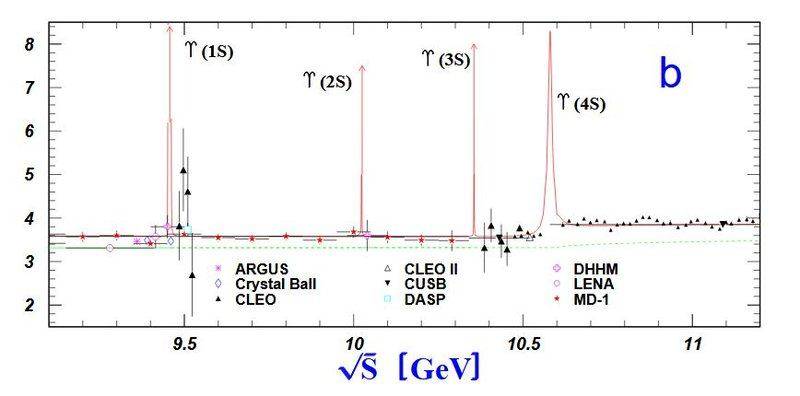
Rplot.JPG
 

Attachments

  • Rplot.JPG
    Rplot.JPG
    27.2 KB · Views: 1,034
Physics news on Phys.org
How did you get 5?
 
Using Monte Carlo simulation and finding the efficiency for the annihilation. Selecting only the events that passa a certain cut, I used σ=Nselected/(Lε) where L is the luminosity and epsilon the efficiency found with Monte Carlo.
I think I'm suposed to get this value and explain it with the ϒ meson, but I don't know how and I didn't find any explanation in any book. Thank you.
 
Then something is wrong with your Monte Carlo or the efficiency treatment.
What are the cross sections you got?

The ϒ mesons don't matter if you are at exactly 10 GeV or generally not inside one of the resonances.
 
The exact center of mass energy is √s=10.539 GeV
σ(e+e-→μ+μ-)=782 pb
σ(e+e-→hadrons)=3917 pb
 
bb13 said:
The exact center of mass energy is √s=10.539 GeV
That is inside the ϒ(4s) peak. Sure, that changes the values. You probably get something between the R-value outside the resonances and the ϒ(4s) decay modes.
 
Could you give some insight about what decay modes could increase the value of σ(e+e-→hadrons) and how would that increase the cross section please?
 
Check the decay modes and see which interaction is leading to them. It is not the electromagnetic interaction.
 
Looking in the PDG website I can see that the decat into B Bbar is the most favourable decay. Is that enough to say why the hadronic cross section is so large? Or should I also look the decays of B Bbar? According to PDG the most favourble decay for B is a leptonic decay, which I don't see how would increase the hadronic cross section, it should in fact lower R as the cross section into muons would increase, wouldn't it?
 
  • #10
The R value considers the direct collision process only. B mesons are hadrons, their decay modes later don’t matter.

Which interaction leads to the decay to two B mesons? Can you see why the derivation of the R value doesn’t work there?
 
  • #11
The weak interaction leads to the two B mesons, right? But I still don't see why the R value doesn't work.

Until know we've seen that the e+e- decays into ϒ(4s) which at the same time decays into B mesons thus increasing the cross section for the decay into hadrons right? I don't understand why the derivation for R doesn't work under this procedure.
 
  • #12
Why would you expect the weak interaction to be relevant?
Even if it would: Why would you expect it to follow a rule that is based on electric charges?

e+e- doesn’t “decay” to ϒ(4s).

The R-value of 10/3 comes from the assumption that the e+e- pair interacts via a virtual photon. Only in this case are the electric charges relevant. An ϒ is not a photon.
 
  • #13
I think I'm starting to understand. So the ϒ is generated when the e+e- annihilate into quark and antiquark via electromagnetic interaction, but the B mesons are generated via the weak interaction on ϒ, so they are not taken into account for the rule of R=10/3, thus increasing that value?
 
  • #14
There is no weak interaction involved.

The ##\Upsilon## is a resonance, it has a cross section way above the process you consider to get R=10/3 for other energies.
It decays via the strong interaction with nearly 100% probability, and that decay produces hadrons.
 

Similar threads

  • · Replies 11 ·
Replies
11
Views
2K
  • · Replies 0 ·
Replies
0
Views
4K
  • · Replies 3 ·
Replies
3
Views
2K
  • · Replies 7 ·
Replies
7
Views
5K
  • · Replies 1 ·
Replies
1
Views
2K
  • · Replies 0 ·
Replies
0
Views
3K
Replies
2
Views
3K
  • · Replies 5 ·
Replies
5
Views
3K
  • · Replies 6 ·
Replies
6
Views
5K
  • · Replies 7 ·
Replies
7
Views
8K