Raw genetic data: Plink and TPED file

  • Thread starter Thread starter DaveC426913
  • Start date Start date
  • Tags Tags
    Data File
Join the discussion
Ask a follow-up here, or get your own question answered by working scientists, mathematicians and engineers — people, not an autocomplete.
Real named experts · corrections over time · the nuance an AI answer skips
3 replies · 2K views
DaveC426913
Gold Member
2025 Award
Messages
24,605
Reaction score
8,945
Well I just checked out my boy's breed of dog. Not what we expected...But the analysis came with some raw data, 200,000 base pairs on ... 41 chromosomes. They're in a .TPED file, which can be opened in Excel. Apparently, it an also be analyzed using PLINK software.

Wondering what I can do to visualize this data in a poster or something.

I mean, I could do it myself manually, but are there any existing options?
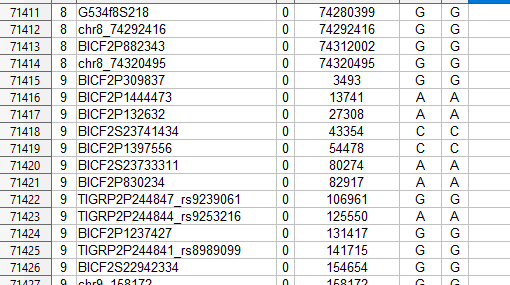
1651351591280.png
 
Biology news on Phys.org
Have you considered making making a karyotype?

This will make far more sense to most people, kind of intuitive.
This is what karyorypes look like:
https://learn.genetics.utah.edu/content/basics/karyotype
Assuming your data is presented as chromosome groups - DNA from one chromosome, then the next.

Write come code to aggregate the data into 41 linear blobs. Add a "centromere as a wider dummy blob" somewhere in the middle of each "chromosome".

Sort of free form art based on real data.
 
jim mcnamara said:
Have you considered making making a karyotype?
Sure.
jim mcnamara said:
Write come code to aggregate the data into 41 linear blobs. Add a "centromere as a wider dummy blob" somewhere in the middle of each "chromosome".
I think my coding days are behind me.
 
There are probably already genetic maps and chromosomal pictures of dog genome available some where.
It might be interesting to know what are the major differences in your dog's genome vs. "normal", and then mapping them to the already known dog genome.
If lots of them map to a single location, maybe its something like a deletion (exciting!).

A list of predicted features your dog might have, based on its molecularly identified alleles that differ from "normal", would be interesting to compare with the dog's actual behaviors.
A big article on how much a dog or its breed influences its behavior and how that compares to the dog's genetic make-up: (https://www.physicsforums.com/threads/big-article-on-dog-breeds-in-science.1014733/).
They have looked at lots of behaviors and compared them with breed and genomic sequence.
That would probably be a good step on the way to a better genetic understanding of your dog.