Ray reflecting off intersecting mirrors

  • Thread starter Thread starter member 731016
  • Start date Start date
  • Tags Tags
    Mirrors Ray
Click For Summary
SUMMARY

The discussion focuses on the behavior of light rays reflecting off intersecting mirrors, specifically addressing the conditions under which multiple reflections occur. Users express confusion regarding the implications of a negative angle of incidence (γ < 0) and how it affects the reflection process. The law of reflection is emphasized, stating that the angle of incidence equals the angle of reflection. Participants suggest using diagrams to clarify the reflection process and ensure accurate representation of angles.

PREREQUISITES
  • Understanding of the law of reflection
  • Basic knowledge of angles and geometry
  • Familiarity with drawing geometric diagrams
  • Experience with light behavior in physics
NEXT STEPS
  • Study the law of reflection in detail
  • Learn about the implications of negative angles in geometric optics
  • Explore advanced topics in ray tracing techniques
  • Practice drawing accurate geometric diagrams for optical scenarios
USEFUL FOR

Students of physics, educators teaching optics, and anyone interested in the principles of light reflection and geometric visualization.

member 731016
Homework Statement
Please see below
Relevant Equations
Please see below
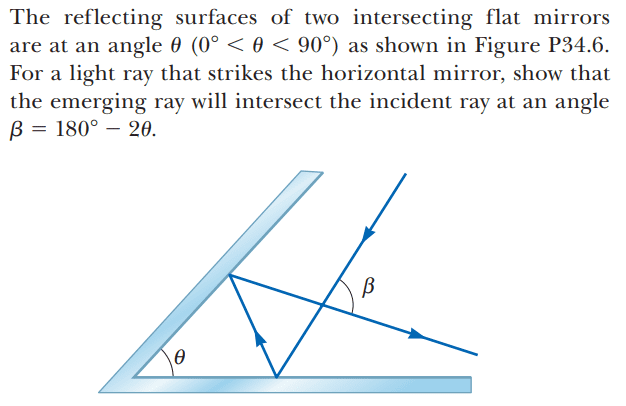
For this problem,
1677384446103.png

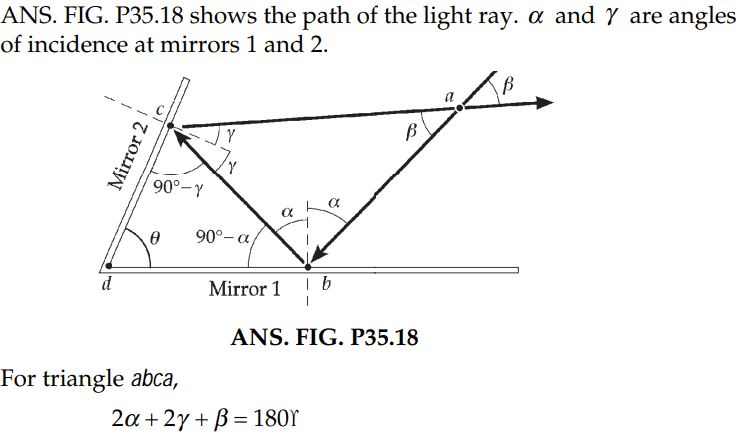
The solution is,
1677384477316.png

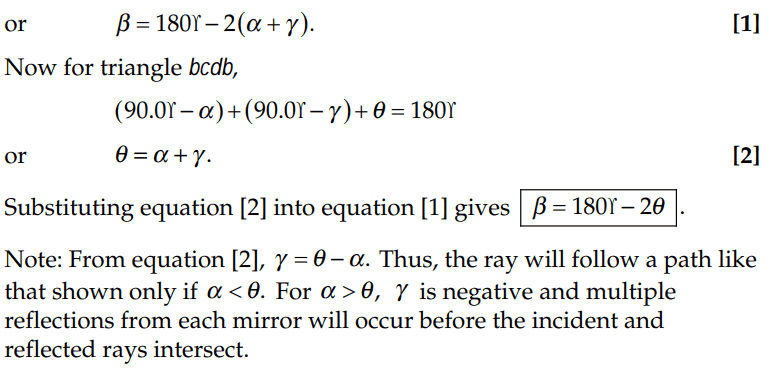
1677384490654.png

I don't understand how if ## \gamma < 0## then there will be multiple reflections? I don't understand how ##\gamma## can be negative.

Many thanks!
 
Physics news on Phys.org
Callumnc1 said:
I don't understand how if ## \gamma < 0## then there will be multiple reflections? I don't understand how ##\gamma## can be negative.

Many thanks!
Try drawing it with θ very small.
 
  • Like
Likes member 731016
haruspex said:
Try drawing it with θ very small.
Thank you for your reply @haruspex!

Like this?
1677388295033.png

Many thanks!
 
Callumnc1 said:
Thank you for your reply @haruspex!

Like this?
View attachment 322878
Many thanks!
First reflection looks fine, the second impossible. How do you figure out where a reflected ray goes?
 
  • Like
Likes member 731016
haruspex said:
First reflection looks fine, the second impossible.
Thank you for your reply @haruspex!

How do you figure out where a reflected ray goes?

Using the law of reflection

EDIT: Apologies, the diagram is not to scale. Let me know if you want me to redo it and I will use a better program (Microsoft paint instead of snip tool)

Many thanks!
 
Last edited by a moderator:
Callumnc1 said:
Using the law of reflection
Which states …?
 
Thank you for your reply @haruspex!

Angle of incidence is equal to angle of reflection

Many thanks!
 
Callumnc1 said:
Thank you for your reply @haruspex!

Angle of incidence is equal to angle of reflection

Many thanks!
But what you drawn for the second reflection is nothing like that.
Draw the normal to the mirror where the ray hits it. The incident ray makes some angle theta to that normal. The reflected ray should also make angle theta to the normal, but on the other side of the normal.
 
  • Like
Likes member 731016
haruspex said:
But what you drawn for the second reflection is nothing like that.
Draw the normal to the mirror where the ray hits it. The incident ray makes some angle theta to that normal. The reflected ray should also make angle theta to the normal, but on the other side of the normal.
Thank you for your reply @haruspex!

I will draw another diagram. Sorry if my replies are a bit slow

Many thanks!
 

Similar threads

  • · Replies 5 ·
Replies
5
Views
502
  • · Replies 9 ·
Replies
9
Views
2K
  • · Replies 16 ·
Replies
16
Views
2K
  • · Replies 5 ·
Replies
5
Views
1K
Replies
1
Views
1K
Replies
7
Views
2K
  • · Replies 11 ·
Replies
11
Views
2K
Replies
12
Views
2K
  • · Replies 4 ·
Replies
4
Views
842
Replies
14
Views
4K