Re-exciting organic scintillator

Click For Summary

Discussion Overview

The discussion revolves around the conditions under which re-excitation of electrons in organic scintillators occurs, particularly focusing on the energy levels involved in these transitions. Participants explore the implications of a statement from a textbook regarding photon energy and re-excitation, examining the specific cases that allow for this phenomenon.

Discussion Character

  • Exploratory, Technical explanation, Debate/contested

Main Points Raised

  • One participant questions the specific case mentioned in the textbook where photon energy is sufficient for re-excitation, recalling a lecturer's claim about decay to S01 being necessary.
  • Another participant explains that most electrons are in the S00 state and require energy from S10 to S00 for excitation, noting that this transition is rare due to S00 being typically filled.
  • It is suggested that transitions from S10 to S01 also require an electron in S01 to facilitate re-excitation, with higher energy transitions becoming increasingly rare.
  • One participant speculates that the book may be referring to fluorescence photons emitted during decay to S00 as the source of sufficient energy for re-excitation, expressing uncertainty about this interpretation.
  • Another participant agrees with the interpretation that fluorescence photons during decay to S00 could be the relevant case, while also noting that temperature affects the availability of empty S0x states for re-excitation.

Areas of Agreement / Disagreement

Participants express differing interpretations of the textbook statement regarding re-excitation, with no consensus on the specific case being discussed. Some agree on the role of fluorescence photons, while others remain uncertain about the implications.

Contextual Notes

The discussion highlights the complexity of energy transitions and the conditions required for re-excitation, with references to temperature effects and the occupancy of energy states. There are unresolved assumptions regarding the definitions of energy levels and the conditions under which re-excitation occurs.

rphys
Messages
4
Reaction score
0
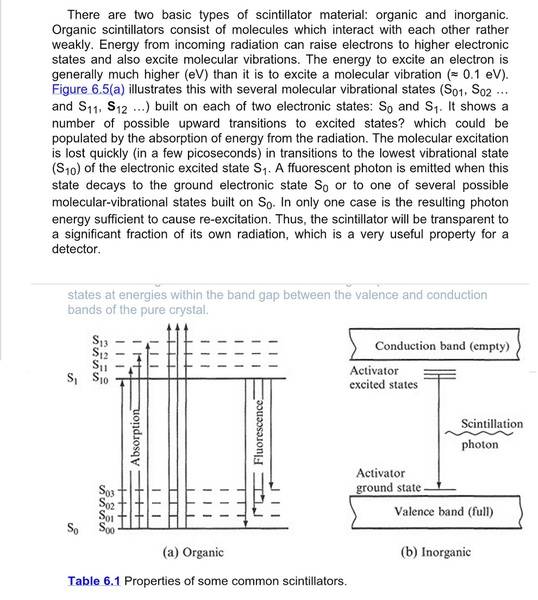
I've attached an image from the book "nuclear physics" by John Lilley.

It says "in only one case is the restulting photon energy sufficient to cause re-excitation". My question is what is this one case? I recall my lecturer saying only decay to S01 is sufficient to cause re-excitation, but I can't find any evidence for this.

Thanks for any help
2nkklc1.jpg
 

Attachments

  • 2nkklc1.jpg
    2nkklc1.jpg
    64.1 KB · Views: 533
Physics news on Phys.org
Most electrons are in S00, they need an energy of at least S10-S00 to be excited. There is only one way an electron in S10 can release that much energy: If it goes to S00. That is usually filled so it is a rare process. You can also have S10->S01 but then you need an electron in S01 to get excited. Transitions to down higher energy levels need even higher energy levels of electrons for re-excitations but they are getting really rare.
 
  • Like
Likes   Reactions: rphys
mfb said:
Most electrons are in S00, they need an energy of at least S10-S00 to be excited. There is only one way an electron in S10 can release that much energy: If it goes to S00. That is usually filled so it is a rare process. You can also have S10->S01 but then you need an electron in S01 to get excited. Transitions to down higher energy levels need even higher energy levels of electrons for re-excitations but they are getting really rare.

So would you say the book is referring to fluorescence photons emitted during decay to S00 as being the ones with sufficient energy to cause re-excitation? I am tempted to repeat what the book has said (only one case) and keep it vague because I am not sure about this.
 
rphys said:
So would you say the book is referring to fluorescence photons emitted during decay to S00 as being the ones with sufficient energy to cause re-excitation?
That's how I would interpret the statement of the book. It depends on the temperature as well but you'll have empty S0x states accessible at every reasonable temperature.
 
  • Like
Likes   Reactions: rphys

Similar threads

  • · Replies 32 ·
2
Replies
32
Views
5K
  • · Replies 15 ·
Replies
15
Views
4K
  • · Replies 24 ·
Replies
24
Views
3K
  • · Replies 20 ·
Replies
20
Views
4K
  • · Replies 0 ·
Replies
0
Views
2K
  • · Replies 4 ·
Replies
4
Views
5K
  • · Replies 9 ·
Replies
9
Views
2K
  • · Replies 8 ·
Replies
8
Views
4K
  • · Replies 9 ·
Replies
9
Views
2K
  • · Replies 7 ·
Replies
7
Views
3K