Reaction rate, rate equation and half life

Click For Summary
SUMMARY

The decomposition of hydrogen peroxide (H2O2) follows the reaction scheme H2O2(l) → H2O(l) + O2(g). The reaction is confirmed to be first-order, and the reaction rate constant, k, can be calculated graphically using Excel software. The rate equation for this reaction is derived from the concentration of H2O2 over time. Additionally, the half-life of hydrogen peroxide can be calculated using the initial concentration, A0, and the established rate constant.

PREREQUISITES
  • Understanding of first-order reaction kinetics
  • Familiarity with Excel for graphical data analysis
  • Knowledge of rate equations in chemical reactions
  • Basic concepts of half-life in chemistry
NEXT STEPS
  • Learn how to calculate reaction rate constants using Excel
  • Study the derivation of first-order rate equations
  • Research the concept of half-life in various chemical reactions
  • Explore advanced kinetics topics, such as Arrhenius equation and temperature effects on reaction rates
USEFUL FOR

Chemistry students, educators, and professionals involved in chemical kinetics and reaction analysis will benefit from this discussion.

Sabra_a
Messages
33
Reaction score
6
thread moved from a technical subforum
Summary: Hydrogen peroxide, H2O2, decomposes as per following reaction scheme:
H2O2(l) → H2O(l) + O2(g)
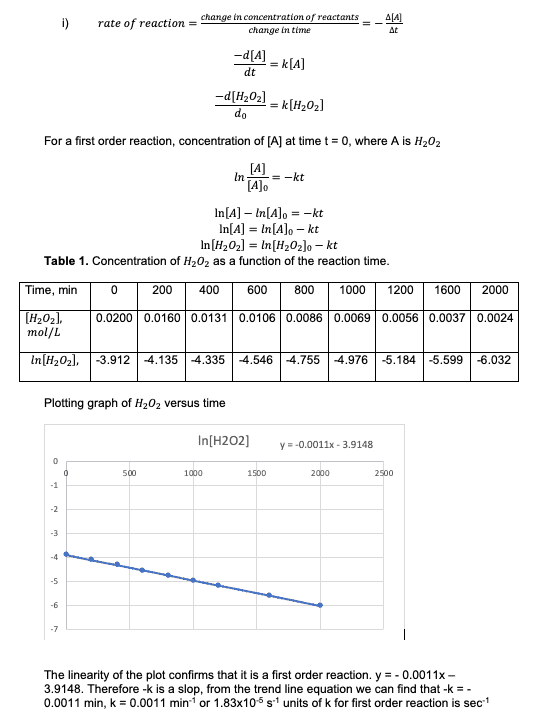
The concentration versus time data for the decomposition of hydrogen peroxide is given in Table 1.

i) Calculate the reaction rate constant, k, graphically, with the aid of Excel software. Confirm that this is a first-order reaction.
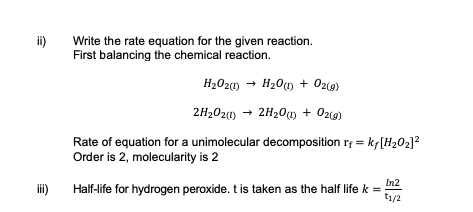
ii) Write the rate equation for the given reaction.
iii) Calculate the half-life for hydrogen peroxide.

I have attached the table and my attempt to solve the question, a feedback will be appreciated. I'm quite stuck on the 2nd and 3rd point
Screen Shot 2019-11-25 at 2.05.14 PM.png
Screen Shot 2019-11-25 at 2.07.52 PM.png
 

Attachments

  • Screen Shot 2019-11-25 at 2.01.08 PM.png
    Screen Shot 2019-11-25 at 2.01.08 PM.png
    3.2 KB · Views: 323
Physics news on Phys.org
This ought to be on the homework help, it is so elementary.
The only hard part is question i) which you or someone seems to have solved already.
The answer to ii) is already in the answer given, you only know need to know what "rate equation" means. See your textbook or Wikipedia.
iii) is almost contained in your answer. [A0] Is the starting concentration of H2O2, so when only half of that is left, what will your fourth equation give you?
 
  • Like
Likes   Reactions: Sabra_a
thank you, for point ii) I wasn't sure about the answer because I thought I answered it in the first part. I rearranged my answers.
Screen Shot 2019-11-25 at 6.05.23 PM.png
Screen Shot 2019-11-25 at 6.06.12 PM.png
 
Looks OK to me.
I guess 1st order rate constants are officially most often quoted in s-1 though 'at home' in the lab you can find minutes/hours/days convenient..
 
Thank you
 

Similar threads

  • · Replies 1 ·
Replies
1
Views
2K
  • · Replies 1 ·
Replies
1
Views
10K
  • · Replies 2 ·
Replies
2
Views
5K
  • · Replies 12 ·
Replies
12
Views
5K
  • · Replies 3 ·
Replies
3
Views
4K
Replies
8
Views
5K
  • · Replies 1 ·
Replies
1
Views
6K
  • · Replies 8 ·
Replies
8
Views
8K
  • · Replies 1 ·
Replies
1
Views
20K
  • · Replies 3 ·
Replies
3
Views
13K