Refractive Index: Part A, B, & C

Click For Summary
Part A of the refractive index homework was confirmed to be correct, while Part B was completed successfully using Snell's Law. For Part C, the key point is that the ray is totally internally reflected at the critical angle, which is indicated to be 27 degrees. The discussion emphasized that no complex formulas are needed for Part C, as it is worth only one mark. Clarification was provided that the critical angle should be measured from the normal, not the angle of incidence.
zain1612
Messages
2
Reaction score
0
Part A i just need to know if i have done it properly.
Part B is done
Part c don't have a clue :cry:
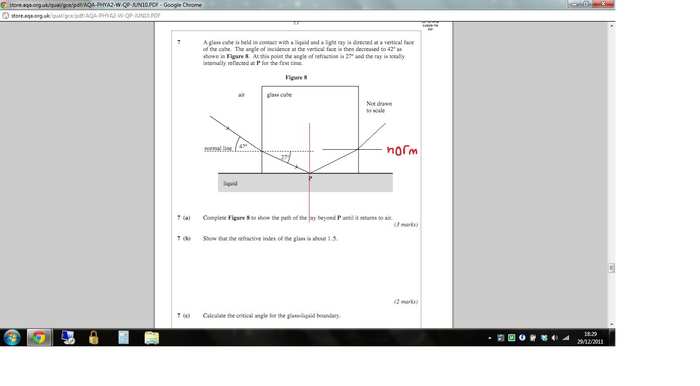
Homework Statement


2ryg5.jpg


Homework Equations


Law of refraction n1*sinχ1=n2*sinχ2
Critical Angle sine(x) = nr/ni

The Attempt at a Solution


part a is on the image above

part b I have done it

Part c no idea
 
Physics news on Phys.org
Read the wording of the question very carefully...the ray is totally internally reflected at P for the first time...
This means that the ray is striking the surface at the critical angle... can you see which angle is the critical angle??
 
Part A All OK.
Part B apply snells law you have all the info!

Part C I have looked at the question paper on the the AQA website and part c is worth 1mark! This means no formula are needed!
The important line is "At this point the angle of relfection is 27 and the ray is totally internally reflected for the first time."
 
bm0p700f said:
Part A All OK.
Part B apply snells law you have all the info!

Part C I have looked at the question paper on the the AQA website and part c is worth 1mark! This means no formula are needed!
The important line is "At this point the angle of reflection is 27 and the ray is totally internally reflected for the first time."

And technician directly addressed that issue.

Another way to look at this is that the critical angle is angle of incidence for which the angle of refraction would be 90° .

I hope that helps.
 
Thanks guys I just reliased I was being stupid. I was taking the angle of incident for the critical angle to be 27° instead of taking it from the normal. Thanks for the help:-p
 
I was writing this as technician was writing. He pressed submit before I did that's all!
 
The book claims the answer is that all the magnitudes are the same because "the gravitational force on the penguin is the same". I'm having trouble understanding this. I thought the buoyant force was equal to the weight of the fluid displaced. Weight depends on mass which depends on density. Therefore, due to the differing densities the buoyant force will be different in each case? Is this incorrect?

Similar threads

  • · Replies 7 ·
Replies
7
Views
2K
  • · Replies 1 ·
Replies
1
Views
2K
Replies
4
Views
1K
  • · Replies 1 ·
Replies
1
Views
2K
  • · Replies 1 ·
Replies
1
Views
3K
  • · Replies 1 ·
Replies
1
Views
2K
  • · Replies 1 ·
Replies
1
Views
3K
Replies
3
Views
2K
  • · Replies 11 ·
Replies
11
Views
2K
  • · Replies 3 ·
Replies
3
Views
2K