Discussion Overview
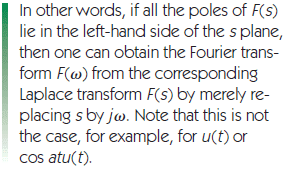
The discussion centers on the relationship between Fourier transforms and Laplace transforms, particularly focusing on the conditions under which the substitution \( s = j\omega \) is valid. Participants explore theoretical aspects, implications for Linear Time-Invariant (LTI) systems, and the significance of poles in the s-plane.
Discussion Character
- Technical explanation
- Conceptual clarification
- Debate/contested
Main Points Raised
- One participant questions the validity of substituting \( s = j\omega \) when all poles have negative real parts, expressing confusion over the reasoning behind this condition.
- Another participant suggests that while the initial statement may be poorly articulated, the conclusion about the relationship between the Fourier and Laplace transforms makes sense, particularly in the context of LTI systems.
- A participant explains that the output of an LTI system can be derived from its impulse response and that substituting \( s = j\omega \) leads to the Fourier transform from the Laplace transform.
- It is noted that the Fourier transform can be viewed as equivalent to the double-sided Laplace transform under the substitution \( s = j\omega \), based on definitions.
- Another participant emphasizes that the validity of the substitution depends on the region of convergence (ROC) of the Laplace transform, stating that it is only valid for right-sided signals where the ROC includes the imaginary axis.
- There is a claim that Fourier transforms and Laplace transforms are not equivalent, with the Fourier transform being a special case of the Laplace transform when \( \sigma = 0 \).
Areas of Agreement / Disagreement
Participants express differing views on the validity of the substitution \( s = j\omega \) and the equivalence of Fourier and Laplace transforms. Some agree on the general relationship but highlight specific conditions that must be met, indicating that the discussion remains unresolved regarding the implications of poles and ROC.
Contextual Notes
Participants mention the importance of the region of convergence for the Laplace transform and its relationship to the Fourier transform, but the discussion does not resolve the implications of these conditions or the definitions involved.