Relative factor, what does the number 1 stand for?

  • Thread starter Thread starter disregardthat
  • Start date Start date
  • Tags Tags
    Relative
Click For Summary

Homework Help Overview

The discussion revolves around the relativity factor equation, often denoted as "gamma," and its implications in the context of special relativity. Participants explore the meaning of the number "1" in the equation and its significance in relation to other expressions, such as 2(pi)r. The conversation touches on concepts of time dilation, length contraction, and the interpretation of relative velocities.

Discussion Character

  • Exploratory, Conceptual clarification, Assumption checking

Approaches and Questions Raised

  • Participants question the meaning of the numerator "1" in the relativity factor equation and discuss its implications for understanding proportionality. There are inquiries about how velocity is measured between observers and the context of relativistic speeds. Some participants express confusion regarding the relationship between mass and the relativity factor.

Discussion Status

The discussion is active, with participants providing insights and clarifications about the relativity factor and its applications. Some guidance has been offered regarding the interpretation of the equations and the historical context of the theories involved. Multiple interpretations of the concepts are being explored, indicating a productive exchange of ideas.

Contextual Notes

Participants note the complexity of the concepts involved, including the distinction between relativistic mass and rest mass, and the challenges of understanding the Lorentz Ether Theory in relation to Special Relativity. There is an acknowledgment of the need for a deeper theoretical understanding beyond memorizing equations.

disregardthat
Science Advisor
Messages
1,864
Reaction score
34
ok i don't know how to use this forums equation pictures so i'll just add a picture of the equation.

And I am not that good in this, I don't have education abour physics or math in this way.
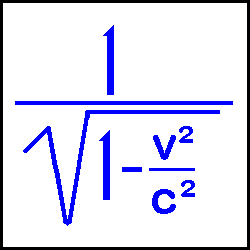
relatvty.gif


This equation is the relativity factor equation and equals the relative factor right? Anyway, I was wondering what the number "1" at the top of the bracket stood for? I have seen people replace it with for example 2(pi)r. what does it stand for, and what does it mean, and what does it mean when it is 1.
 
Physics news on Phys.org
Jarle said:
This equation is the relativity factor equation and equals the relative factor right?
Sure, usually called "gamma".
Anyway, I was wondering what the number "1" at the top of the bracket stood for?
It's the numerator of that fraction. In the fraction 1/2, what does the 1 stand for? Same answer.
 
I don't think he asked what the 1 in the numerator was for. I think he was asking why the factor is inversely proportional rather than proportional. This factor, which as Doc Al said is usually denoted by "gamma," was developed by Lorrentz as an answer to the failed idea of the luminiferous aether (that light is carried by some sort of light wind). Lorrentz deduced the factor from the Michelson-Morely interferometry experiments (extra info) in order to formulate his modified aether postulate, which Einstein later showed to be wrong - but the factor of gamma still worked. You could look up the derivation if you are interested.

As far as the 2*pi*r goes, you must be taking it out of context. Maybe it was describing some kind of one dimensional general relativity, which is much different from special relativity..
 
Ah, thanks I understand it now. The only thing I'm not quite sure of is that when we use a velocity, is that the number of the meters between the observer and object per second?

If one travels in 200 000 km\s one way, and another 200 000 km\s in the opposite direction. Each of these travellers would surely not measure the other to go in 400 000 km\s, even though a third observer would see both go in 200 000 km\s in the respective directions.

So, the velocity we are putting in is the velocity one observer measure an object moving. How do we measure the space that is laid between them each second?
 
Well that specific equation is used for time dilation and length contraction. A similar equation is used for relative velocities (you can't just add vectors as you suspected) Check this out:

http://en.wikipedia.org/wiki/Relative_velocity
 
Last edited:
turdferguson said:
Well that specific equation is used for time dilation and length contraction. A similar equation is used for relative velocities (you can't just add vectors as you suspected) Check this out:

http://en.wikipedia.org/wiki/Relative_velocity

And mass! :smile:

I did not understand which of the equations you had to use... If it has more factors than v and c you must tell me what the letters stand for, if you want.
 
Jarle said:
And mass! :smile:

I did not understand which of the equations you had to use... If it has more factors than v and c you must tell me what the letters stand for, if you want.
a36f6e2a92eb2270625360963129f3f8.png


w and v are the respective velocities of the two objects. Normally, you could just subtract vectors (the numerator of the equation). Keep in mind that if theyre approaching each other as you said, their signs are opposite and youre actually adding. But with relativistic speeds, the rules start to break down and you need a familiar-looking denominator.
 
Mindscrape said:
Lorrentz deduced the factor from the Michelson-Morely interferometry experiments (extra info) in order to formulate his modified aether postulate, which Einstein later showed to be wrong - but the factor of gamma still worked.

AFAIK, Lorentz Ether Theory (LET) and Special Relativity (SR) are identical in outcome. SR did not "win the day" because SR predicts some observed outcome not predicted by LET (they predict identical results). Rather, SR became the dominant theory because of its elegance and simplicity. Lorentz-Fitzgerald contraction is derived in SR and merely axiomatic in LET.

----------

Jarle said:
And mass! :smile:

:eek: Not mass! That is an archaic view. The equations come out the same if you whether you factor the Lorentz factor into the mass or leave it as-is. If you do factor the Lorentz factor into the mass, the mass varies with direction. Yech.
 
I don't really know anything about the Lorentz Ether Theory. Originally special relativity became accepted because of it's elegance, but now doesn't LET come into conflict with field theory?
 
  • #10
Thanks for the equation.

Why not mass? The http://www.1728.com/reltivty.htm Relativity calculator says that the mass is multiplied with the relative factor.

And what is the lorentz ether theory?
 
  • #11
Jarle, I strongly urge you not to study physics by means of memorizing equations (which is what you appear to be doing) without knowing the theory behind them.

Why not mass? Because relativistic mass leads to an ugly mess. The relativistic mass varies with the direction a force is applied.

Here are Einstein's own words on relativistic mass:
From a letter by Einstein to Lincoln Barnett written in 1948:
It is not good to introduce the concept of the mass [itex]M = m/\sqrt{1-v^2/c^2}[/itex] of a body for which no clear definition can be given. It is better to introduce no other mass than `the rest mass' m. Instead of introducing M, it is better to mention the expression for the momentum and energy of a body in motion.


Lorentz Ether Theory (LET) was a precursor to Special Relativity. The Lorentz-Fitzgerald contraction was an axiomatic attempt to explain away the null results of the Michelson-Morley experiment while retaining some remnant of the aether. There is an absolute reference frame in LET. However, the Lorentz-Fitzgerald contraction makes it impossible to detect the aether or the absolute reference frame. Experimental physicists like to measure things to validate or disprove a theory. LET postulated an aether that experimentalists could never detect. What value is a theory in physics that is based on something that is inherently undetectable?
 
  • #12
Well, so it is not really the mass that is rising, it's the momentum? Why does it say 'm' then in the equation. And is there are place where I can read about the theory behind the equations?
 

Similar threads

  • · Replies 6 ·
Replies
6
Views
2K
  • · Replies 8 ·
Replies
8
Views
1K
  • · Replies 32 ·
2
Replies
32
Views
2K
  • · Replies 11 ·
Replies
11
Views
2K
  • · Replies 21 ·
Replies
21
Views
1K
  • · Replies 11 ·
Replies
11
Views
3K
Replies
2
Views
2K
  • · Replies 3 ·
Replies
3
Views
7K
  • · Replies 3 ·
Replies
3
Views
3K
  • · Replies 6 ·
Replies
6
Views
3K