Relative Length to Relative Volume

Click For Summary
SUMMARY

This discussion focuses on calculating the relative volume change of a rectangular prism traveling close to the speed of light while rotating. It establishes that the volume of the object is reduced by the same factor as its length due to Lorentz contraction, with no contraction occurring along the transverse axes. The conversation also highlights the importance of considering the time it takes for light rays to reach an observer when visualizing the object optically.

PREREQUISITES
  • Understanding of Lorentz contraction in special relativity
  • Familiarity with the geometry of rectangular prisms
  • Basic knowledge of 3D object visualization techniques
  • Concept of time dilation and its effects on observation
NEXT STEPS
  • Research the mathematical formulation of Lorentz contraction
  • Explore the effects of relativistic speeds on 3D object rendering
  • Learn about the implications of time dilation on visual perception
  • Investigate the geometry of rotating objects in relativistic physics
USEFUL FOR

Physicists, 3D modelers, and anyone interested in the effects of relativistic speeds on object dimensions and visual representation.

Aureum
Messages
5
Reaction score
0
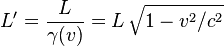
I understand relative length well but I what to image a 3d object traveling close to the speed of light. As we know objects have speed, direction, and rotation. So I was wondering if there is a general equation to calculate the relative volume change of a Rectangular Prism rotating and traveling near the speed of light at any given time.

Relevant equations
1749bc0c276b392671c59b17cd12990e.png
 
Physics news on Phys.org
When you say you want to "image" the object, do you mean that you're actually trying to draw a picture of what it would look like optically? If so, then you can't just do that using the Lorentz contraction, because you also get effects from the time it takes light rays to reach your eye.

If all you mean is that you want to calculate the volume as expressed in a frame where the object isn't at rest, then the volume is reduced by the same factor as the length. There is no Lorentz contractions along the two transverse axes.
 
In an inertial frame of reference (IFR), there are two fixed points, A and B, which share an entangled state $$ \frac{1}{\sqrt{2}}(|0>_A|1>_B+|1>_A|0>_B) $$ At point A, a measurement is made. The state then collapses to $$ |a>_A|b>_B, \{a,b\}=\{0,1\} $$ We assume that A has the state ##|a>_A## and B has ##|b>_B## simultaneously, i.e., when their synchronized clocks both read time T However, in other inertial frames, due to the relativity of simultaneity, the moment when B has ##|b>_B##...

Similar threads

  • · Replies 14 ·
Replies
14
Views
2K
  • · Replies 22 ·
Replies
22
Views
2K
  • · Replies 9 ·
Replies
9
Views
3K
  • · Replies 10 ·
Replies
10
Views
2K
  • · Replies 1 ·
Replies
1
Views
1K
  • · Replies 32 ·
2
Replies
32
Views
2K
  • · Replies 8 ·
Replies
8
Views
1K
  • · Replies 7 ·
Replies
7
Views
2K
  • · Replies 35 ·
2
Replies
35
Views
3K
  • · Replies 6 ·
Replies
6
Views
1K