Repulsion before the screen in a double-slit experiment

Click For Summary
SUMMARY

The discussion centers on misconceptions regarding the double-slit experiment involving electrons. It clarifies that only one electron is present at a time, negating the idea of electron cloning and subsequent repulsion. The interference pattern observed is a result of many electrons hitting the screen at various points, not due to interactions between multiple electrons. Misinterpretations often arise from popular science sources, emphasizing the need for foundational knowledge in physics.

PREREQUISITES
  • Understanding of quantum mechanics principles
  • Familiarity with the double-slit experiment
  • Knowledge of electron behavior and charge interactions
  • Basic grasp of wave-particle duality
NEXT STEPS
  • Study the fundamentals of quantum mechanics
  • Explore detailed explanations of the double-slit experiment
  • Learn about wave-particle duality in quantum physics
  • Investigate reputable physics resources beyond popular media
USEFUL FOR

Students of physics, educators, and anyone interested in understanding quantum mechanics and the nuances of the double-slit experiment.

JonAce73
Messages
6
Reaction score
0
TL;DR
There could be no interference of electron in double-slit experiment due to electron self-repulsion. Am I right?
Consider a double slit experiment with electrons fired illustrated in the attached figure. One interpretation of this experiment is that each fired electron clones itself, one of the clone passes through one slit and the other through another slit then they reached the screen where they interfere. Now, just before the two electrons reached the screen they must repel each other as they are of similar charge polarity, a repulsion like in electron self interaction inside an atom. By this repulsion they likely would land in different spots on the screen thereby no interference will happen. But obviously there is. Is there anything wrong with my understanding on the repulsion aspect?
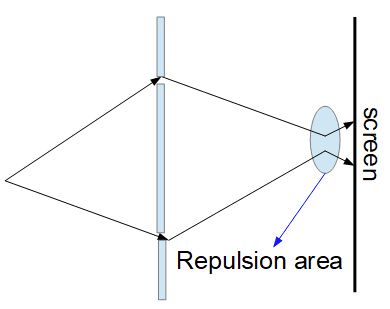
InterferenceQuestion.png
 
  • Skeptical
Likes   Reactions: weirdoguy
Physics news on Phys.org
JonAce73 said:
Consider a double slit experiment with electrons fired illustrated in the attached figure. One interpretation of this experiment is that each fired electron clones itself, one of the clone passes through one slit and the other through another slit then they reached the screen where they interfere.

There is no cloning in the double-slit experiment. There is only ever one electron.

JonAce73 said:
Now, just before the two electrons reached the screen they must repel each other as they are of similar charge polarity, a repulsion like in electron self interaction inside an atom.

There are not two electrons, there is only one electron.

JonAce73 said:
By this repulsion they likely would land in different spots on the screen thereby no interference will happen. But obviously there is. Is there anything wrong with my understanding on the repulsion aspect?

Only one electron hits the screen. There is no interference pattern for a single electron. Each electron hits the screen at a single point. The intereference pattern is built up from firing a large number of electrons. They hit the sceen at various points and collectively form a wave-like interference pattern.
 
  • Like
Likes   Reactions: JonAce73 and vanhees71
JonAce73 said:
One interpretation of this experiment is that each fired electron clones itself

It's false, but where did you get that from?
 
  • Like
Likes   Reactions: vanhees71
PeroK said:
There is no cloning in the double-slit experiment. There is only ever one electron.
There are not two electrons, there is only one electron.
Only one electron hits the screen. There is no interference pattern for a single electron. Each electron hits the screen at a single point. The intereference pattern is built up from firing a large number of electrons. They hit the sceen at various points and collectively form a wave-like interference pattern.
Thanks a lot.
 
weirdoguy said:
It's false, but where did you get that from?
From Sabine Hossenfelder's YouTube video.
 
JonAce73 said:
From Sabine Hossenfelder's YouTube video.

Please give a link. I strongly suspect you are misinterpreting something in the video.
 
Don't learn physics from YouTube.
 
  • Like
Likes   Reactions: vanhees71
Meir Achuz said:
Don't learn physics from YouTube.
There's some great stuff on there!
 
  • Like
Likes   Reactions: etotheipi, vanhees71 and Motore
True, the only trouble for the layman is to decide what's indeed great an which contributions are, well,... Since I'm a layman on almost all scientific subjects, I try to get information on a subject not only from YouTube videos.
 
  • #10
Meir Achuz said:
Don't try to learn physics from YouTube.
Fixed it for you
 
  • #11
PeroK said:
There's some great stuff on there!

There might be, but the only way to tell is to already know the material. For someone who doesn't already know the material, they won't be able to tell whether a particular video is actually giving them good information or is misleading them.
 
  • Like
Likes   Reactions: Motore, vanhees71, etotheipi and 1 other person
  • #12
PeterDonis said:
There might be, but the only way to tell is to already know the material. For someone who doesn't already know the material, they won't be able to tell whether a particular video is actually giving them good information or is misleading them.
There are bona fide lecture series on there. Not just pop science. There's rubbish in a public library too!
 
  • Like
Likes   Reactions: Motore and vanhees71

Similar threads

  • · Replies 15 ·
Replies
15
Views
1K
  • · Replies 3 ·
Replies
3
Views
501
  • · Replies 10 ·
Replies
10
Views
1K
  • · Replies 20 ·
Replies
20
Views
2K
  • · Replies 15 ·
Replies
15
Views
1K
  • · Replies 10 ·
Replies
10
Views
1K
  • · Replies 7 ·
Replies
7
Views
1K
  • · Replies 9 ·
Replies
9
Views
2K
  • · Replies 9 ·
Replies
9
Views
2K
  • · Replies 5 ·
Replies
5
Views
2K