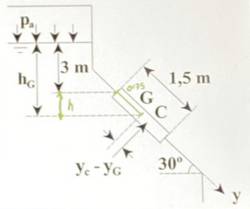
Resultant force and centre of pressure in a tank

Click For Summary
SUMMARY

The forum discussion focuses on calculating the resultant force and center of pressure for a tank scenario involving hydrostatic pressure. Key calculations include determining the center of gravity (hcg = 3.375 m) and resultant force (F = 148,989.375 N) using the pressure at the centroid (pCG = 33,108.75 Pa) and the area (A = 4.5 m2). The discussion emphasizes the importance of correctly applying the second moment of area (Ixx) in the context of static equilibrium and pressure distribution, correcting misconceptions about the center of pressure (ycp) and its calculation.

PREREQUISITES
  • Understanding of hydrostatic pressure principles
  • Familiarity with the second moment of area (Ixx) calculations
  • Knowledge of static equilibrium concepts
  • Ability to perform integration for area calculations
NEXT STEPS
  • Study the derivation and applications of the second moment of area in fluid mechanics
  • Learn about hydrostatic pressure distribution in submerged surfaces
  • Explore the calculation of center of pressure for various geometric shapes
  • Review static equilibrium principles in fluid systems
USEFUL FOR

Engineering students, fluid mechanics practitioners, and professionals involved in structural analysis of tanks and pressure vessels.

Guillem_dlc
Messages
188
Reaction score
17
Homework Statement
The tank in the figure contains water and a uniform pressure ##p_a## acts on its surface. We wish to determine the resultant force ##F##, and its centre of pressure ##y_c-y_G##, on a flat gate of base ##3\, \textrm{m}## and height ##1,5\, \textrm{m}##. The damper is located on a wall of the tank with an inclination of ##30## degrees with respect to the horizontal. The upper base of the damper is located at ##3\, \textrm{m}## depth. Consider the following cases: a) ##p_a=p_{\textrm{atm}}## and b) ##p_a=125\, \textrm{kPa}##.
Relevant Equations
##I_{xx}=\iint y^2\, dA##
Figure:
5E13FCF2-1351-4777-88EC-B2DF9F5289A4.jpeg


a) CASE A ##\rightarrow p_a=101300\, \textrm{Pa}##
$$F_{\textrm{res}}?,\,\, y_c-y_{cg}=y_{cp}$$
We find ##h_{cg}\rightarrow h_{cg}=3+h##
$$h=0,75\cdot \sin (30)=0,375\, \textrm{m}\rightarrow h_{cg}=3,375\, \textrm{m}$$
$$p_{cG}=\rho_{H2O}gh_{cg}=33108,75\, \textrm{Pa}$$
We calculate ##A=1,5\cdot 3=4,5\, \textrm{m}^2##
$$\boxed{F=p_{CG}\cdot A=148989,375\, \textrm{N}}$$
$$I_{xx}=\iint y^2\, dA=\int_0^{1,5}\int_0^3 y^2\, dxdy=\int_0^{1,5}y^2\int_0^3 dxdy=3\int_0^{1,5}y^2\, dy=$$
$$=3\left[ \dfrac{y^3}{3}\right]_0^{1,5}=3,375$$
$$y_{CP}=-\dfrac{\rho_{H2O}g\sin \theta I_{xx}}{F_{CG}}=0,111$$
I don't get the ##I_{xx}## right and I don't know why? Is it calculated in this way?
$$I_{xx}=\iint y^2\, dA$$
It should give ##\dfrac{b\cdot L^3}{12}##.
 
Physics news on Phys.org
You are supposed to be looking for the effective force acting on the gate, and it’s applied location(the center of pressure). The gate is in static equilibrium. The moment of inertia of the gate is not going to be a factor, it is not a dynamics problem.

Isolate the gate, assume it’s being held closed. Sketch the pressure distribution acting over its interior for the different gauge pressures acting over surface ##a##. Use that to determine the effective force on the gates interior, and it’s location using the proper formulas for those quantities.
 
Last edited:
  • Like
Likes   Reactions: Guillem_dlc and Lnewqban
The Second Moment of Area (Not Moment of Inertia o:) - Thanks @Lnewqban) is a factor! I'm sorry...I forgot it was in the formula for ##y_{cp}##. Anyhow, you don't have to do the integral, you have it written in the last part of the OP.
 
Last edited:
  • Like
Likes   Reactions: Lnewqban
  • Like
Likes   Reactions: erobz
With the integral I have not done this in the end?
 
For part (a) your force looks correct.

What they are asking you to find is:

$$ y_{cp} = \bar{y} + \frac{ \bar{I} }{ \bar{y} A} $$

$$ ( y_{cp} - \bar{y} ) = \frac{ \bar{I} }{ \bar{y} A} $$

Guillem_dlc said:
$$y_{CP}=-\dfrac{\rho_{H2O}g\sin \theta I_{xx}}{F_{CG}}=0,111$$

Where does the negative sign come from, and where did it go?

That expression is not equal to ##y_{cp}## (see above).

If you are going to use the Force and the density to calculate the area of the plate ##A## (which unnecessary and introduces computational error), label it correctly as ##F##. Its not ##F_{CG}##.

I feel like you have made a mess of things trying to be overly clever with substitutions. I think its correct (other than the minus sign and the labeling), but you have not made it easy to check.
 
  • Like
Likes   Reactions: Lnewqban
You are correct, that whatever you are going to do after that should result in (for the rectangle):

$$I_{xx} = \frac{1}{12}bh^3$$
 
Last edited:
erobz said:
Where does the negative sign come from, and where did it go?
As ##y_{cp}## is a measure of the centre of gravity, I have given the result as an absolute value.

But maybe I should have left the sign to indicate where it goes.

For example, when you want to find the height of the centre of pressures then I do ##h_{cp}=h_{cg}+y_{cp}## with the sign I have been given from the formula so I know if it is higher or lower, but otherwise I put it in absolute value.
 
The actual question you have is what you've done incorrectly calculating the second moment of area of a rectangular plate?

For starters the limits of integration are wrong. Put coordinate system through the centroid of the area. What are the limits of integration with respect to those axes?
 
Last edited:
  • #10
Guillem_dlc said:
As ##y_{cp}## is a measure of the centre of gravity, I have given the result as an absolute value.
##y_{cp}## is the center of pressure, not the center of gravity. The depths are measured as positive downward from the surface. ##( y_{cp} - \bar{y}) > 0## for these types of problems. No need for absolute values.
 
  • Like
Likes   Reactions: Guillem_dlc
  • #11
erobz said:
The actual question you have is what you've done incorrectly calculating the second moment of area of a rectangular plate?

For starters the limits of integration are wrong. Put coordinate system through the centroid of the area. What are the limits of integration with respect to those axes?
##-0,75## to ##0,75## and ##-1,5## to ##1,5##?
 
  • #12
Guillem_dlc said:
##-0,75## to ##0,75## and ##-1,5## to ##1,5##?
ok, just leave it in parameters ##h## and ##b## for now. What are the limits for the integration w.r.t. ##y## in terms of ##h##, and ##x## in terms of ##b## respectively?
 
  • #13
erobz said:
ok, just leave it in parameters ##h## and ##b## for now. What are the limits for the integration w.r.t. ##y## in terms of ##h##, and ##x## in terms of ##b## respectively?
##-h/2## to ##h/2## and ##-b/2## to ##b/2##
 
  • Like
Likes   Reactions: erobz
  • #14
Good. You can do that integration or (highly recommended), using the arguments of symmetry make life easier.

$$ I_{xx} = \int_{-b/2}^{b/2} \int_{-h/2}^{h/2} y^2 dy \, dx = 2 \int_{0}^{b/2} \int_{0}^{h/2} y^2 dy \, dx $$
 
  • Like
Likes   Reactions: Guillem_dlc
  • #15
erobz said:
Good. You can do that integration or (highly recommended), using the arguments of symmetry make life easier.

$$ I_{xx} = \int_{-b/2}^{b/2} \int_{-h/2}^{h/2} y^2 dy \, dx = 2 \int_{0}^{b/2} \int_{0}^{h/2} y^2 dy \, dx $$
So if I have a circle I will have to switch to polars, right?
 
  • #16
Guillem_dlc said:
So if I have a circle I will have to switch to polars, right?
I don't know that you have to... probably would be a good idea.
 
  • #17
Guillem_dlc said:
So if I have a circle I will have to switch to polars, right?

The problem is equivalent to finding the x coordinate of the mass centre of a vertical cylinder with a horizontal base but with a top sloped at some angle.
##\int_{-r}^r(a x+b)\sqrt{r^2-x^2}x.dx##
##\int_{-\pi}^\pi(ar\cos(\theta)+b)r\sin(\theta)r\cos(\theta).(-r)\sin(\theta)d\theta##
 
  • Like
Likes   Reactions: Guillem_dlc

Similar threads

  • · Replies 10 ·
Replies
10
Views
2K
  • · Replies 17 ·
Replies
17
Views
2K
Replies
9
Views
2K
  • · Replies 16 ·
Replies
16
Views
2K
  • · Replies 1 ·
Replies
1
Views
2K
  • · Replies 2 ·
Replies
2
Views
2K
  • · Replies 36 ·
2
Replies
36
Views
5K
  • · Replies 1 ·
Replies
1
Views
2K
  • · Replies 7 ·
Replies
7
Views
2K
  • · Replies 5 ·
Replies
5
Views
10K