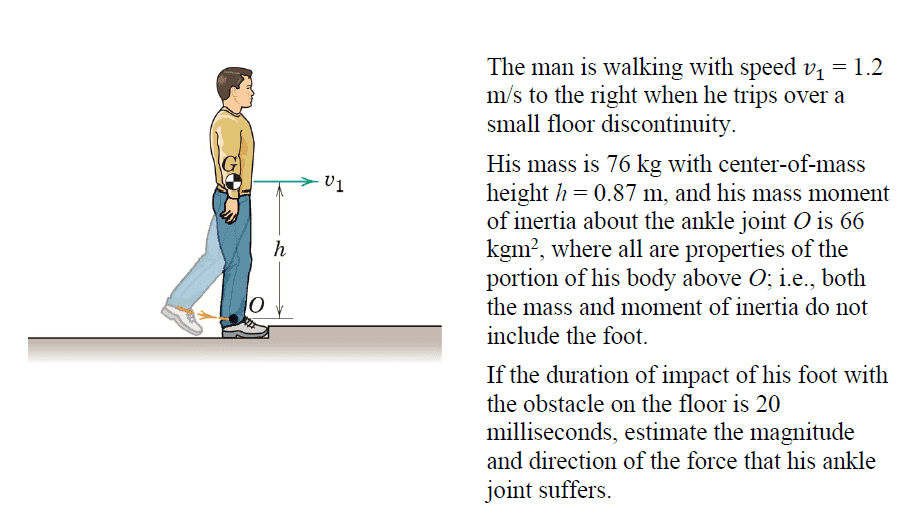
Rigid body kinetics -- force on ankle joint

Click For Summary
SUMMARY

The discussion focuses on the calculation of joint force on the ankle during an impact, utilizing the principles of rigid body kinetics and angular momentum conservation. The participant derived an angular velocity of 1.202 rad/s and calculated the velocity of the ankle joint as 1.05 m/s. The resulting joint force was computed to be -585 N, indicating a deceleration. The conversation emphasizes the importance of correctly defining the axis of rotation and understanding impulse during the collision.

PREREQUISITES
  • Understanding of rigid body dynamics
  • Familiarity with angular momentum conservation principles
  • Knowledge of impulse-momentum theorem
  • Basic proficiency in physics equations related to rotational motion
NEXT STEPS
  • Study the impulse-momentum theorem in detail
  • Learn about the effects of angular momentum on joint forces in biomechanics
  • Explore advanced topics in rigid body dynamics
  • Investigate the role of collision duration in force calculations
USEFUL FOR

Physicists, biomechanics researchers, sports scientists, and engineers involved in analyzing joint forces during impacts.

mastermechanic
Messages
107
Reaction score
15
Homework Statement
Rigid body kinetics problem involving Impulse-Momentum application
Relevant Equations
G = m.v and H = m.v.r
PROBLEM
H55.PNG


Here from the conservation of angular momentum I found angular velocity just before impact,
$$ H_1 = 0 $$
$$ H_2 = I_0\omega + mV_0d $$
$$ H_2 = 66\omega + 76.(1.2).(0.87)$$
$$ H_1 = H_2 $$
$$ \omega = 1.202 rad/s $$

But I couldn't solve it to find joint force.

Thanks in advance,
 
Last edited:
Physics news on Phys.org
mastermechanic said:
$$ H = I_0\omega + mV_0d $$
What is H in this equation? If it is supposed to express angular momentum conservation, the equation does not look like it. Angular momentum conservation is expressed as $$L_{\text{before}}=L_{\text{after}}.$$Is your ##d## the same as ##h## in the figure? How are you going to use the information that the collision lasts 20 msec? Hint: Think "impulse".
 
Last edited:
You're right I just wrote it fast, the angular momentum is zero before the impact and is the expression I wrote above after the impact. So I found $$ \omega = 1.202 rad/s $$

I found a way but I appreciate if you confirm it's validity,

V of the ankle joint,

$$ V = \omega.r $$
$$V = 1.202 * 0.87 = 1.05 m/s $$
$$ \frac {m.(V_f - V_i)} {t} = \frac {76.(1.05 - 1.2)} {0.02} = - 585 N $$

Is this correct?
 
Last edited:
mastermechanic said:
You're right I just wrote it fast, the angular momentum is zero before the impact
The angular momentum about what axis is zero before the impact?
 
jbriggs444 said:
The angular momentum about what axis is zero before the impact?

To the page
 
mastermechanic said:
Is this correct?
It's what I got. Nevertheless, think about the answer you gave to @jbriggs444. If the angular momentum is zero before the impact and non-zero after the impact, it cannot be conserved through the collision, can it?
 
Last edited:
mastermechanic said:
To the page
The page? I do not understand. The page is a plane. An axis is a line. If you draw a normal rising out of the page, that still does not define an axis because no location for the line is defined.

The problem statement gives a large hint about what axis to use. The problem is that you've not correctly used it.
 

Similar threads

  • · Replies 12 ·
Replies
12
Views
2K
Replies
335
Views
16K
  • · Replies 3 ·
Replies
3
Views
2K
  • · Replies 9 ·
Replies
9
Views
2K
  • · Replies 30 ·
2
Replies
30
Views
4K
  • · Replies 3 ·
Replies
3
Views
2K
  • · Replies 7 ·
Replies
7
Views
12K
Replies
7
Views
2K
  • · Replies 14 ·
Replies
14
Views
3K