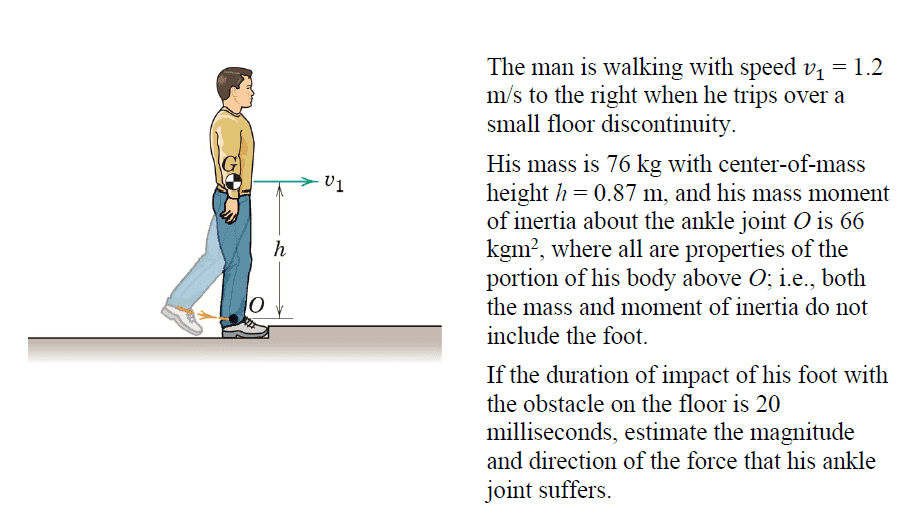
Rigid body kinetics -- force on ankle joint

mastermechanic
Messages
107
Reaction score
15
Homework Statement
Rigid body kinetics problem involving Impulse-Momentum application
Relevant Equations
G = m.v and H = m.v.r
PROBLEM
H55.PNG


Here from the conservation of angular momentum I found angular velocity just before impact,
$$ H_1 = 0 $$
$$ H_2 = I_0\omega + mV_0d $$
$$ H_2 = 66\omega + 76.(1.2).(0.87)$$
$$ H_1 = H_2 $$
$$ \omega = 1.202 rad/s $$

But I couldn't solve it to find joint force.

Thanks in advance,
 
Last edited:
on Phys.org
mastermechanic said:
$$ H = I_0\omega + mV_0d $$
What is H in this equation? If it is supposed to express angular momentum conservation, the equation does not look like it. Angular momentum conservation is expressed as $$L_{\text{before}}=L_{\text{after}}.$$Is your ##d## the same as ##h## in the figure? How are you going to use the information that the collision lasts 20 msec? Hint: Think "impulse".
 
Last edited:
You're right I just wrote it fast, the angular momentum is zero before the impact and is the expression I wrote above after the impact. So I found $$ \omega = 1.202 rad/s $$

I found a way but I appreciate if you confirm it's validity,

V of the ankle joint,

$$ V = \omega.r $$
$$V = 1.202 * 0.87 = 1.05 m/s $$
$$ \frac {m.(V_f - V_i)} {t} = \frac {76.(1.05 - 1.2)} {0.02} = - 585 N $$

Is this correct?
 
Last edited:
mastermechanic said:
You're right I just wrote it fast, the angular momentum is zero before the impact
The angular momentum about what axis is zero before the impact?
 
jbriggs444 said:
The angular momentum about what axis is zero before the impact?

To the page
 
mastermechanic said:
Is this correct?
It's what I got. Nevertheless, think about the answer you gave to @jbriggs444. If the angular momentum is zero before the impact and non-zero after the impact, it cannot be conserved through the collision, can it?
 
Last edited:
mastermechanic said:
To the page
The page? I do not understand. The page is a plane. An axis is a line. If you draw a normal rising out of the page, that still does not define an axis because no location for the line is defined.

The problem statement gives a large hint about what axis to use. The problem is that you've not correctly used it.
 

Similar threads

  • · Replies 12 ·
Replies
12
Views
3K
Replies
335
Views
19K
  • · Replies 3 ·
Replies
3
Views
2K
  • · Replies 9 ·
Replies
9
Views
3K
  • · Replies 30 ·
2
Replies
30
Views
4K
  • · Replies 3 ·
Replies
3
Views
2K
  • · Replies 7 ·
Replies
7
Views
12K
Replies
7
Views
2K
  • · Replies 14 ·
Replies
14
Views
3K