Rigid body relative acceleration

Click For Summary
SUMMARY

The discussion focuses on calculating the vertical displacement, velocity, and acceleration of point B on a rigid body (ship) that rotates and moves around three axes (x, y, z) around its center of gravity. The known parameters include acceleration, velocity, and position at point A, along with the original position vector from A to B. The solution involves using a rotation matrix to determine the relative vector (r_AB) and subsequently calculating the relative velocity and acceleration. The participant highlights the dependency of z-axis acceleration on the rotational speed around the z-axis and seeks clarification on maintaining a fixed coordinate system for accurate calculations.

PREREQUISITES
  • Understanding of rigid body dynamics
  • Familiarity with rotation matrices
  • Knowledge of angular velocity and its impact on motion
  • Proficiency in vector calculus
NEXT STEPS
  • Study the application of rotation matrices in rigid body dynamics
  • Learn about the effects of angular velocity on linear acceleration
  • Explore fixed versus rotating reference frames in physics
  • Investigate advanced topics in kinematics and dynamics of rigid bodies
USEFUL FOR

Students and professionals in mechanical engineering, robotics, and physics who are involved in the analysis of rigid body motion and dynamics.

Remko

Homework Statement


Rigid body (ship) rotate and moves around 3 axis (x,y,z) around the center of gravity. The position is of the center of gravity is not known.
What is known: At a point (A) the accereleration, velocity and position and rotational acceleration, velocity and position are known (measured). And the original position vector (relative to the fixed world) from point A to a point B.

What is wanted: The vertical (z-direction) displacement, velocity and acceleration of point B.

2. The attempt at a solution
With the known angles the relative vector (r_AB) between point A a B can be easily calculated with a rotation matrix:
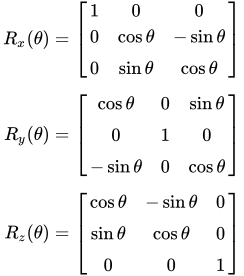
a6821937d5031de282a190f75312353c970aa2df


When you add the the measured position of A to this r_AB the new position of B is known.
Now the relative velocity can be calculated as
image006.gif

so the velocity v_B=v_A+ v_B/A

and the relative acceleration is:
image012.gif

So the acceleration is a_B=a_A+a_B/A.

Now the my first question is whether this is correct?
And secondly I find it strange that when you take the z-componont of the acceleration it is dependent on the rotational speed around the z-axis (because of the double cross product). Why is this? You would think this rotational speed around its axis has nothing to do with any movement or acceleration along that axis.

And also a similar problem with the velocity in z direction which is dependent on the yaw (the angle around the z axis). Which i also find strange.
 
Last edited by a moderator:
Physics news on Phys.org
I think it's because the z-axis is being rotated into the other axes that do change the z-axis acceleration. So the instantaneous (current) z-axis rotation will start changing the (moved) z-axis acceleration.
 
Last edited:
FactChecker said:
I think it's because the z-axis is being rotated into the other axes that do change the z-axis acceleration. So the instantaneous (current) z-axis rotation will start changing the (moved) z-axis acceleration.
But that would mean that the x,y and z axis are not fixed. And in my case i want that the axis are fixed to the world, because i want the know the position, velocity and acceleration of point B with regard to the ground (seabed). Does that mean i need another way to calculate my all this? Or did i misunderstood your explanation?
 
Remko said:
But that would mean that the x,y and z axis are not fixed. And in my case i want that the axis are fixed to the world, because i want the know the position, velocity and acceleration of point B with regard to the ground (seabed). Does that mean i need another way to calculate my all this? Or did i misunderstood your explanation?
I think you understood my answer and have a good question. I'll have to think about that and I gave away all my references when I retired. I may have to leave this to someone more expert in this subject.
 
FactChecker said:
I think you understood my answer and have a good question. I'll have to think about that and I gave away all my references when I retired. I may have to leave this to someone more expert in this subject.
Okay, Thanks anyway!
 
I think i found the solution. I first rotate the position (r) with a rotation matrix R and then I start multiplying that with the angular velocity which is still aligned with the 'old' fixed coordinate system. So to calculate this correctly the angular velocity should be also be multiplied with the rotation matrix to get it in the same reference frame.
 

Similar threads

  • · Replies 3 ·
Replies
3
Views
2K
  • · Replies 3 ·
Replies
3
Views
2K
  • · Replies 3 ·
Replies
3
Views
1K
  • · Replies 8 ·
Replies
8
Views
2K
  • · Replies 6 ·
Replies
6
Views
3K
  • · Replies 7 ·
Replies
7
Views
2K
  • · Replies 5 ·
Replies
5
Views
4K
  • · Replies 3 ·
Replies
3
Views
2K
Replies
5
Views
2K