What mistake did I make when solving for the equilibrium of a rigid object?

Click For Summary
The discussion centers on solving for the equilibrium of a rigid object, where the initial attempt led to an incorrect answer. Key mistakes included using vector arrows for forces instead of their magnitudes, which complicated the torque equation. Additionally, choosing point C for torque calculations was suboptimal, as it did not allow for the elimination of an unknown force. The participant also misjudged the directions of forces D and U, leading to errors in the torque equation. After correcting these mistakes, the participant achieved the correct solution.
agusb1
Messages
7
Reaction score
1
Homework Statement
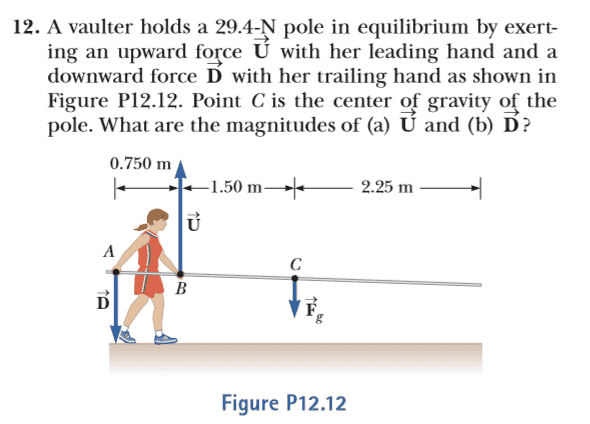
A vaulter holds a 29.4 N pole in equilibrium by exerting an upward force with her leading hand and a downward force with her trailing hand as shown in Figure (included below). Point C is the center of gravity of the pole.
Relevant Equations
Sum of forces in y direction = -D + U - Fg = 0
Here's the task:
1565493996948.png


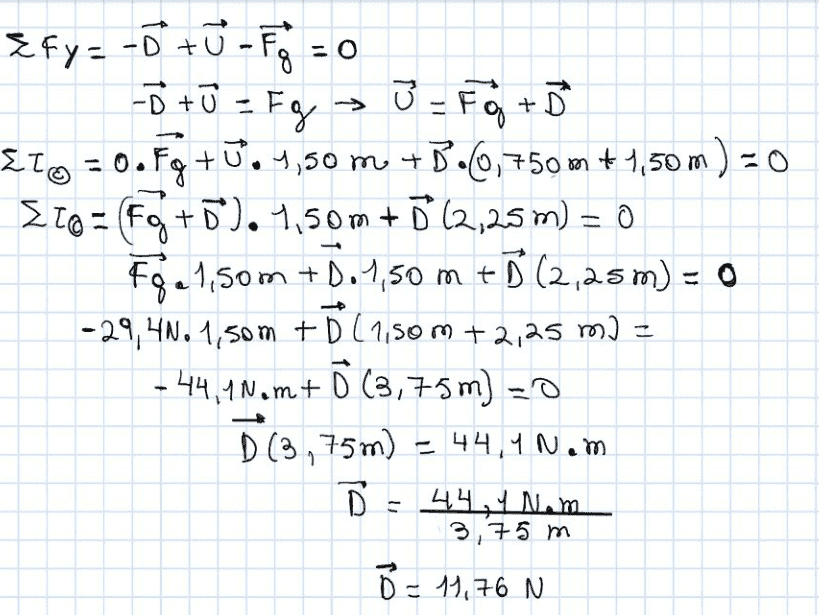
My attempt at a solution (I choose C as an axis):
1565494651492.png

However, the textbook solution says D should be 58.8. What am I doing wrong?
 
Physics news on Phys.org
First of all, please remove the vector arrows over your forces. Although the forces are vectors, what you are actually using in your computations is their magnitudes.

Second, the above tends to confuse you when you are writing down the torque equation. Be mindful of the proper directions of the torques.

Third, while not wrong, choosing C as the point for considering the torque is not ideal. A good choice would let you disregard one of your unknowns completely for that equation rather than having the known gravitational force provide no torque.
 
I see. I realize I had incorrectly assumed D and U had the same direction, but they have opposite ones. I also had incorrectly written -29.4 in the torque equation when it should had been +29.4. I re-calculated it and now I get the correct result. Thanks.
 
  • Like
Likes berkeman
The book claims the answer is that all the magnitudes are the same because "the gravitational force on the penguin is the same". I'm having trouble understanding this. I thought the buoyant force was equal to the weight of the fluid displaced. Weight depends on mass which depends on density. Therefore, due to the differing densities the buoyant force will be different in each case? Is this incorrect?

Similar threads

  • · Replies 11 ·
Replies
11
Views
1K
Replies
6
Views
2K
  • · Replies 8 ·
Replies
8
Views
2K
Replies
6
Views
2K
  • · Replies 5 ·
Replies
5
Views
3K
  • · Replies 9 ·
Replies
9
Views
1K
Replies
15
Views
2K
  • · Replies 6 ·
Replies
6
Views
4K
  • · Replies 1 ·
Replies
1
Views
2K
  • · Replies 9 ·
Replies
9
Views
1K