Rotational equilibrium problem (ladder against a wall)

Join the discussion
Ask a follow-up here, or get your own question answered by working scientists, mathematicians and engineers — people, not an autocomplete.
Real named experts · corrections over time · the nuance an AI answer skips
4 replies · 4K views
LuigiAM
Messages
55
Reaction score
7
Hi everyone,

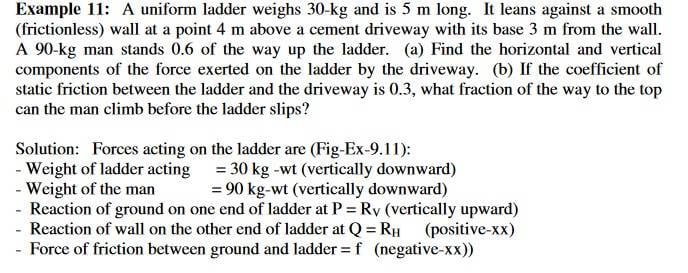
Our professor gave us a bunch of solved problems to practice with before the exam, and this one I'm struggling with:
lFK4EXn.jpg

lBMn6Io.jpg


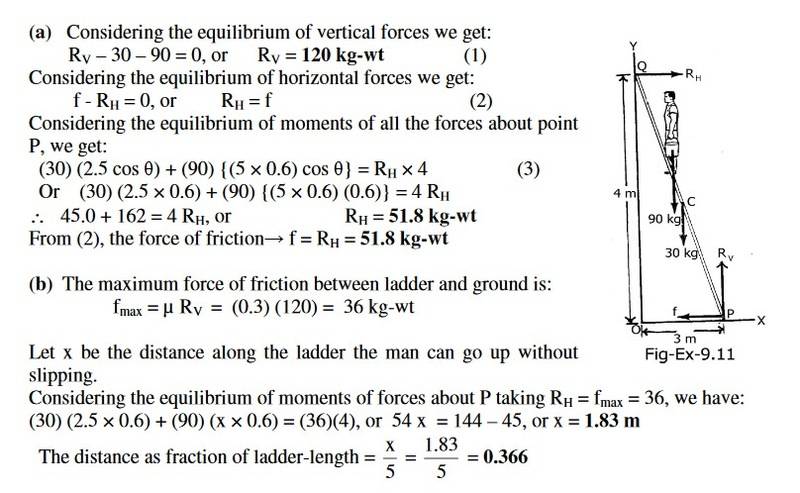
I'm trying to work through the solution step by step, and I get stuck at the point (3).

What I understand is that we want to get the value of RH, which is equal in magnitude to friction. So to do this, we do rotational equilibrium - the total of all the moments must be zero.

What I don't understand is why is it set equal to RH times 4? I don't understand this. RH is acting at the end of the latter, which is 5 meters long. Shouldn't it be RH times 5 instead of 4?
 

Attachments

  • lFK4EXn.jpg
    lFK4EXn.jpg
    47.6 KB · Views: 1,351
  • lBMn6Io.jpg
    lBMn6Io.jpg
    62 KB · Views: 2,038
Physics news on Phys.org
LuigiAM said:
Hi everyone,

Our professor gave us a bunch of solved problems to practice with before the exam, and this one I'm struggling with:

View attachment 216495
View attachment 216496

I'm trying to work through the solution step by step, and I get stuck at the point (3).

What I understand is that we want to get the value of RH, which is equal in magnitude to friction. So to do this, we do rotational equilibrium - the total of all the moments must be zero.

What I don't understand is why is it set equal to RH times 4? I don't understand this. RH is acting at the end of the latter, which is 5 meters long. Shouldn't it be RH times 5 instead of 4?
When you calculate torque produce by Rh taking pivot point at ground then
Torque =perpendicular distace from pivot to direction of force χ Rh
Thats why here 4 is taken not 5
 
  • Like
Likes   Reactions: LuigiAM
Ohh I think I get it... it's because Rh is in a different direction than the weight of the man and the weight of the ladder, so we multiply it by sin rather than cosine, and 5 times the sin of 53.1 is 4?

It's a bit unintuitive for me (I haven't done trigonometry since the late 90s...!)

I think the drawing is a bit unhelpful, it's easier if I re-draw the ladder as a straight line to show the forces at their angle so it becomes more clear)
 
LuigiAM said:
Ohh I think I get it... it's because Rh is in a different direction than the weight of the man and the weight of the ladder, so we multiply it by sin...
I think the drawing is a bit unhelpful, it's easier if I re-draw the ladder as a straight line to show the forces at their angle so it becomes more clear)
and I know it's just supposed to be a sketch, but their drawing isn't even close to being scaled (3-4-5) triangle. ?:)