Rotational inertia - globes connected by a thin rod

Click For Summary
SUMMARY

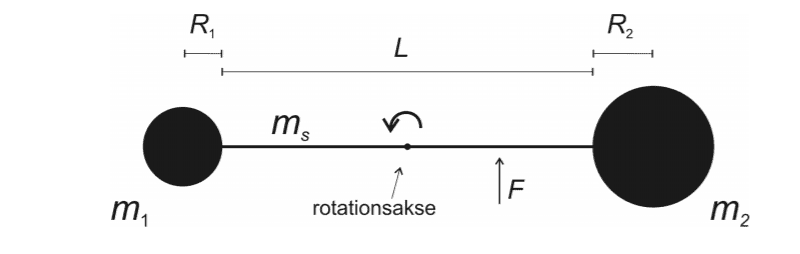
The discussion centers on calculating the rotational inertia of a system comprising two massive globes connected by a thin rod. The globes have radii R1 = 0.18 m and R2 = 0.28 m, with masses m1 = 193 kg and m2 = 726 kg, while the rod has a mass of ms = 10 kg and a length of L = 0.88 m. The overall moment of inertia is confirmed to be I = 476 kg·m², derived using the parallel axis theorem and the formulas for solid spheres and rods. The correct formulas applied include I = (2/5 * m * r²) for the spheres and I = (1/12 * m * L²) for the rod.

PREREQUISITES
  • Understanding of rotational inertia and moment of inertia (MoI)
  • Familiarity with the parallel axis theorem
  • Knowledge of the formulas for solid spheres and rods
  • Basic principles of rigid body dynamics
NEXT STEPS
  • Study the parallel axis theorem in detail
  • Learn about the moment of inertia for various geometric shapes
  • Explore applications of rotational dynamics in engineering
  • Investigate advanced topics in rigid body motion
USEFUL FOR

Students and professionals in physics, mechanical engineering, and anyone involved in the study of rotational dynamics and inertia calculations.

naji0044
Messages
7
Reaction score
0
Homework Statement
Finding the rotational inertia
Relevant Equations
I=∑m*r^2
Problem Statement: Finding the rotational inertia
Relevant Equations: I=∑m*r^2

A rigid body of 2 massive globes with homogenous mass distribution and a thin rod is connecting the 2 globes. The globes has radius R1 = 0.18 m and R2 =0.28 m and masses m1=193 kg and m2=726 kg. The thin rod has the mass ms=10kg and the length L=0.88 m. THe body can rotate frictionless around the rotation axis in the middle of the thin rod.

a) Calculate the the body's overall inertiamoment and show that the inertiamoment is I=476 kgm^2

my calculations are m1*(1/2*L+r1)^2+m2*(1/2*L+r2)^2 and i doubt if this is even correct and can't tell how the inertiamoment of the rod would look. Ignore the F(force)
Udklip.PNG
 
Physics news on Phys.org
Hint: Don't treat the spheres as if they were point masses. (Think parallel axis theorem.)
 
naji0044 said:
cant tell how the inertiamoment of the rod would look
You should have a standard formula for the MoI of a uniform stick about its centre. Similarly for a uniform solid sphere.
 
okay so for a solid sphere i use 2/5*m*r^2 and for the rod it is 1/12*m*L^2?
 
naji0044 said:
okay so for a solid sphere i use 2/5*m*r^2 and for the rod it is 1/12*m*L^2?
Yes, about their respective centers.
 
Okay so you use the formula I=Icm+Md^2 and therefore:
2/5*m1*r1^2+m1*(r1+1/2*L)^2 + 2/5*m2*r2^2+m2*(-r2-1/2*L)^2 + 1/12*m3*L+m3*1
 
naji0044 said:
m3*1
Where does this term come from?
The rest is fine.
 
haruspex said:
Where does this term come from?
The rest is fine.
haruspex said:
honestly i am
Where does this term come from?
The rest is fine.
 
I am not sure how to calculate the rod when the rotation axis is right on the middle of it
 
  • #10
naji0044 said:
I am not sure how to calculate the rod when the rotation axis is right on the middle of it
That's what the ##\frac 1{12}mL^2## formula gives you. There is nothing to add in this case.
 
  • Like
Likes   Reactions: naji0044

Similar threads

Replies
2
Views
2K
  • · Replies 4 ·
Replies
4
Views
1K
  • · Replies 8 ·
Replies
8
Views
1K
  • · Replies 4 ·
Replies
4
Views
2K
  • · Replies 9 ·
Replies
9
Views
2K
  • · Replies 13 ·
Replies
13
Views
3K
  • · Replies 12 ·
Replies
12
Views
2K
  • · Replies 9 ·
Replies
9
Views
2K
  • · Replies 3 ·
Replies
3
Views
1K
  • · Replies 13 ·
Replies
13
Views
2K