High School Row reduction, Gaussian Elimination on augmented matrix

Click For Summary
To solve the matrix using Gaussian elimination, start by applying row operations systematically to eliminate entries below the leading coefficients. The first step involves using the first row to eliminate the first entry of the second and third rows. Next, manipulate the second row to eliminate the second entry of the third row. It's important to show your work and ensure that the final matrix accurately represents the corresponding equations without labeling rows incorrectly. Understanding these steps will help clarify the process of row reduction.
Rafa3D
Messages
3
Reaction score
1
Member warned to post homework questions in the proper forum section
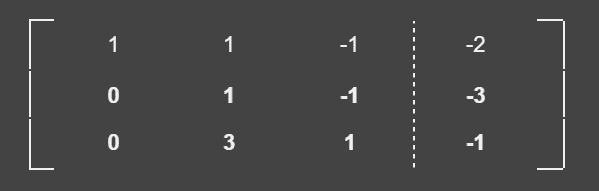
Hi! Please, could you help me on how to solve the following matrix ?
I need to replace the value 3 on the third line by 0, the first column need to remain zero and 1 for the third column. I'm having a lot of difficulties with this. How would you proceed ?

1680987895171.png


Thank you for your time and help.
All best
 
Physics news on Phys.org
Usually you go row by row. Use the first row to knock out the first entry of the second row, then the first row to knock out the first entry of the third row, and then the second row to knock out the second entry of the third row. The first two parts are done for you in this matrix!
 
Office_Shredder said:
Usually you go row by row. Use the first row to knock out the first entry of the second row, then the first row to knock out the first entry of the third row, and then the second row to knock out the second entry of the third row. The first two parts are done for you in this matrix!
I m sorry, but I still don't understand :(
 
Why don't you start by listing out all the operations you can do.
 
Hi @Rafa3D. Welcome to PF.

The general rule here is that you have to show evidence of your own effort before we help. You will get guidance/steering/advice rather than answers. That being said…

Let’s use ‘R1’ as shorthand for 'row one' for example.

Q1. What would R2 be if you multiplied it by 3? Tell us what it would be.

Q2. Subtract your answer from R3 (four subtractions to do). You will get a new R3 but R1 and R2 haven’t changed. Tell us what the matrix is now.

If you answer Q1 and Q2 correctly, there’s one final step.

Note, there are many YouTube videos explaining this.
 
Steve4Physics said:
Hi @Rafa3D. Welcome to PF.

The general rule here is that you have to show evidence of your own effort before we help. You will get guidance/steering/advice rather than answers. That being said…

Let’s use ‘R1’ as shorthand for 'row one' for example.

Q1. What would R2 be if you multiplied it by 3? Tell us what it would be.

Q2. Subtract your answer from R3 (four subtractions to do). You will get a new R3 but R1 and R2 haven’t changed. Tell us what the matrix is now.

If you answer Q1 and Q2 correctly, there’s one final step.

Note, there are many YouTube videos explaining this.
Thank you. I think I got the idea :

1681049851166.png
 
  • Like
Likes Steve4Physics
Rafa3D said:
Thank you. I think I got the idea :

View attachment 324667
Yes. You can skip some of the steps for brevity if you are comfortable with this. For example you don't really need to write
0*¼ 0*¼ 4*¼ | 8*¼
You could immediately write
0 0 1 | 2.

And you have labelled the rows of the final matrix as x, y and z on the left side. That's wrong here. Remember your final matrix represents these equations:
1.x + 1·y - 1·z = -2
0·x + 1·y - 1·z = -3
0·x + 0·y +1·z = 2

Also, you are allowed to swap rows, so it makes no sense to label a row as x or y or z.
 

Similar threads

  • · Replies 5 ·
Replies
5
Views
1K
  • · Replies 14 ·
Replies
14
Views
3K
  • · Replies 26 ·
Replies
26
Views
5K
  • · Replies 13 ·
Replies
13
Views
8K
  • · Replies 2 ·
Replies
2
Views
2K
  • · Replies 8 ·
Replies
8
Views
2K
Replies
6
Views
5K
  • · Replies 3 ·
Replies
3
Views
3K
  • · Replies 1 ·
Replies
1
Views
2K
  • · Replies 1 ·
Replies
1
Views
1K