Is there a connection between Rule 30 and the Golden Ratio?

  • Context: Graduate 
  • Thread starter Thread starter EebamXela
  • Start date Start date
  • Tags Tags
    Golden ratio Ratio
Click For Summary

Discussion Overview

The discussion explores a potential connection between Rule 30, a cellular automaton, and the Golden Ratio. Participants examine the chaotic and ordered properties of Rule 30's output and consider whether the ratio of these properties aligns with the Golden Ratio over iterations. The conversation includes theoretical, experimental, and speculative elements.

Discussion Character

  • Exploratory
  • Technical explanation
  • Conceptual clarification
  • Debate/contested
  • Experimental/applied

Main Points Raised

  • One participant theorizes that the ratio of chaotic to ordered regions in Rule 30 aligns with the Golden Ratio, particularly in early iterations.
  • Another participant notes that the alignment between the Golden Ratio line and the actual separation point diminishes after a certain number of iterations.
  • It is suggested that lines of cells parallel to the left edge of Rule 30 eventually settle into a repeating pattern, and distances to these patterns could be analyzed.
  • A participant shares observations that altering the center cell of each row affects the patterns but does not change the position of the divisory line, implying a consistent behavior influenced by the initial conditions.
  • Graphs are provided to illustrate the ratio and the length of repeating patterns, constructed based on the identified moments when patterns break.
  • Another participant reflects on their past work linking cellular automata and the Golden Ratio, proposing that there is a relationship between chaotic regimes and the Golden Ratio, supported by historical figures in the field.
  • This participant also introduces the concept of "Asynsis" and discusses broader implications of the Golden Ratio in natural systems and design.

Areas of Agreement / Disagreement

Participants express a range of viewpoints, with some supporting the idea of a connection between Rule 30 and the Golden Ratio, while others raise questions about the consistency of this relationship over iterations. The discussion remains unresolved, with multiple competing views on the nature of the relationship.

Contextual Notes

Some claims depend on specific interpretations of the patterns observed in Rule 30, and the discussion includes various assumptions about the behavior of cellular automata and their relationship to the Golden Ratio. The mathematical steps and definitions used in the analysis are not fully resolved.

Who May Find This Useful

This discussion may be of interest to those studying cellular automata, mathematical patterns, chaos theory, and the Golden Ratio, as well as individuals exploring the intersections of mathematics, design, and natural systems.

EebamXela
Messages
16
Reaction score
0
I was messing around with cellular automata and wanted to test a theory i had.

If you look close at the elementary cellular automata Rule 30 you'll notice that the right
side is chaotic, while the left side has chaotic properties but it does have order and
repetition.

There is an imaginary line that you could draw that separates the two sides that slopes
slightly to the left.

My theory was that the ratio of the right side and the left side of each row follows closely to
the Golden Ratio.

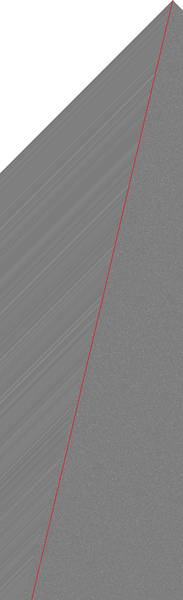
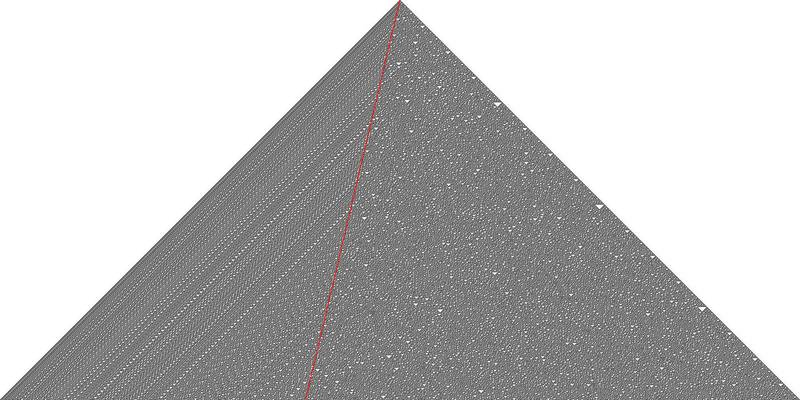
I've attached an image of the first 10,000 iterations of Rule 30 and overlaid a red line that
represents the golden ratio dividing line (not the actual dividing line). You should see that
for a while up at the top the golden ratio line and the actual separation point match up
almost perfectly. But eventually they start to separate.

Is this just a coincidence? Or is there something to this?

1000 Iterations
8283395272_bf875e2fe8_b.jpg


10,000 Iterations
8283355398_f4835efdf0_k.jpg
 
Mathematics news on Phys.org
You see yourself, that the line doesn't match any more after 6000 iterations or so.
 
Looks like every line of cells parallel to the left edge eventually settles into a repeating pattern. Maybe you could extract the distance (from right edge) to the start of the repeats and the length of the repeat, and plot those against distance from left edge.
 
One observation: I tried altering randomly the center cell of each row (all cells directly below the initial black cell) after each iteration; while the patterns on both sides change, there is always regularity on the left side of the triangle, and the divisory 'line' invariably appears at the same place. Altering the center cell to be not random, but constantly black or constantly white, also leaves the 'line' at the same place. (Presumably the line is the effect of the fixed white area beyond the left border of the triangle, as propagated inwards by the rule.)
 
If it helps, here are two graphs close to wht haruspex was asking. The first is the ratio you look for, the second is the length of the repeating pattern on the diagonals parallel to the left border. Both as a function of vertical distance from the top. Constructed by the method haruspex outlined: detecting the moment when the repeating pattern (of lines parallel to the left border) breaks.

attachment.php?attachmentid=54120&stc=1&d=1356026215.png
attachment.php?attachmentid=54121&stc=1&d=1356026215.png
 

Attachments

  • rule30_ratio_small.png
    rule30_ratio_small.png
    5.7 KB · Views: 812
  • rule30_len_small.png
    rule30_len_small.png
    2.1 KB · Views: 800
Thanks Dodo, that's intriguing. It looks like all repeats are length sixteen (some just happening to consist of a repeated pattern of some shorter length). That sounds like something that should be provable.
 
Intriguing results.
As an architect and designer I've been following the relationships between CAs and the Golden Ratio since my student dissertations back in London at the Computer Science and Engineering faculty of the University of Westminster in the mid-90s.

I speculated then that there was a likely relationship between the "sensitively dependent" CA regimes on the "edge of chaos" and the Golden Ratio, which I now develop on in the following blog: http://asynsis.wordpress.com

Asynsis is a neologism meaning "asymmetrical creation"
(more on http://www.quora.com/Asynsis).

I believe that Conway, Langton, Kauffman, Bak and Wolfram are all on the same
track when they describe CAs in this transitional domain.
That the "edge of chaos" regime is the most creative and persistent for
a very simple, elegant reason - one that links a law of beauty with one of optimisation.

There is a believe, also a strong link with the new universal Constructal design law of nature and culture as well, where nature evolves to flow currents of energy, matter and information more easily, with greater power over time. The geometrical signature of these behaviours can also be expressed as the Golden Ratio iterated over time. In the Asynsis blog, I also cite a 2006 proof of my further speculation that the Golden Ratio, or Phi for short is imbedded in the Feigenbaum diagram or Logistic map of bifurcations modelling systems expressing both chaotic and ordered regimes.
So what we have is a new classical-scale theory of everything based on the geometric constant of Phi, where nature self-organises itself and builds complexity in numerous permutations that can be traced back to the Golden Ratio - the archetypal fractal.
We begin to see how nature allows design to emerge analogically and optimally from entropy.
 

Similar threads

  • · Replies 62 ·
3
Replies
62
Views
11K
  • · Replies 7 ·
Replies
7
Views
2K
  • · Replies 4 ·
Replies
4
Views
4K
  • · Replies 10 ·
Replies
10
Views
4K
  • · Replies 1 ·
Replies
1
Views
3K
  • · Replies 13 ·
Replies
13
Views
4K
  • · Replies 1 ·
Replies
1
Views
5K
  • · Replies 6 ·
Replies
6
Views
6K
Replies
29
Views
5K
  • · Replies 4 ·
Replies
4
Views
3K