Sure, but what’s the connection to the topic of this thread?alexandrinushka said:As for the Twin Paradox: https://en.m.wikipedia.org/wiki/Twin_paradox
Sagnac effect for matter beams
- Context: High School
- Thread starter alexandrinushka
- Start date
Join the discussion
Ask a follow-up here, or get your own question answered by working scientists, mathematicians and engineers — people, not an autocomplete.
Real named experts · corrections over time · the nuance an AI answer skips
40 replies · 5K views
Physics news on Phys.org
alexandrinushka
- 66
- 16
@Sagittarius A-Star actually... hum...
The final formula for the time lag due to the Sagnac effect calculated by Rizzi and Ruggiero (their formula 25 with the proper Lorentz factor for the local rotating clock time) is different from the one in the link (formulae 9 and 13). The link takes c2 - v2 as a denominator, while R&R take c2 as a denominator.
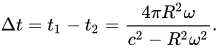
Wiki gives one that is the same with the link:
On Wiki they do indeed proceed by later removing the v2 (as it is negligible due to the high c2), but I don't think R&R ever apply approximations in their derivation.
The final formula for the time lag due to the Sagnac effect calculated by Rizzi and Ruggiero (their formula 25 with the proper Lorentz factor for the local rotating clock time) is different from the one in the link (formulae 9 and 13). The link takes c2 - v2 as a denominator, while R&R take c2 as a denominator.
Wiki gives one that is the same with the link:
On Wiki they do indeed proceed by later removing the v2 (as it is negligible due to the high c2), but I don't think R&R ever apply approximations in their derivation.
Last edited:
alexandrinushka
- 66
- 16
Hello @Nugatory we were discussing earlier if the Sagnac effect applies as well to non-circular paths. I was thinking about some clocks, that would move around a square shape (but it can also be a triangle, whatever, but not necessarily a circle). When back in front of the stationary clock in the lab, the clocks that have moved around the square will show a time lag. So I was asking if that is similar to the twin paradox, when the twin that left Earth and then came back is actually younger. @Sagittarius A-Star said he could not find it on PF, so I just linked a brief reference.Nugatory said:Sure, but what’s the connection to the topic of this thread?
jartsa
- 1,582
- 141
If you have one clock going around a small square, you will see a clock that is gaining time slowly, when you look at some point on the path. Because the clock is constantly doing small trips at high speed.alexandrinushka said:Hello @Nugatory we were discussing earlier if the Sagnac effect applies as well to non-circular paths. I was thinking about some clocks, that would move around a square shape (but it can also be a triangle, whatever, but not necessarily a circle). When back in front of the stationary clock in the lab, the clocks that have moved around the square will show a time lag. So I was asking if that is similar to the twin paradox, when the twin that left Earth and then came back is actually younger. @Sagittarius A-Star said he could not find it on PF, so I just linked a brief reference.
If you add more clocks on the path, what you see does not change very much ... because the square is small. i mean those clocks that have tried to synchronize themselves while going around the square.
- 1,536
- 1,151
That was only meant as a joke.alexandrinushka said:@Sagittarius A-Star said he could not find it on PF
- 1,536
- 1,151
At Rizzi and Ruggiero they calculate in formula (25) the time-delta in the rotating frame, while in my link (formulae 9 and 13) they calculate the time-delta with reference to the non-rotating frame.alexandrinushka said:@Sagittarius A-Star actually... hum...
The final formula for the time lag due to the Sagnac effect calculated by Rizzi and Ruggiero (their formula 25 with the proper Lorentz factor for the local rotating clock time) is different from the one in the link (formulae 9 and 13). The link takes c2 - v2 as a denominator, while R&R take c2 as a denominator.
- Rizzi and Ruggiero formula 25 (clock on the disk at ##\Sigma##, see also before formula 20 and text of figure 1):
##\Delta \tau = 2 \ v \ 2 \pi r \gamma / c^2##
- The link - formulae 9 and 13 (clock in the stationary frame):
##\Delta t = 2 \gamma \ v \ 2 \pi r \gamma / c^2##
That's a nicely formatted formulaalexandrinushka said:Wiki gives one that is the same with the link:
![]()
On Wiki they do indeed proceed by later removing the v2 (as it is negligible due to the high c2), but I don't think R&R ever apply approximations in their derivation.
- Wikipedia has exactly the same result as the others (but calculation only for light signals in vacuum, clock in the stationary frame):
##\Delta t = \frac {4v \pi r } {c^2(1-v^2/c^2)} = 2 \gamma \ v \ 2 \pi r \gamma / c^2##
- You can also see from my posting #13: The formula for the Sagnac ##\Delta t## is nothing else than the term for "relativity of simultaneity" in the inverse Lorentz transformation, multiplied with ##2## (and with ##\require {color} \color{orange} \gamma \color{black}## for the stationary frame.
##\require {color} \Delta t = \color{orange} \gamma \color{black} (\Delta t' + \color{red} {\frac {v} {c^2} \Delta x'} \color{black})##
You need only to plug-in:
## \Delta t' := 0## (measured with 2 clocks at both end of the cable, that were synchronized on the rotating disk with light in both directions via the cable)
##\require {color} \color{red} \Delta x' \color{black} := \ 2 \pi r \gamma##
Multiply ##\Delta t## of the LT with ##2## because there are 2 signals in opposite direction involved.
Last edited:
alexandrinushka
- 66
- 16
I am sorrySagittarius A-Star said:That was only meant as a joke.
- 1,536
- 1,151
That was not silly of you.alexandrinushka said:I am sorrysilly of me
You are right regarding the twin paradox:
alexandrinushka said:Hello @Nugatory we were discussing earlier if the Sagnac effect applies as well to non-circular paths. I was thinking about some clocks, that would move around a square shape (but it can also be a triangle, whatever, but not necessarily a circle). When back in front of the stationary clock in the lab, the clocks that have moved around the square will show a time lag.
alexandrinushka
- 66
- 16
@Sagittarius A-Star for the "nicely formatted" formula you'll be really disappointed: I copy pasted it from Wiki 
Rizzi and Co say also that the space on the disk is not time-orthogonal (although I admit I don't really understand what they mean by that... I guess something like "impossible to define a common simultaneity relationship" or something) and that therefore:
"Moreover we stress that it is not possible to describe the relative space in terms of space-time foliation, i.e. in the form x0 = const, where x0 is an appropriate coordinate time, because the space of the disk, as we show in Appendix A.14, is not time-orthogonal." They go on by trying to link that weird space to physical space (with tangential projection techniques and then... I got lost. Although I remember from school what a tangent is and a projection as well).
Can you explain in ELI5 terms what is that supposed to mean? Why project stuff? Why can't we just "live" in this relative space (to use their terminology)?
If that is too much and crosses into metaphysics and you feel like it does not belong here, I'll completely understand. I am trying hard to link this stuff to our current experience and I fail


Also, thanks a lot for the previous comment. If I get it right, the time gap in the lab is just the time gap on the rotating disk multiplied by the Lorentz factor.
I have to admit I get confused when 1 is used instead of c2
You teach me humility really. When I was teaching Russian to a teenage girl and had to go 10 times through the same material I thought "she must be retarded" and lost my patience eventually.
I admire your ability to go over the same Lorentz factors, the switching between different frames and the nice formatting... all that for a complete stranger (and one who only has some high school math + some uni calculus). Thanks
Rizzi and Co say also that the space on the disk is not time-orthogonal (although I admit I don't really understand what they mean by that... I guess something like "impossible to define a common simultaneity relationship" or something) and that therefore:
"Moreover we stress that it is not possible to describe the relative space in terms of space-time foliation, i.e. in the form x0 = const, where x0 is an appropriate coordinate time, because the space of the disk, as we show in Appendix A.14, is not time-orthogonal." They go on by trying to link that weird space to physical space (with tangential projection techniques and then... I got lost. Although I remember from school what a tangent is and a projection as well).
Can you explain in ELI5 terms what is that supposed to mean? Why project stuff? Why can't we just "live" in this relative space (to use their terminology)?
If that is too much and crosses into metaphysics and you feel like it does not belong here, I'll completely understand. I am trying hard to link this stuff to our current experience and I fail
Also, thanks a lot for the previous comment. If I get it right, the time gap in the lab is just the time gap on the rotating disk multiplied by the Lorentz factor.
I have to admit I get confused when 1 is used instead of c2
You teach me humility really. When I was teaching Russian to a teenage girl and had to go 10 times through the same material I thought "she must be retarded" and lost my patience eventually.
I admire your ability to go over the same Lorentz factors, the switching between different frames and the nice formatting... all that for a complete stranger (and one who only has some high school math + some uni calculus). Thanks
- 1,536
- 1,151
I overlooked this. I think it is better to create LaTeX formulas instead uploading pictures of formulas.alexandrinushka said:@Sagittarius A-Star for the "nicely formatted" formula you'll be really disappointed: I copy pasted it from Wiki![]()
I am not familiar with the definition of orthogonality of coordinate systems, so maybe someone else can correct me, if I write something wrong. My understanding is:alexandrinushka said:Rizzi and Co say also that the space on the disk is not time-orthogonal (although I admit I don't really understand what they mean by that... I guess something like "impossible to define a common simultaneity relationship" or something)
- Consider first a 2-dimensional x-/y-coordinate system with Euclidean Geometry. The coordinate axes are orthogonal, if you can calculate every distance as ##\sqrt{{\Delta x}^2+{\Delta y}^2}## (Pythagorean theorem).
- In 1907, Hermann Minkowski found out, that according to SR we live in a 4-dimensional spacetime with a slightly different Geometry than the Euclidean (with different signs under the square-root). The 4 coordinate-axes are orthogonal, if you can calculate every spacetime interval as ##\sqrt{|{{c^2\Delta t}^2-\Delta x}^2-{\Delta y}^2-{\Delta z}^2|}##. This is only the case for inertial frames.
Source:Wikipedia said:##ds^2 = - \left( 1 - \omega^2 r^2 \right) dt^2 + 2 \omega r^2 dt d\phi + dz^2 + dr^2 + r^2 d\phi^2##
...
Notice the "cross-terms" involving ##dt\ d\phi##, which show that the Born chart is not an orthogonal coordinate chart.
https://en.wikipedia.org/wiki/Born_coordinates#Transforming_to_the_Born_chart
Yes that is too much for me, sorry. Maybe the neightboring thread helps.alexandrinushka said:"Moreover we stress that it is not possible to describe the relative space in terms of space-time foliation, i.e. in the form x0 = const, where x0 is an appropriate coordinate time, because the space of the disk, as we show in Appendix A.14, is not time-orthogonal." They go on by trying to link that weird space to physical space (with tangential projection techniques and then... I got lost. Although I remember from school what a tangent is and a projection as well).
Can you explain in ELI5 terms what is that supposed to mean? Why project stuff? Why can't we just "live" in this relative space (to use their terminology)?
If that is too much and crosses into metaphysics and you feel like it does not belong here, I'll completely understand. I am trying hard to link this stuff to our current experience and I fail![]()
Last edited:
- 50,372
- 26,422
Not only is it better, it's in accordance with the forum rules.Sagittarius A-Star said:I think it is better to create LaTeX formulas instead uploading pictures of formulas.
Similar threads
- WannabeNewton
- · Replies 58 ·
- Special and General Relativity
- Replies
- 58
High School
Relativistic simultaneity and effects on time
- pervect
- · Replies 9 ·
- Special and General Relativity
- Replies
- 9
- Alex Pavel
- · Replies 3 ·
- Special and General Relativity
- Replies
- 3
- Thadriel
- · Replies 21 ·
- Special and General Relativity
- Replies
- 21
Graduate
Sagnac Effect and Special Relativity
- KingNothing
- · Replies 8 ·
- Special and General Relativity
- Replies
- 8
- Sophrosyne
- · Replies 31 ·
- Special and General Relativity
- Replies
- 31
High School
Help Understanding special relativity
- sqljunkey
- · Replies 24 ·
- Special and General Relativity
- Replies
- 24
- alexandrinushka
- · Replies 83 ·
- Special and General Relativity
- Replies
- 83
High School
Is Dark Matter a Misunderstood Global Effect?
- wolram
- · Replies 13 ·
- Astronomy, Astrophysics, Cosmology
- Replies
- 13
High School
Is Special Relativity Universally Accepted?
- Jimmy87
- · Replies 46 ·
- Special and General Relativity
- Replies
- 46