Satellite changing distance as θ changes how?

  • Thread starter Thread starter LearninDaMath
  • Start date Start date
  • Tags Tags
    Satellite
Click For Summary

Homework Help Overview

The discussion revolves around the relationship between the angle θ and the height h of a satellite above the Earth's surface. The original poster is exploring how changes in θ affect h, particularly in the context of an Earth-observing satellite's ability to see portions of the Earth's surface.

Discussion Character

  • Exploratory, Conceptual clarification, Assumption checking

Approaches and Questions Raised

  • The original poster questions the implications of h changing as θ changes, considering whether this indicates movement or rotation of the Earth or the satellite. Other participants discuss the relationship between h and θ, noting that as h decreases, θ increases.

Discussion Status

Some participants have reached personal conclusions about the relationship between h and θ, while others are still exploring the implications of these changes. There is a request for further insight into a related question, indicating ongoing engagement with the concepts.

Contextual Notes

The original poster emphasizes that they are not seeking direct answers to the problem but rather an understanding of the underlying concepts. There is also a mention of a separate question involving trigonometric functions and graphical representations, which may affect the focus of the discussion.

LearninDaMath
Messages
295
Reaction score
0
note

Please note: I am not asking for the answer, nor am I asking how to solve a) or b). This question is about what it means that h is changing as θ is changing.

textbook question

An Earth observing satellite can see only a portion of the Earth's surface. The satellite has horizon sensors that can detect the angle θ shown in the accompanying figure. Let r be the radius of the Earth and h the distance of the satellite from the Earth's surface.

a) show that h = r(cscθ -1)

b)Using r = 6378km, find the rate at which h is changing with respect to θ when θ = 30 degrees. Express in km/degree

question

The illustration for this question is:
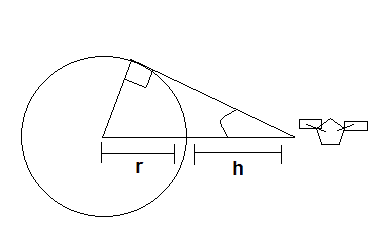
satellite.png


How/why is h changing as the angle changes? Does this imply the Earth is traveling in some direction or rotating? Or does it imply the satellite is changing is traveling in some direction...or rotating? It seems like the answer is implying that the satelite getting closer to the Earth as the angle changes? Why?
 
Physics news on Phys.org
nevermind, i reasoned it out...is it correct, i don't know, but it makes sense to me :)
 
θ is the angle on the right hand side of the triangle, at the vertex where the satellite is.
When h is smaller (satellite closer to the Earth), the angle θ must be larger. As h changes, θ must change as well. Draw the diagram with h larger or smaller and you will see that θ has changed with h.
 
Thanks, that's what I concluded. Appreciate your response.

Would you be able to lend some insight on this question:

https://www.physicsforums.com/showthread.php?t=582325

It's a classic ladder question from my calc book. But its still physics. I have the correct answer and understand the process of getting to the correct answer.

However, there seems to be no graphical representation of what is going on. I am interested to know how a question like this would be represented graphically.

Since I'm using trig functions, f(θ) = sin(θ) specifically, would I represent the function as a sin graph? And then the derivative would be the line tangent to the sin function at θ = 60?

The derivative of sinθ is cosθ, so the slope of the tan would be cos(60) = 1/2.

However, the actual derivative is 1/2 * 10 since the original function is sin60 = x/10 , so I actually have 10cos60 = 10*1/2 = 5 = Mtan

So the slope of the tangent of sin(θ) at θ = 60 is 1/2 , however, the function in the question is 10sinθ = f(θ) = x ...so is the graph f(θ) = sin(θ) = x or f(θ) = 10sin(θ) = x ...or neither?
 
The function is x = 10*sin(θ). You could graph x vs θ and find the slope at θ = 60 to visualize your solution dx/dθ = 10*cos θ = 5.
 

Similar threads

  • · Replies 4 ·
Replies
4
Views
2K
  • · Replies 6 ·
Replies
6
Views
3K
Replies
5
Views
3K
Replies
5
Views
3K
Replies
2
Views
4K
  • · Replies 2 ·
Replies
2
Views
3K
  • · Replies 4 ·
Replies
4
Views
3K
  • · Replies 2 ·
Replies
2
Views
5K
  • · Replies 2 ·
Replies
2
Views
1K
  • · Replies 1 ·
Replies
1
Views
2K