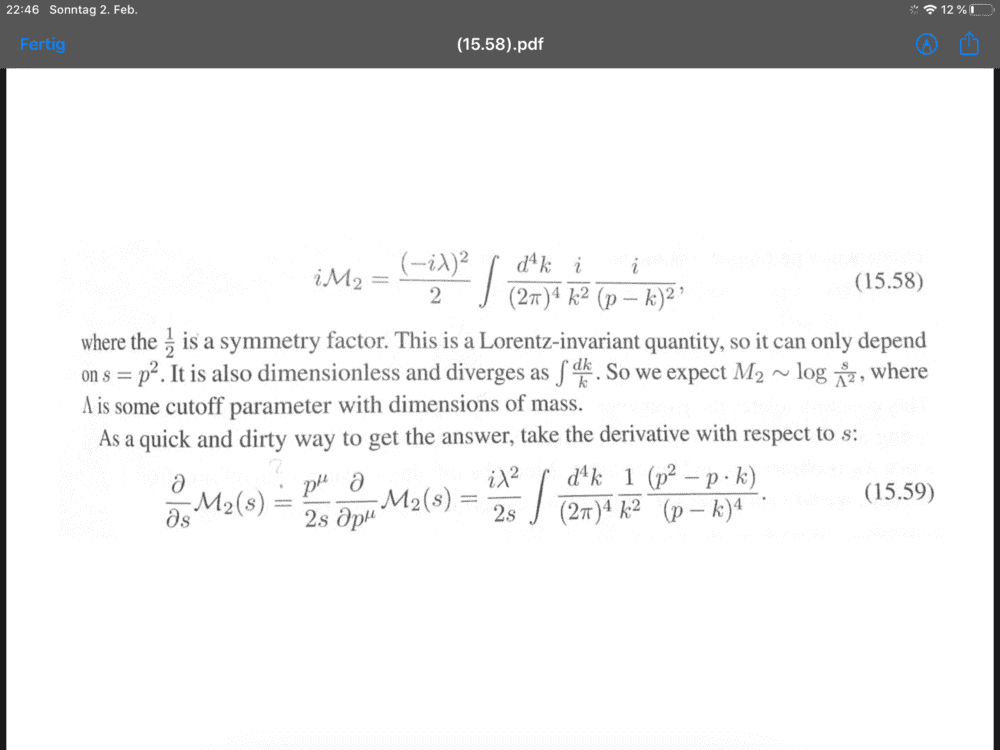
Schwartz QFT book, equation 15.59

  • Context: Undergrad 
  • Thread starter Thread starter Pnin
  • Start date Start date
  • Tags Tags
    Book Qft
Click For Summary

Discussion Overview

The discussion revolves around understanding a specific equation (15.59) from Schwartz's Quantum Field Theory book. Participants seek clarification on the steps involved in rewriting a derivative and an integral as presented in the text.

Discussion Character

  • Technical explanation
  • Debate/contested

Main Points Raised

  • One participant expresses confusion regarding the rewriting of the derivative and the integral in equation 15.59.
  • Another participant suggests that the confusion may stem from the derivative rewrite involving the relationship between the momentum and its squared form, leading to a specific expression for the derivative with respect to a variable s.
  • The explanation includes the use of the chain rule and the independence of variables k and p, indicating how the derivative operator can pass through the integral sign.
  • A later reply confirms that the explanation provided clarifies the initial confusion, indicating that the steps are now understood.

Areas of Agreement / Disagreement

Participants do not reach a consensus on the clarity of the original equation, but one participant expresses satisfaction with the explanation provided, suggesting some level of agreement on the understanding of the steps involved.

Contextual Notes

Some assumptions regarding the nature of the momentum vector and its properties are present, but these are not explicitly stated in the discussion. The discussion does not resolve all potential uncertainties regarding the mathematical steps involved.

Who May Find This Useful

Readers interested in advanced topics in quantum field theory, particularly those studying Schwartz's text and seeking clarification on specific equations and their derivations.
Pnin
Messages
20
Reaction score
1
Can someone please explain what the author does here in 15.59? I do not understand both steps. Neither the rewriting of the derivative, nor the integral.

0CC065C0-9702-47B5-B34E-24180FBF1BE0.png


thank you
 
Last edited:
Physics news on Phys.org
Attachment seems hard to open.
 
I pasted an image.
 
Pnin said:
Can someone please explain what the author does here in 15.59? I do not understand both steps. Neither the rewriting of the derivative, nor the integral.

View attachment 256512

thank you
I'm guessing the bit that's confusing you about the derivative rewrite involves the following:$$s ~=~ p^2 ~=~ p^\alpha p_\alpha ~,~~~~ \Rightarrow~~ p^\alpha = \hat p^\alpha \, s^ {1/2} ~,$$where the overhat denotes a unit vector. (This assumes ##p^\alpha## is not lightlike.) Then,$$\frac{\partial p^\alpha}{\partial s} ~=~ \frac{\partial s^ {1/2}}{\partial s} \; \hat p^\alpha ~=~ \frac{1}{ 2 s^ {1/2}}\; \hat p^\alpha ~=~ \frac{s^{1/2}}{ 2 s}\; \hat p^\alpha ~=~ \frac{p^\alpha}{2s} ~.$$
So, using the chain rule,$$\frac{\partial M}{\partial s} ~=~ \frac{\partial p^\mu}{\partial s} \; \frac{\partial M}{\partial p^\mu} ~=~ \frac{p^\alpha}{2s} \; \frac{\partial M}{\partial p^\mu} ~.$$
Next, the ##\partial/\partial p^\mu## operator passes through the integral sign (since the variables ##k## and ##p## are independent). Then it's just a matter of performing $$\frac{\partial}{\partial p^\mu} \; \frac{1}{(p - k)^2} $$which is merely an application of the usual quotient rule for derivatives. (Can you do that bit?)
 
  • Like
  • Informative
Likes   Reactions: vanhees71, mfb and Pnin
Fantastic! Crystal-clear now. Thanks strangerep, much appreciated!
 

Similar threads

  • · Replies 1 ·
Replies
1
Views
2K
  • · Replies 2 ·
Replies
2
Views
2K
  • · Replies 1 ·
Replies
1
Views
2K
  • · Replies 11 ·
Replies
11
Views
3K
  • · Replies 25 ·
Replies
25
Views
3K
  • · Replies 4 ·
Replies
4
Views
3K
  • · Replies 17 ·
Replies
17
Views
4K
  • · Replies 3 ·
Replies
3
Views
4K
  • · Replies 3 ·
Replies
3
Views
2K
  • · Replies 9 ·
Replies
9
Views
4K