Schwinger-Dyson equations derivation

  • Context: Undergrad 
  • Thread starter Thread starter simonjech
  • Start date Start date
  • Tags Tags
    Derivation
simonjech
Gold Member
Messages
12
Reaction score
5
This is the part of Schwinger-Dyson equations derivation. I did not understand how can we obtain the commutator in the last line of the picture. I understand why the delta functions appeared from Heaviside functions but there is no minus sign in any term so how can we get the commutator? Anticommutator would make more sence for me.
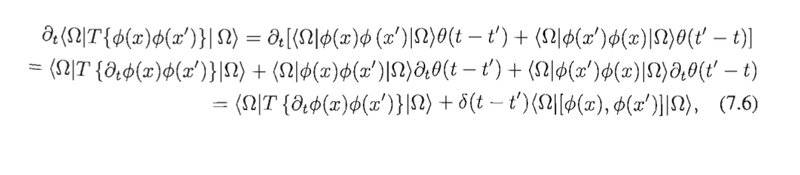
Screenshot_20230305_212957_Drive.jpg
 
Physics news on Phys.org
Write down ##\theta (-t)## in terms of ##\theta (t)##. Drawing the graph of ##\theta (-t)## helps.
 
Last edited:
  • Like
Likes   Reactions: vanhees71, simonjech and malawi_glenn
Or just use the chain rule for differentiation
 
  • Like
Likes   Reactions: vanhees71
I think that i figured it out. The problem was that I did not realized that
Screenshot_20230306_154107_Math Editor.jpg
.
 
  • Like
Likes   Reactions: vanhees71, malawi_glenn, julian and 1 other person

Similar threads

  • · Replies 12 ·
Replies
12
Views
2K
  • · Replies 1 ·
Replies
1
Views
2K
  • · Replies 1 ·
Replies
1
Views
2K
  • · Replies 1 ·
Replies
1
Views
2K
  • · Replies 1 ·
Replies
1
Views
2K
  • · Replies 39 ·
2
Replies
39
Views
5K
  • · Replies 39 ·
2
Replies
39
Views
6K
  • · Replies 12 ·
Replies
12
Views
3K
  • · Replies 2 ·
Replies
2
Views
4K
  • · Replies 8 ·
Replies
8
Views
2K