Schwinger-Dyson equations derivation

  • Level: Undergrad 
  • Thread starter simonjech
  • Start date
  • Tags Tags
    Derivation
3 replies · 2K views · last reply
simonjech
Gold Member
Messages
12
Reaction score
5
This is the part of Schwinger-Dyson equations derivation. I did not understand how can we obtain the commutator in the last line of the picture. I understand why the delta functions appeared from Heaviside functions but there is no minus sign in any term so how can we get the commutator? Anticommutator would make more sence for me.
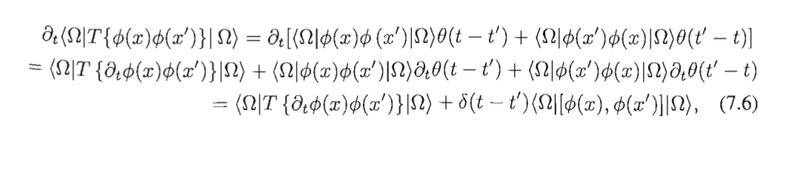
Equation (7.6): a three-line derivation of the time derivative of a time-ordered vacuum expectation value of phi(x)phi(x'), with theta functions and a delta function term giving a commutator.
 
Write down ##\theta (-t)## in terms of ##\theta (t)##. Drawing the graph of ##\theta (-t)## helps.
 
Last edited:
  • Like
Likes   Reactions: vanhees71, simonjech and malawi_glenn
I think that i figured it out. The problem was that I did not realized that
Equation: partial derivative with respect to x of theta(-x) equals negative delta(x), where theta is the Heaviside step function and delta is the Dirac delta.
.
 
  • Like
Likes   Reactions: vanhees71, malawi_glenn, julian and 1 other person