Science Project Help: Periodic Table Game with Modified Board and 48 Questions

  • Thread starter Thread starter actingbiz1
  • Start date Start date
  • Tags Tags
    Project
Click For Summary
SUMMARY

The discussion centers around a science project involving a periodic table game, where the user has modified an existing board and created 48 questions across four categories: Periodic Table, Chemical Bonds, Metals, and Chemical Symbols. The user successfully added 12 questions related to chemical symbols, providing answers for elements such as Copper (Cu), Neon (Ne), and Molybdenum (Mo). Feedback from other forum members commends the variety of questions and suggests incorporating additional queries about the properties or uses of elements to enhance the educational value of the game.

PREREQUISITES
  • Understanding of the periodic table and elemental symbols
  • Basic knowledge of chemical bonds and their types
  • Familiarity with metals and their properties
  • Experience in creating educational games or quizzes
NEXT STEPS
  • Research properties and uses of elements in the periodic table
  • Explore game design principles for educational purposes
  • Learn about different types of chemical bonds and their significance
  • Investigate additional categories for science-related quiz questions
USEFUL FOR

Students, educators, and game developers interested in creating engaging educational tools for teaching chemistry concepts.

actingbiz1
Messages
11
Reaction score
0
I have a science project. Its called the periodic table game.

I decided to use a board off the internet and modify it to fit the game. I need 48 questions.
I have 36. I have them in different categorys. I need 4 categorys.

You can view them in the doc file.

Can someone please help me with 12 more questions?

I have also provided the picture of the gameboard, before modification.
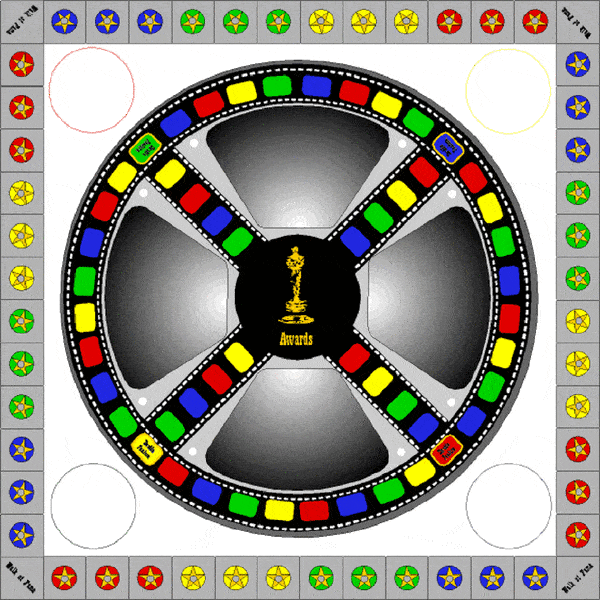
REEL.gif


Ok, I decided to have:

Periodic table
Chemical bonds
Metals
and
Chemical Symbols...

These are the last 12 questions i added:

Chemical Symbol

1. Cu
Answer: Copper

2. Ne
Answer: Neon

3. F
Answer: Flourine

4. Ir
Answer: Iridium

5. Ba
Answer: Barium

6. Arsenic
Answer: As

7. Nickel
Answer: Ni

8 Lithium
Answer: Li

9. Krypton
Answer: Kr

10. Silicon
Answer: Si

11. Sodium
Answer: Na

12. Molybdenum
Answer: Mo


can anyone give comments?
 

Attachments

Last edited:
Physics news on Phys.org


Great job on coming up with 12 more questions for your science project! It looks like you have a good mix of questions covering different categories such as chemical symbols, metals, and the periodic table. One suggestion I have is to maybe add some questions about the properties or uses of certain elements, as that would add an extra layer of knowledge to the game. Overall, it looks like you have a well-rounded and engaging project. Good luck!
 
The book claims the answer is that all the magnitudes are the same because "the gravitational force on the penguin is the same". I'm having trouble understanding this. I thought the buoyant force was equal to the weight of the fluid displaced. Weight depends on mass which depends on density. Therefore, due to the differing densities the buoyant force will be different in each case? Is this incorrect?

Similar threads

  • · Replies 2 ·
Replies
2
Views
2K
  • · Replies 4 ·
Replies
4
Views
4K
  • · Replies 10 ·
Replies
10
Views
2K
Replies
7
Views
4K
Replies
35
Views
10K
  • · Replies 4 ·
Replies
4
Views
4K
Replies
29
Views
5K
  • · Replies 7 ·
Replies
7
Views
5K
  • · Replies 67 ·
3
Replies
67
Views
15K
  • · Replies 1 ·
Replies
1
Views
3K