Second highest frequency in a sound pipe

Click For Summary
The discussion revolves around calculating the second highest frequency in a sound pipe, where participants clarify that the question likely intended to ask for the second lowest frequency instead. The correct formula used is 3c/(4L), but there is confusion regarding the values for the speed of sound (340 m/s) and the length of the pipe. Participants acknowledge the common linguistic confusion between "second highest" and "second lowest," noting that such terminology can lead to misunderstandings in physics problems. Ultimately, the calculations presented are deemed correct, but the phrasing of the question is criticized for its ambiguity. Clear communication in scientific contexts is essential to avoid such confusion.
Bolter
Messages
262
Reaction score
31
Homework Statement
See below
Relevant Equations
Speed = frequency x wavelength
So here is my question

Screenshot 2020-03-13 at 16.57.48.png

Screenshot 2020-03-13 at 16.57.52.png

Have tried it and got these as my answers

IMG_4089.JPG


Have I done part b) correctly over here to find the 2nd highest frequency?

Any help would be much appreciated! Thanks
 
Physics news on Phys.org
Bolter said:
Homework Statement:: See below
Relevant Equations:: Speed = frequency x wavelength

So here is my question

View attachment 258637
View attachment 258638
Have tried it and got these as my answers
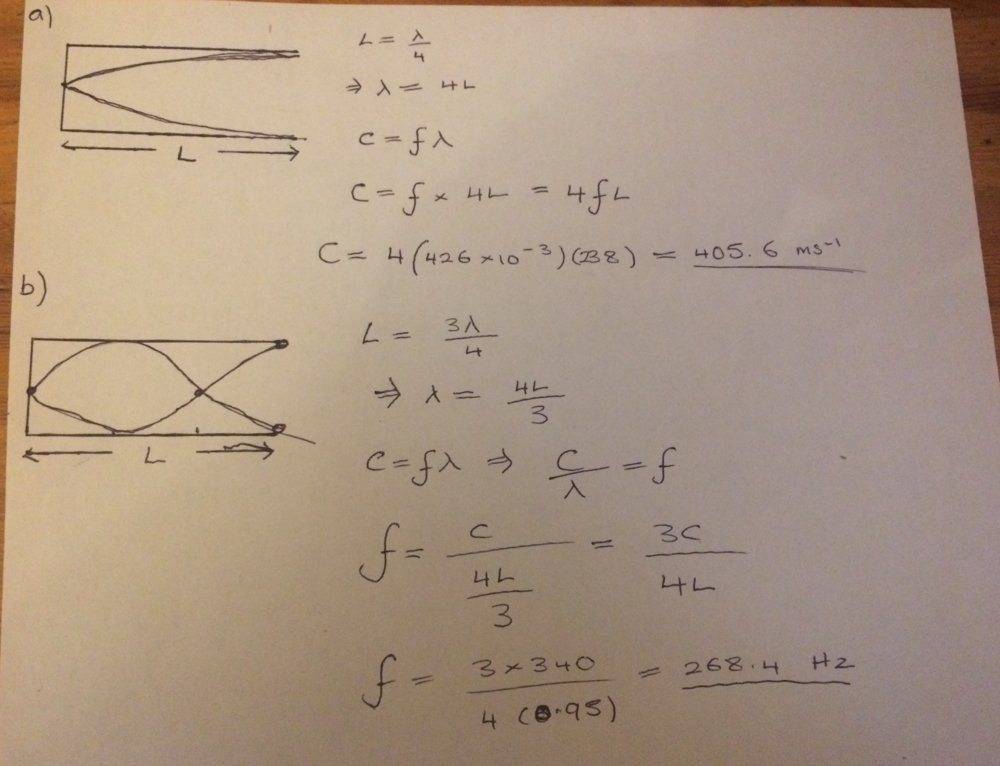
View attachment 258639

Have I done part b) correctly over here to find the 2nd highest frequency?

Any help would be much appreciated! Thanks
You were doing fine as far as 3c/(4L), but I don't understand the numbers you plugged in for c and L.

By the way, what you have (almost) calculated is the second lowest frequency, which is what the question should have asked for. There is no highest frequency.
 
haruspex said:
You were doing fine as far as 3c/(4L), but I don't understand the numbers you plugged in for c and L.

By the way, what you have (almost) calculated is the second lowest frequency, which is what the question should have asked for. There is no highest frequency.

Ah yes I see why the question should’ve meant second lowest frequency and not second highest

For the c and L values I have plugged in, these are just the speed of sound (which is 340 m/s) and length of the sound sound pipe in mm (I converted them back into meters to keep in SI units)
 
Bolter said:
For the c and L values I have plugged in, these are just the speed of sound (which is 340 m/s) and length of the sound sound pipe in mm (I converted them back into meters to keep in SI units)
Ah, sorry, I misread the question. I was looking at data in the first part.
Your answers are fine.
 
  • Like
Likes Bolter
Bolter said:
Ah yes I see why the question should’ve meant second lowest frequency and not second highest

I completely agree what second highest should mean, but I can’t help point out the screwy confusions of how people actually use language. In the common vernacular people will sometimes say “second highest” when they mean “second in height”, so the “third highest rung on the ladder” is understood to be counted from the bottom. Very poor choice for a physics problem, but not unusual for English.
 
  • Like
Likes Bolter
Cutter Ketch said:
“second highest” when they mean “second in height”
Hmm... I would use those interchangeably, both meaning second from the top.
 
The book claims the answer is that all the magnitudes are the same because "the gravitational force on the penguin is the same". I'm having trouble understanding this. I thought the buoyant force was equal to the weight of the fluid displaced. Weight depends on mass which depends on density. Therefore, due to the differing densities the buoyant force will be different in each case? Is this incorrect?

Similar threads

  • · Replies 23 ·
Replies
23
Views
3K
  • · Replies 8 ·
Replies
8
Views
2K
Replies
3
Views
2K
Replies
3
Views
1K
  • · Replies 4 ·
Replies
4
Views
3K
Replies
4
Views
2K
Replies
8
Views
1K
  • · Replies 7 ·
Replies
7
Views
2K
  • · Replies 33 ·
2
Replies
33
Views
3K