Second moment of inertia for a bent rectangle

Click For Summary

Discussion Overview

The discussion revolves around calculating the second moment of inertia for a complex beam cross-section consisting of bended sections. Participants are exploring the implications of geometry on deflection and moment calculations, with a focus on theoretical and practical aspects of beam analysis.

Discussion Character

  • Technical explanation
  • Debate/contested
  • Mathematical reasoning

Main Points Raised

  • One participant describes a beam cross-section with specific dimensions and requests assistance in calculating the second moment of inertia and deflection.
  • Multiple participants inquire about the axis of the second moment of inertia, with one specifying interest in Iyy, which is the moment about the vertical direction.
  • Concerns are raised regarding the clarity of the provided figures, questioning whether they represent a cross-section or a plan view, and the orientation of the axes.
  • One participant suggests that a three-dimensional representation may be necessary for a complete understanding of the problem, despite another asserting that the second moment of inertia depends solely on area.
  • Discussion includes the effect of loading in the negative y-direction on the beam's curvature and the relevance of the second moment perpendicular to the x-y plane, Izz.
  • A participant mentions analyzing deflection under uniform loading, comparing the current model to other beam profiles with similar cross-sectional areas.
  • Another participant suggests that the long z-dimension may indicate a plate bending problem rather than a beam problem, leading to a potential shift in analysis approach.

Areas of Agreement / Disagreement

Participants express differing views on the necessity of a three-dimensional presentation and the implications of the loading direction on the analysis. There is no consensus on the best approach to calculate the second moment of inertia or the nature of the problem (beam vs. plate bending).

Contextual Notes

Participants have not reached an agreement on the definitions or methods to apply for calculating the second moment of inertia, and there are unresolved questions regarding the geometry and loading conditions of the beam.

Ole Forsell
Messages
10
Reaction score
0
Hello.
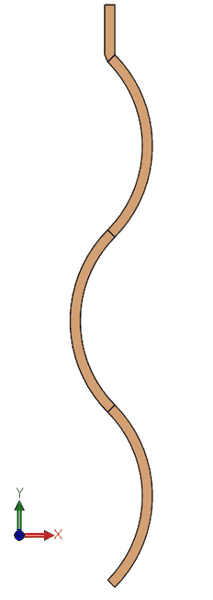
I am currently working with a beam with the following cross-section:
upload_2017-3-20_8-47-17.png

It consist of three bended sections with the following parameters, alpha = 90 degrees, Thickness = 4 mm, Radius = 50.59 mm.
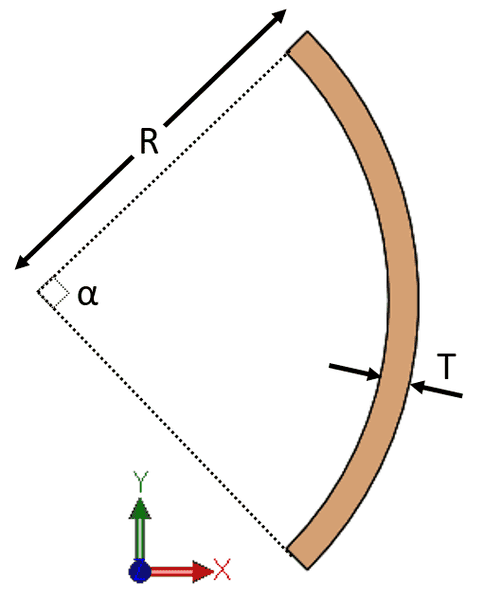
upload_2017-3-20_8-50-9.png

The top section consist of a small triangle and a rectangle. the triangle have a width = 4 mm and height = 2.81 mm. The rectangle have width = 4 mm and height = 19.60 mm.

The area of the profile is given by the following equation, and should be approximately 1000 mm2:

upload_2017-3-20_9-6-35.png


I need to find the deflection of this beam, and thereby the second moment of inertia. I have already found this to be 4273323.41 mm4 in Section Properties in Solidworks, but this need to be substantiated by hand calculations. Does anybody know how to calculate the second moment of inertia for such a geometry?Ole
 
Last edited:
Engineering news on Phys.org
You want the second moment with respect to what axis?

Which ever axis it is, just apply the definition and carry out the integration.
 
Dr.D said:
You want the second moment with respect to what axis?

Which ever axis it is, just apply the definition and carry out the integration.

Thank you for answering. I would like to find Iyy, which in this case mean in vertical direction.
Which definition do you mean?
 
Your figure is unclear. Is the sinuous figure at the top truly a cross section, or is it a plan view? Where is the y-axis in that view? Which way is the loading applied?

You need a three dimensional presentation of your problem to make clear what the situation really is.
There are definitions online and elsewhere for the second moment of an area expressed in terms of integration.
 
Dr.D said:
Your figure is unclear. Is the sinuous figure at the top truly a cross section, or is it a plan view? Where is the y-axis in that view? Which way is the loading applied?

You need a three dimensional presentation of your problem to make clear what the situation really is.
There are definitions online and elsewhere for the second moment of an area expressed in terms of integration.

Both figures are captured from the front plane, but shows the cross-section of the model. The x and y-axis is shown in both figures, and y is in vertical direction. The loading is applied in negative y-direction.

I have the 3D model, and can extract all information from SolidWorks, but these values need to be substantiated by calculations. But the second (area) moment of inertia only depends on the area, why would I need a 3D presentation?

Do you have any links, or formulas I can use to solve the problem?
 
If the load is applied in the negative y direction as you say, this will tend to straighten the "crooked stick." This straightening action will involve bending (actually reducing the radius of curvature) in each of the arcs. Bending of this sort depends upon the second moment perpendicular to the x-y plane, Izz. You have not shown us what that section looks like.
 
Dr.D said:
If the load is applied in the negative y direction as you say, this will tend to straighten the "crooked stick." This straightening action will involve bending (actually reducing the radius of curvature) in each of the arcs. Bending of this sort depends upon the second moment perpendicular to the x-y plane, Izz. You have not shown us what that section looks like.

The model shown in the figure is extruded 11 meters in the z-direction. In perspective, the height of the beam in y-direction is approximately 220 mm. So it is very long compared to the cross-section. I think I might have been a little unclear in the problem desciption. I want to analyse the deflection when the beam is fixed in both ends, and subjected to a uniform load which represents its own weight

I've been looking into a few other beam profiles, i.e, hollow tube, hollow triangle and T-profile, all with approximately the same cross-section area and the same length in z-direction. Assuming the same coordinate system as for this model, the deflection off the beam could be decided by only looking at Iyy for all these other beams. Why would it be any different for this model?
 
With the z dimension at 11 m, it sounds like a plate bending problem, not a beam problem.

However, I seem to be unable to communicate with you clearly, so I'm going to drop out and let someone else try.
 

Similar threads

  • · Replies 11 ·
Replies
11
Views
3K
  • · Replies 12 ·
Replies
12
Views
3K
  • · Replies 7 ·
Replies
7
Views
3K
  • · Replies 4 ·
Replies
4
Views
5K
  • · Replies 1 ·
Replies
1
Views
1K
Replies
3
Views
2K
  • · Replies 2 ·
Replies
2
Views
8K
  • · Replies 5 ·
Replies
5
Views
4K
  • · Replies 1 ·
Replies
1
Views
6K
Replies
5
Views
26K