Area moment of inertia calculation without standard formula

Click For Summary

Discussion Overview

The discussion revolves around the calculation of the area moment of inertia (M.I.) of a rectangle without using the standard formula. Participants explore experimental methods, the concept of integration, and the relationship between the number of strips used in the calculation and the accuracy of the results.

Discussion Character

  • Exploratory
  • Technical explanation
  • Mathematical reasoning

Main Points Raised

  • One participant describes a method for calculating M.I. by dividing a rectangle into strips and measuring areas and distances to the center of gravity.
  • Another participant notes that increasing the number of strips improves the accuracy of the M.I. calculation, suggesting that finer divisions reduce error.
  • A later reply explains that integration involves slicing an area into infinitely thin strips and summing their contributions to approach the true value.
  • Participants discuss the historical context of integration and how it relates to approximating areas using upper and lower bounds.
  • One participant expresses a desire for a deeper understanding of how integration works in this context.
  • Another participant provides a mathematical expression for calculating M.I. using integration, indicating that more divisions lead to a more accurate result.

Areas of Agreement / Disagreement

Participants generally agree on the principle that finer divisions yield more accurate results, but there is no consensus on the deeper understanding of integration or its application in this specific context.

Contextual Notes

Some participants express uncertainty about the mathematical concepts involved, particularly integration, and how it applies to their experimental findings. There are also references to historical proofs that may not be fully explored in the discussion.

k.udhay
Messages
167
Reaction score
13
Hi,

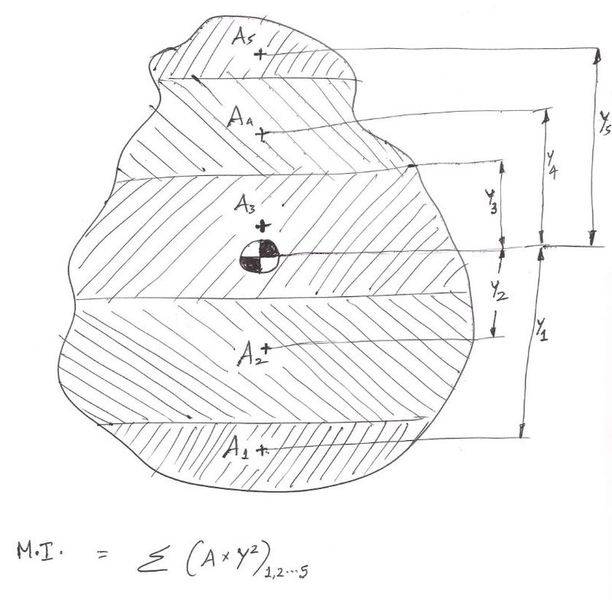
I read in a textbook that area Moment of Inertia (M.I.) of any shape would be Ʃ of (y2 χ A)1,2...n where,
A represents the Area of strip no. 1, 2... n
y is the distance between globlal centre of gravity (C.G.) of the shape to th local C.G. of strip no. 1, 2... n
(pl. look at the image)
f6OOWBn.jpg


Though I remember the formula for finding M.I. of a rectangle is [bd3/12] where b and d are breadth and depth of the rectangle, I tried doing it experimentally.

That is:
1. I Drew a rectangle.
2. Split it into 4 equal strips.
3. Measured area and the distance between local and global C.G.s.
4. Did Ʃ of (y2χA)1,2,3 and 4.

I didn't get the value equal to the one done using standard formula. Surprisingly, when I did the same exercise but with splitting the rectangle into 8 equal parts, I got a different answer. But this answer went closer to the M.I. by standard formula.

Now, when I try to find the reason myself, I see that the standard formula has been derived using integration. Since, I am pretty bad in math, can somebody pl. explain me the concept of integration with this example? This will help me to understand when to use integration as well. Many thanks in advance!
 
Engineering news on Phys.org
hi k.udhay! :smile:
k.udhay said:
… Surprisingly, when I did the same exercise but with splitting the rectangle into 8 equal parts, I got a different answer. But this answer went closer to the M.I. by standard formula.

Now, when I try to find the reason myself, I see that the standard formula has been derived using integration. Since, I am pretty bad in math, can somebody pl. explain me the concept of integration with this example? This will help me to understand when to use integration as well. Many thanks in advance!

integration cuts the area into slices

we then pretend that each slice is a perfect rectangle, and we add the moments of inertia for each slice

the more finely we cut the slices, the lower the error is (eg 8 slices is better than 4 :wink:)

if we cut it "infinitely" fine, the error tends to zero …

that's integration! :smile:
 
Hi Tim. Thanks for the reply. I understood that the thinner we split it, more accurate the results are. But I want to know how integration does this... I don't know how to put in words. How is integration cutting the rectangle into more thinly strips? Thanks.
 
hi k.udhay! :smile:

a completely rigorous proof was known to the ancient greeks …

you slice it into n strips,

then you draw the largest rectangle that just fits inside each strip, and the smallest rectangle that just fits outside

you add up the values for all the inside rectangles, call that sum an

and you add up the values for all the outside rectangles, call that sum An

obviously the value for the original irregular area is always between an and An

the difference (An - an) obviously tends to 0 as n tends to infinity, so both An and an tend to the same value, A …

so that value, A, must be the value for the original area :wink:
 
Thanks, Tim. I think I will take some more time to completely understand the concept of integration. Though, your explanation has given me a direction to think on. Thanks again!:thumbs:
 
Area moment of inertia calc...

MOI can be calculated as ∫y[square]dA...
If we wish to calculate it with respect to horizontal axis of symmetry x...than we need to divide it into infintesimal elements as you were doing...more the divisions, better the solution,less is the error involved...

As per the attachment the infintesimal strip area can be calculated as (b.dy)..
substituting it we get...
I = 2∫y[square] [b.dy]... [limits from 0 to h/2]

solving this you get what you intended to ...
b[d][/3]/12
 

Attachments

  • Area moment of Iner.jpg
    Area moment of Iner.jpg
    6 KB · Views: 666

Similar threads

  • · Replies 4 ·
Replies
4
Views
3K
  • · Replies 11 ·
Replies
11
Views
3K
  • · Replies 6 ·
Replies
6
Views
3K
  • · Replies 7 ·
Replies
7
Views
3K
  • · Replies 3 ·
Replies
3
Views
4K
Replies
25
Views
2K
  • · Replies 5 ·
Replies
5
Views
4K
  • · Replies 3 ·
Replies
3
Views
7K
Replies
13
Views
3K
  • · Replies 13 ·
Replies
13
Views
3K