Separable Polynomials - Paul E Bland's definition and exampl

Click For Summary
SUMMARY

Paul E. Bland defines a separable polynomial in his book "The Basics of Abstract Algebra" as an irreducible polynomial that has distinct roots in its splitting field. The polynomial example given, ##f(x) = (x^2 + 2)^2 (x^2 - 3)##, is of degree 6 but does not have 6 distinct roots, leading to confusion regarding its irreducibility. The discussion highlights that in fields with nonzero characteristic, such as ##\mathbb{Z}_2##, the polynomial ##x^2 + 1## serves as an example of a polynomial with a repeated root, demonstrating the nuances of separability in different field characteristics.

PREREQUISITES
  • Understanding of polynomial definitions and properties in abstract algebra.
  • Familiarity with field theory, particularly splitting fields.
  • Knowledge of irreducible polynomials and their characteristics.
  • Basic concepts of field characteristics, including zero and nonzero characteristics.
NEXT STEPS
  • Study the concept of splitting fields in detail, focusing on examples in both zero and nonzero characteristic fields.
  • Explore the properties of irreducible polynomials and their role in field extensions.
  • Investigate the implications of polynomial separability in various algebraic structures.
  • Examine additional examples of polynomials with repeated roots in fields of nonzero characteristic.
USEFUL FOR

Students and researchers in abstract algebra, particularly those focusing on field theory and polynomial properties, will benefit from this discussion. It is also valuable for educators seeking to clarify the concept of separable polynomials in their curriculum.

Math Amateur
Gold Member
MHB
Messages
3,920
Reaction score
48
I am reading Paul E Bland's book: The Basics of Abstract Algebra and I am trying to understand his definition of "separable polynomial" and his second example ...

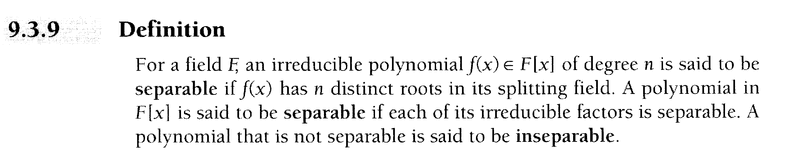
Bland defines a separable polynomial as follows:
?temp_hash=3fe8cdf2beb62400e3e56319cd158346.png

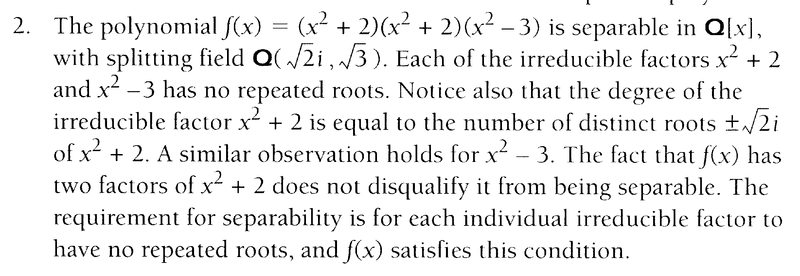
... and Bland's second example is as follows:
?temp_hash=3fe8cdf2beb62400e3e56319cd158346.png


I am uncomfortable with, and do not fully understand the above definition and am uncomfortable with the example as well ... I hope someone can clarify my difficulties and problems ...

The first and second sentences of the definition above seem to lead to different notions of separability to me ...

The first sentence of the definition:

" ... ... For a field ##F##, an irreducible polynomial ##f(x) \in F[x]## of degree ##n## is said to be separable if ##f(x)## has ##n## distinct roots in its splitting field ... ... "

Under this definition of a separable polynomial, the polynomial in Bland's example:

##f(x) = (x^2 + 2)^2 (x^2 - 3)##

is of degree ##n = 6## and splits in (among other fields) in ##\mathbb{C}## and does NOT have ##6## distinct roots (as the roots ##\pm \sqrt{2} i## are repeated) ... ...(EDIT ... hmm ... last minute thought! ... but i guess you could argue that ##f(x)## is not irreducible ... is that the key to my confusion ...?)... BUT ...The second sentence of Bland's definition reads:

" ... ... A polynomial in ##F[x]## is said to be separable if each of its irreducible factors is separable if each of its irreducible factors is separable ... "

Well ... under this definition I (uncomfortably) go along with Bland's analysis of

##f(x) = (x^2 + 2) (x^2 + 2) (x^2 - 3)##

in his example ...BUT i remain uncomfortable with this ... I cannot think of an example of a case where this definition gives rise to a repeated root ...can someone please give a simple example of a polynomial with a repeated root under Bland's definition ...
Help will be much appreciated ...

Peter
 

Attachments

  • Bland - Definition of a Separable Polynomial ....png
    Bland - Definition of a Separable Polynomial ....png
    13.4 KB · Views: 951
  • Bland - Example of a Separable Polynomial ....png
    Bland - Example of a Separable Polynomial ....png
    28 KB · Views: 954
Physics news on Phys.org
Math Amateur said:
I cannot think of an example of a case where this definition gives rise to a repeated root ...can someone please give a simple example of a polynomial with a repeated root under Bland's definition ...
That's because they are not easy to find.

If the field has zero characteristic, all irreducible polynomials have distinct roots in the splitting field.

But that is not the case for fields with nonzero characteristic. An example is the polynomial ##x^2+1## over the field ##\mathbb Z_2##. The splitting field is ##\mathbb Z_2+i\mathbb Z_2##, and the root ##i## has multiplicity two.

There's more detail here.
 
  • Like
Likes   Reactions: Math Amateur
Math Amateur said:
I am uncomfortable with, and do not fully understand the above definition and am uncomfortable with the example as well ... I hope someone can clarify my difficulties and problems ...
Me too. I wonder why he needs separability in such a broad sense, will say for reducible polynomials as well as for irreducible. Maybe it makes further considerations easier. But he is consistent with this definition as he requires all irreducible parts to be separable which is the point that counts. It counts because the whole theory is about field extensions, and for them irreducibility is important. Composed polynomials can be factored and field extensions therefore reduced to steps in which each is with an irreducible polynomial. In the example above we have the two possible towers: ##\mathbb{Q} \subseteq \mathbb{Q}(\sqrt{2}i) \subseteq \mathbb{Q}(\sqrt{2}i,\sqrt{3})## and ##\mathbb{Q} \subseteq \mathbb{Q}(\sqrt{3}) \subseteq \mathbb{Q}(\sqrt{2}i,\sqrt{3})##. So that's why I'm a bit confused, too. I cannot see the need for his definition.

But it isn't easy to find an inseparable field extension anyway.

In the characteristic ##0## case, all irreducible polynomials are separable. And with his definition: all polynomials are separable.

In the characteristic ##p## case, a field extension is perfect (= all elements are separable) if and only if the field contains to each element also its ##p-##th root.

That narrows the inseparable cases a lot. So the main problem for you is probably to keep the definitions in the various books apart and not so much the definition itself. What counts are the irreducible polynomials and I guess that other authors simply don't define separability for reducible polynomials. Apparently Bland does. So what? Btw. that was my first thought as I read his definition: What about the doubles in the reducible case? I had expected that he would have ruled them out and was surprised he didn't. Good that he gave this example to destroy any doubts how he means it. So as a summary: separable is if all irreducible factors are separable, regardless how often they occur.
 
  • Like
Likes   Reactions: Math Amateur
Thanks for the help Andrew, fresh_42 ...

Reflecting on what you have said ...

Peter
 
andrewkirk said:
That's because they are not easy to find.

If the field has zero characteristic, all irreducible polynomials have distinct roots in the splitting field.

But that is not the case for fields with nonzero characteristic. An example is the polynomial ##x^2+1## over the field ##\mathbb Z_2##. The splitting field is ##\mathbb Z_2+i\mathbb Z_2##, and the root ##i## has multiplicity two.

There's more detail here.
Thanks Andrew ... appreciate the help ...

But just clarifying your example ...

If ##i## is a root of ##f(x)## with multiplicity ##2## then

##f(x) = (x -i ) ( x - i ) = x^2 - 2xi - 1 = x^2 - 1## ...Did you mean ##f(x) = x^2 - 1## ... or have I made an error ...PeterEDIT ... oh ... I think that in ##\mathbb{F}_2## we have ##-1 \equiv 1## ...

... so ... ##x^2 - 1 \equiv x^2 + 1## ... is that right?
 
Math Amateur said:
... so ... ##x^2 - 1 \equiv x^2 + 1## ... is that right?
Yes, that's right.
 
andrewkirk said:
That's because they are not easy to find.

If the field has zero characteristic, all irreducible polynomials have distinct roots in the splitting field.

But that is not the case for fields with nonzero characteristic. An example is the polynomial ##x^2+1## over the field ##\mathbb Z_2##. The splitting field is ##\mathbb Z_2+i\mathbb Z_2##, and the root ##i## has multiplicity two.

There's more detail here.
Hi Andrew ...

Just another clarification ...

You write:

" ... ... An example is the polynomial ##x^2+1## over the field ##\mathbb Z_2##. The splitting field is ##\mathbb Z_2+i\mathbb Z_2##, and the root ##i## has multiplicity two. ... "

Given that the roots of the polynomial ##x^2+1## over the field ##\mathbb Z_2## are ##i## of multiplicity ##2## isn't the splitting field just ##i\mathbb Z_2##?

Peter

EDIT ... now I realize that I'm a bit unsure how to determine a splitting field ..
 
Math Amateur said:
You write:

" ... ... An example is the polynomial ##x^2+1## over the field ##\mathbb Z_2##. The splitting field is ##\mathbb Z_2+i\mathbb Z_2##, and the root ##i## has multiplicity two. ... "

Given that the roots of the polynomial ##x^2+1## over the field ##\mathbb Z_2## are ##i## of multiplicity ##2## isn't the splitting field just ##i\mathbb Z_2##?
The splitting field is the smallest field containing ##\mathbb Z_2## and the roots of the polynomial, ie containing ##\mathbb Z_2\cup\{i\}##. That field is ##\mathbb Z_2(i)##.

##i\mathbb Z_2## is not a field, as it's not closed under multiplication, so it can't be the splitting field. But the splitting field is the field generated by ##i\mathbb Z_2##.
 
  • Like
Likes   Reactions: Math Amateur
andrewkirk said:
The splitting field is the smallest field containing ##\mathbb Z_2## and the roots of the polynomial, ie containing ##\mathbb Z_2\cup\{i\}##. That field is ##\mathbb Z_2(i)##.

##i\mathbb Z_2## is not a field, as it's not closed under multiplication, so it can't be the splitting field. But the splitting field is the field generated by ##i\mathbb Z_2##.
Thanks Andrew ... that certainly clarified that issue ...

Thanks for all your help and support with the above series of posts ..

Peter
 

Similar threads

  • · Replies 6 ·
Replies
6
Views
5K
Replies
48
Views
5K
  • · Replies 10 ·
Replies
10
Views
3K
Replies
1
Views
2K
  • · Replies 0 ·
Replies
0
Views
2K
Replies
3
Views
1K
Replies
1
Views
1K
  • · Replies 1 ·
Replies
1
Views
2K
  • · Replies 3 ·
Replies
3
Views
2K
  • · Replies 6 ·
Replies
6
Views
3K