Splitting Fields and Separable Polynomials ....

Click For Summary

Discussion Overview

The discussion revolves around the definitions and interpretations of separable polynomials as presented in different algebra textbooks, specifically comparing the definitions given by David S. Dummit and Richard M. Foote (D&F) with those by Paul E. Bland. Participants explore the implications of these definitions, particularly in the context of irreducibility and the presence of multiple roots, as well as the concept of separability over different fields.

Discussion Character

  • Debate/contested
  • Technical explanation
  • Conceptual clarification

Main Points Raised

  • Some participants note that D&F defines a separable polynomial as one that has no multiple roots, while Bland requires irreducibility and the absence of non-distinct roots.
  • There is a question about the significance of the differences in definitions between D&F and Bland, particularly regarding whether one definition is more commonly accepted than the other.
  • Participants discuss specific examples, such as the polynomial ##f(x) = (x^2 + 2)^2 (x^2 - 3)##, where Bland finds it separable, while D&F's analysis would suggest it is inseparable.
  • There is curiosity about the term "over" in the context of separable polynomials, with participants seeking clarification on how separability can vary depending on the field.
  • One participant references Zariski and Samuel's definition, which aligns with Bland's approach, emphasizing the distinction between irreducible and general cases of separability.
  • Another participant introduces van der Waerden's definitions, discussing normal and separable extensions and the historical context of these terms.

Areas of Agreement / Disagreement

Participants express differing views on the definitions of separable polynomials and their implications, indicating that there is no consensus on which definition is more standard or preferable. The discussion remains unresolved regarding the significance of these differences.

Contextual Notes

Participants highlight the potential limitations in definitions, such as the dependence on irreducibility and the implications of multiple roots, but do not resolve these issues. The discussion also touches on the historical evolution of terminology in the field.

Math Amateur
Gold Member
MHB
Messages
3,920
Reaction score
48
I am reading both David S. Dummit and Richard M. Foote : Abstract Algebra and Paul E. Bland's book: The Basics of Abstract Algebra ... ...

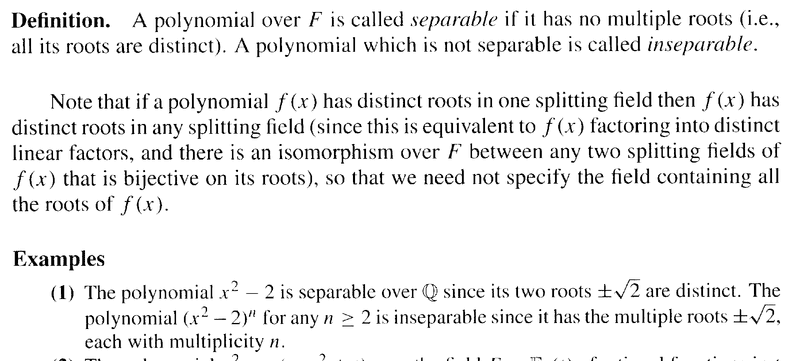
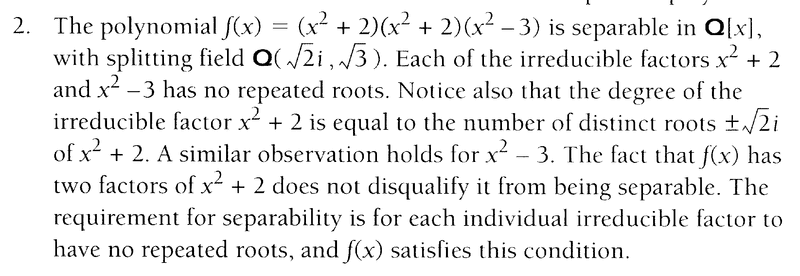
I am trying to understand separable polynomials ... ... but D&F and Bland seem to define them slightly differently and interpret the application of the definitions differently in examples ... I need help to understand why these things appear different and what the significance and implications of the differences are ...D&F define separable polynomial ... and give an example as follows:
?temp_hash=fa2f76956f2b960bd41ad6e66b9bb839.png

?temp_hash=fa2f76956f2b960bd41ad6e66b9bb839.png

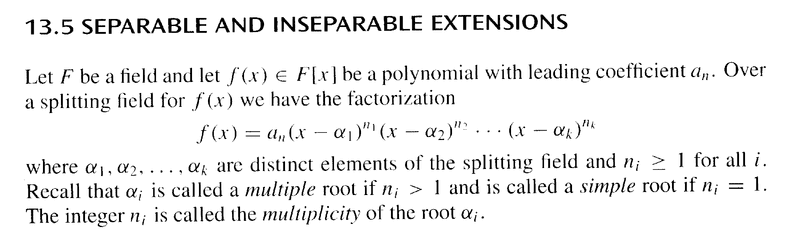
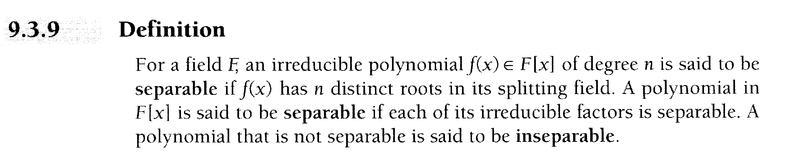
Bland defines separable polynomials as follows ... and also gives an example ...
?temp_hash=fa2f76956f2b960bd41ad6e66b9bb839.png

?temp_hash=fa2f76956f2b960bd41ad6e66b9bb839.png


My questions are as follows:Question 1 Now ... for Bland, to qualify to be a separable polynomial, a polynomial must be irreducible ... and then it must have no non-distinct roots ...

For D&F any polynomial that has no multiple roots is separable ...Is this difference in definitions significant?

Which is the more usual definition?
Question 2In D&F in Example 1 we are given a polynomial ##f(x) = x^2 - 2## as an example of a separable polynomial ...

... and ... D&F also as us to consider ##(x^2 - 2)^n## for ##n \ge 2## as inseparable as it has repeated or multiple roots ##\pm \sqrt{2}## ...

... a particular case would be ##(x^2 - 2)^2## and a similar analysis would mean ##(x^2 + 2)^2## would also be inseparable ...BUT ...

Bland analyses the polynomial ##f(x) = (x^2 + 2)^2 ( x^2 - 3)## and comes to the conclusion that ##f## is separable ... when I think that D&Fs analysis would have found the polynomial to be inseparable ...

Can someone explain and reconcile the differences in D&F and Bland's approaches and solutions ... ...

Question 3In D&F Example 1 we read ...

" ... ... The polynomial ##x^2 - 2## is separable over ##\mathbb{Q}## ... ... "I am curious and somewhat puzzled and perplexed about how the term "over" applies to a separable polynomial ... both D&F and Bland define separability in terms of distinct or non-multiple roots ... they do not really define separability OVER something ...

Can someone explain how "over" comes into the definition and how a polynomial can be separable over one field but not separable over another ... ?

Hope that someone can help ...

Peter
 

Attachments

  • D&F - PART 1 - Definition of Separable Polynomial and Example - PART 1  ... ....png
    D&F - PART 1 - Definition of Separable Polynomial and Example - PART 1 ... ....png
    19.1 KB · Views: 635
  • D&F - Definition of Separable Polynomial and Example ... ....png
    D&F - Definition of Separable Polynomial and Example ... ....png
    31.4 KB · Views: 821
  • Bland - Definition of a Separable Polynomial ....png
    Bland - Definition of a Separable Polynomial ....png
    13.4 KB · Views: 856
  • Bland - Example of a Separable Polynomial ....png
    Bland - Example of a Separable Polynomial ....png
    28 KB · Views: 789
Physics news on Phys.org
i am not an expert, but i think that the key definition is of a separable irreducible polynomial, where both definitions agree. i.e. i think the main point is to define a separable extension, which only uses the concept of a separable minimal (hence irreducible) polynomial. i may be wrong, but i would bet on this version.

I have just looked it up in zariski samuel where they define separable to be distinct roots in the irreducible case, and in thje general case to be that all irreducible factors are separable. they are definitely authoritative to me at least. this seems to be bland's definition. but note that it does not give any different version of the theory of separable field extensions. i hope. check that out.
 
  • Like
Likes   Reactions: Math Amateur
mathwonk said:
i am not an expert, but i think that the key definition is of a separable irreducible polynomial, where both definitions agree. i.e. i think the main point is to define a separable extension, which only uses the concept of a separable minimal (hence irreducible) polynomial. i may be wrong, but i would bet on this version.

I have just looked it up in zariski samuel where they define separable to be distinct roots in the irreducible case, and in thje general case to be that all irreducible factors are separable. they are definitely authoritative to me at least. this seems to be bland's definition. but note that it does not give any different version of the theory of separable field extensions. i hope. check that out.
Thanks mathwonk ... given that you have outlined a very likely resolution of the issue, I will keep your ideas in mind and read onward ...

Thanks again for your help and support...

Peter
 
thanks Peter. Note that this definition allows one to say that any spliting field of a separable polynomial is a normal and separable extension, i.e. Galois, in most people's terminology. although be careful to check since I think some people just call these normal.
 
  • Like
Likes   Reactions: Math Amateur
Here's van der Waerden's definition which I have learnt:

##K \subseteq L## is a normal field extension (## \Leftrightarrow L ## is a Galois extension of ##K##), iff ##L## is algebraic over ##K## and each irreducible polynomial ##f(x) \in K[x]## that has one zero in ##L##, i.e. ##g(\alpha) = 0## for an element ##\alpha \in L##, completely splits into linear factors in ##L[x]##. For short:
##K \subseteq L## is normal ##=## ##K \subseteq L## is Galois ##=## algebraic ##+## one zero in ##L## implies all zeros in ##L##.

An element ##\alpha## which is a zero of an irreducible polynomial ##f(x) \in K[x]##, i.e ##f(\alpha)=0##, is called separable element with respect to ##K##, if ##f(x)## has only separated (simple) zeros. This means in a splitting field for ##f(x)## all factors are linear, that is ##(x-\beta)^2## or higher powers must not occur as factors. The irreducible polynomial ##f(x)## is also called separable polynomial, if all its zeros are separable. Elements that are not separable are called inseparable and likewise the polynomial.

Now an extension ##K \subseteq L## is called separable extension with respect to ##K##, if it is algebraic and all elements of ##L## are separable with respect to ##K##.
Otherwise the extension is called inseparable.

A field ##K## is called perfect, if all irreducible polynomials in ##K[x]## are separable.

All fields of characteristic ##0## are perfect.

As a historic side note, van der Waerden mentions, that Steinitz originally called separable elements, polynomials and field extensions as "of first kind" and the others, the inseparable "of second kind". He (van der Waerden) further says: "... I suggest to call it separable as this is more illustrating because all zeros are separated."
 
  • Like
Likes   Reactions: Math Amateur
mathwonk said:
thanks Peter. Note that this definition allows one to say that any spliting field of a separable polynomial is a normal and separable extension, i.e. Galois, in most people's terminology. although be careful to check since I think some people just call these normal.

Thanks again ... yes, will carefully check ...

Peter
 
fresh_42 said:
Here's van der Waerden's definition which I have learnt:

##K \subseteq L## is a normal field extension (## \Leftrightarrow L ## is a Galois extension of ##K##), iff ##L## is algebraic over ##K## and each irreducible polynomial ##f(x) \in K[x]## that has one zero in ##L##, i.e. ##g(\alpha) = 0## for an element ##\alpha \in L##, completely splits into linear factors in ##L[x]##. For short:
##K \subseteq L## is normal ##=## ##K \subseteq L## is Galois ##=## algebraic ##+## one zero in ##L## implies all zeros in ##L##.

An element ##\alpha## which is a zero of an irreducible polynomial ##f(x) \in K[x]##, i.e ##f(\alpha)=0##, is called separable element with respect to ##K##, if ##f(x)## has only separated (simple) zeros. This means in a splitting field for ##f(x)## all factors are linear, that is ##(x-\beta)^2## or higher powers must not occur as factors. The irreducible polynomial ##f(x)## is also called separable polynomial, if all its zeros are separable. Elements that are not separable are called inseparable and likewise the polynomial.

Now an extension ##K \subseteq L## is called separable extension with respect to ##K##, if it is algebraic and all elements of ##L## are separable with respect to ##K##.
Otherwise the extension is called inseparable.

A field ##K## is called perfect, if all irreducible polynomials in ##K[x]## are separable.

All fields of characteristic ##0## are perfect.

As a historic side note, van der Waerden mentions, that Steinitz originally called separable elements, polynomials and field extensions as "of first kind" and the others, the inseparable "of second kind". He (van der Waerden) further says: "... I suggest to call it separable as this is more illustrating because all zeros are separated."
Thanks fresh_42 ... that clarifies the issue considerably...

Peter
 

Similar threads

  • · Replies 8 ·
Replies
8
Views
4K
  • · Replies 0 ·
Replies
0
Views
3K
Replies
1
Views
2K
  • · Replies 10 ·
Replies
10
Views
3K
  • · Replies 8 ·
Replies
8
Views
2K
  • · Replies 5 ·
Replies
5
Views
3K
  • · Replies 1 ·
Replies
1
Views
2K
  • · Replies 9 ·
Replies
9
Views
2K
  • · Replies 1 ·
Replies
1
Views
2K
  • · Replies 1 ·
Replies
1
Views
3K