Series capacitance added to parallel resonant tank changing the resonant freq?

Click For Summary
SUMMARY

The discussion focuses on the effects of adding a series capacitor (C2) to a parallel resonant tank circuit. It is established that while the parallel resonant frequency remains unchanged, a new series resonance occurs at a lower frequency. In the simulation conducted, with both capacitors at 64 pF and an inductor of 16 µH, the parallel resonance was observed at 5 MHz and the series resonance at 3.5 MHz. The presence of a diode (D1) in the circuit causes C2 to charge and reverse bias the diode, resulting in minimal output.

PREREQUISITES
  • Understanding of parallel tank circuits and resonance
  • Knowledge of capacitor and inductor behavior in AC circuits
  • Familiarity with circuit simulation tools
  • Basic principles of diode operation in resonant circuits
NEXT STEPS
  • Explore the effects of series and parallel resonance in RLC circuits
  • Learn about circuit simulation techniques using software like LTspice
  • Investigate the role of resistance in resonant circuits
  • Study the impact of diodes on AC signal behavior in resonant circuits
USEFUL FOR

Electrical engineers, circuit designers, and hobbyists interested in resonant circuit behavior and simulation techniques.

hobbs125
Messages
108
Reaction score
0
HI all,

A parallel tank circuit at resonance has a theoretical infinite impedance. However due to the resistance of L and C some power is dissipated so a small current will flow from the source.

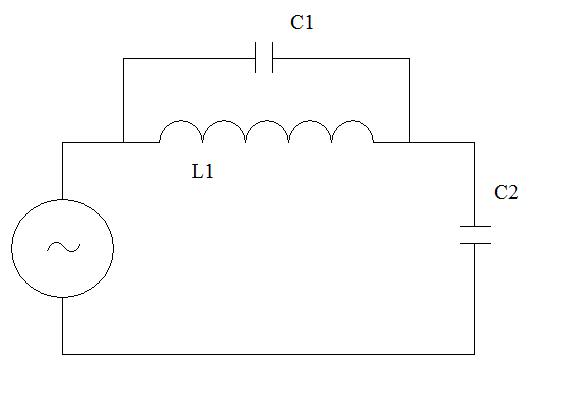
If a parallel tank circuit is oscillated at it's resonant frequency and a capacitor (C2) is added in series the circuit's impedance will change. But will it change the resonant frequency?
123.jpg


-----NEXT----

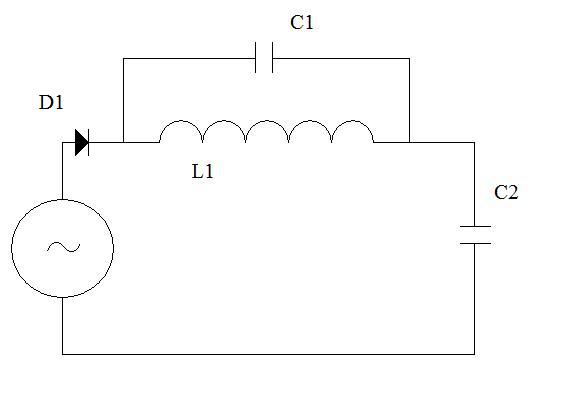
If the circuit has a diode (D1) in it the parallel tank will still resonante since the resonance takes place between the parallel L and C. So if a capacitor (C2) is added to the circuit will the resonant frequency change?
1234.jpg


Thanks in advance!
 
Engineering news on Phys.org
Putting a capacitor in series with the parallel tuned circuit will not change the parallel resonant frequency, but it will introduce a new series resonance at a lower frequency.

To see an effect, though, you would need to add a suitable resistor in series with the signal source.

I simulated it with 5000 ohms in series with your circuit. Both capacitors were 64 pF and the inductor was 16 µH.

Parallel resonance was at 5 MHz and series resonance was at 3.5 MHz

Adding a diode will cause C2 to charge up and reverse bias the diode for most of the input waveform. So there will be little or no output.
 

Similar threads

  • · Replies 10 ·
Replies
10
Views
2K
Replies
2
Views
3K
Replies
1
Views
2K
Replies
26
Views
8K
  • · Replies 21 ·
Replies
21
Views
1K
Replies
14
Views
2K
Replies
3
Views
3K
  • · Replies 51 ·
2
Replies
51
Views
5K
Replies
3
Views
3K
  • · Replies 9 ·
Replies
9
Views
3K