MHB Set of points on the complex plane

Click For Summary
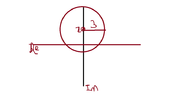
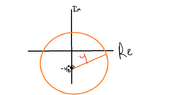
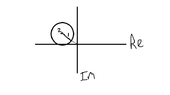
The discussion focuses on sketching sets of points on the complex plane based on given conditions. Condition (a) describes a circle with a center at (1, -1) and a radius of 1. Condition (b) defines a circle centered at (0, 1) with a radius of 3, including all points inside this circle. Condition (c) describes a circle centered at (0, 4) with a radius of 4, encompassing all points outside this circle. The distinctions between equalities and inequalities in the conditions are emphasized for accurate representation.
cbarker1
Gold Member
MHB
Messages
345
Reaction score
23
Dear Everybody, I am wanting to check the solution to this question:

Sketch the set of points determined by the given conditions:
a.) $\left| z-1+i \right|=1$
b.)$\left| z+i \right|\le3$
c.)$\left| z-4i \right|\ge4$

work:
I know (a.) is a circle with radius 1 and its center at (-1,1) on the complex plane see in figure 1.
I know (b.) is a circle with radius 3 and its center at (0,1) on the complex plane see in figure 2.
I know (c.) is a circle (?) with radius 4 with its center (0,-4) on the complex plane see in figure 3.

Thanks
Cbarker1
 

Attachments

  • Problem 5a for Complex Analysis.png
    Problem 5a for Complex Analysis.png
    2.3 KB · Views: 121
  • Problem 5b for Complex Analysis.png
    Problem 5b for Complex Analysis.png
    2.6 KB · Views: 118
  • Problem 5c for Complex Analysis.png
    Problem 5c for Complex Analysis.png
    3.4 KB · Views: 140
Physics news on Phys.org
Almost. But "=", "\le", and "\ge" are not the same! In general, |z- a| is the distance from complex number z to complex number a. Yes, the set of points, z, in the complex plane, such that |z- 1+ i|= |z- (1- i)|= 1 is the circle with center at 1- i, (1, -1), and radius 1. Similarly, |z+ i|= 3 is the circle with center at i, (0, 1), and radius 3. But your problem has \le rather than =. In addition to the circle where the distance is equal to 3, this set contains also the interior of the circle, the "disk" with center at i and radius 3.

Likewise, (c) is the circle with center 4i, (0, 4), and all points outside that circle.
 
We all know the definition of n-dimensional topological manifold uses open sets and homeomorphisms onto the image as open set in ##\mathbb R^n##. It should be possible to reformulate the definition of n-dimensional topological manifold using closed sets on the manifold's topology and on ##\mathbb R^n## ? I'm positive for this. Perhaps the definition of smooth manifold would be problematic, though.

Similar threads

  • · Replies 2 ·
Replies
2
Views
2K
  • · Replies 7 ·
Replies
7
Views
2K
  • · Replies 22 ·
Replies
22
Views
4K
  • · Replies 3 ·
Replies
3
Views
2K
  • · Replies 14 ·
Replies
14
Views
3K
  • · Replies 4 ·
Replies
4
Views
3K
  • · Replies 3 ·
Replies
3
Views
2K
  • · Replies 2 ·
Replies
2
Views
2K
Replies
1
Views
2K
Replies
3
Views
2K