Shapiro-Wilks test and the order statistic

  • Context: Undergrad 
  • Thread starter Thread starter Mayhem
  • Start date Start date
  • Tags Tags
    Statistic Test
Join the discussion
Ask a follow-up here, or get your own question answered by working scientists, mathematicians and engineers — people, not an autocomplete.
Real named experts · corrections over time · the nuance an AI answer skips
6 replies · 2K views
Mayhem
Messages
439
Reaction score
324
TL;DR
How to interpret the order statistic in the context of SW
Given the Shapiro-Wilk test value W:
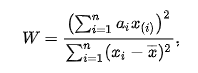
1654873563116.png

where I'm interested in the numerator. If my data is sorted in ascending order, my understanding is that $x_(i) = x_i$. Is that correct?
 
Last edited:
on Phys.org
Mayhem said:
Summary: How to interpret the order statistic in the context of SW

Given the Shapiro-Wilk test value W:
View attachment 302652
where I'm interested in the numerator. If my data is sorted in ascending order, my understanding is that $x_(i) = x_i$. Is that correct?
Sounds right to me. From the wiki page, https://en.wikipedia.org/wiki/Shapiro–Wilk_test:
##x_{(i)}## (with parentheses enclosing the subscript index i; not to be confused with ##x_i##) is the ith order statistic, i.e., the ith-smallest number in the sample
 
Orodruin said:
The Wiki page seems to be saying explicitly that in general ##x_{(i)} \neq x_i##.
But if the elements of the sequence are already ordered from smallest to largest, then ##x_{(i)} = x_i##.
 
Orodruin said:
The Wiki page seems to be saying explicitly that in general ##x_{(i)} \neq x_i##.
Yes, but for computation, finding the special case where ##x_{(i)} = x_i## makes life easier, which I did, and I got the right results when debugging random samples against known calculators.