Share Animal Pictures: For Animal Lovers

  • Thread starter Thread starter micromass
  • Start date Start date
  • Tags Tags
    Animal
Join the discussion
Registration is free. Ask a follow-up in this thread, or start your own.
3,073 replies · 328K views
Keith_McClary said:
1aE9_1Y58OwWv-u9wDeYzHd4Vvrn0cUWaLqMfiMpGXIUEOPQ6wOMUmNExmUlVQMg14t4bK26eS5L8bWehIT3lmqAYqIPGfSbx4u43gVtDZAF169A7E4d6GmBQJZWXaOg9V2OPOC_pQXQD3BRepEFgEtvB6f7YA=s0-d-e1-ft

thenarwhal.ca
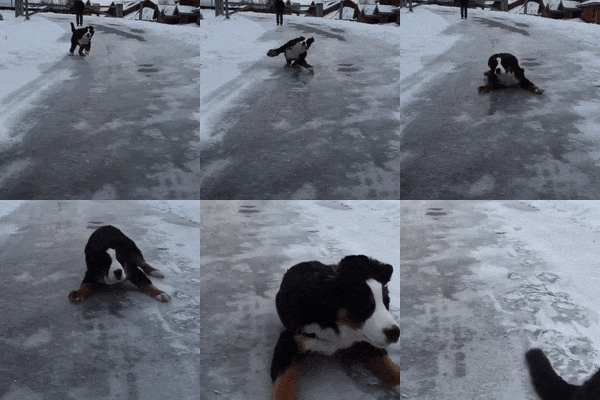
Correct me if I'm wrong, but isn't this a swiss breed?
 
Physics news on Phys.org
fresh_42 said:
this a swiss breed?
I would say its a funny breed.
 
  • Like
Likes   Reactions: pinball1970 and phinds
"Hey, look at what I did!"

Duck on photo.jpg
 
  • Haha
  • Like
Likes   Reactions: pinball1970, DaveE, Keith_McClary and 2 others
DennisN said:
"Hey, look at what I did!"
"I explored that whole mud flat and didn't find any insects, worms, or molluscs."
 
  • Like
  • Haha
Likes   Reactions: pinball1970, DennisN and BillTre
A variety of frog eyes:

Screen Shot 2022-03-24 at 10.11.59 PM.png
 
  • Like
  • Love
  • Informative
Likes   Reactions: Melbourne Guy, Klystron, DennisN and 3 others
Here's a nice picture of a human primate, in a tree (non-native environment).
Screen Shot 2022-03-26 at 1.00.47 PM.png

Its a National Geographic picture of the day.
The human primate, Julia Butterfly Hill, is in a 1,000-year-old, 180-foot-tall redwood in Humboldt County, California. Trying to keep the tree from being cut down or something, I think.

Her posture reminds me of a lemer (non-human primate):
Screen Shot 2022-03-26 at 2.35.56 PM.png
 
  • Love
  • Like
Likes   Reactions: DennisN, strangerep and Klystron
BillTre said:
Here's a nice picture of a human primate, in a tree (non-native environment).
[...]
The human primate, Julia Butterfly Hill, is in a 1,000-year-old, 180-foot-tall redwood in Humboldt County, California.
Wow, she must be very high up. I imagine a 1,000-year-old redwood would be astonishingly wide at the base? How long could she hang on in that position??
BillTre said:
Trying to keep the tree from being cut down or something, I think.
Her posture reminds me of a lemer (non-human primate):
It's strange, but I have a strong, irrational love for those type of people -- even though I learned (the hard way) many years ago that they're usually serious nutcases. :oldconfused:
 
  • Like
  • Haha
Likes   Reactions: pinball1970, Klystron and BillTre
strangerep said:
How long could she hang on in that position??
I think she, like the lemer, is sitting on a limb behind the trunk.
 
BillTre said:
I think she, like the lemer, is sitting on a limb behind the trunk.
Oh, yes, you're right. Still,... I wonder how long one's bumhole can be deprived of blood before it becomes a serious health risk. :oldwink:
 
An amazing photo: :))

An ant trying to take down a flying wasp (by Murat Öztürk)​

ezx27rmtw2771.jpg


Source:
 
  • Like
  • Wow
Likes   Reactions: pinball1970, collinsmark and BillTre
BillTre said:
Her posture reminds me of a lemer (non-human primate):
Lemurs are among my absolute favorite animals. They're small, beautiful and smart.
 
Last edited:
  • Like
Likes   Reactions: pinball1970, Klystron and BillTre
strangerep said:
So do we know who won?
I don't. If the ant brings more ants to the next fight, he is upping the ante.
 
  • Haha
Likes   Reactions: Klystron and BillTre
This morning while walking through a secluded garden outside the swimming pool, I interrupted three large male grackles in skirmisher formation on the lawn intent on a meal. The black birds reluctantly abandoned their breakfast as I approached, cawing and otherwise signaling disapproval.

Strong winds had blown paper trash onto the lawn that I assumed either contained food scraps or had attracted insects which in turn attracted the scavenging corvus. Upon closer inspection, the paper scraps showed no food residue or insect infestation.

Imagine my bemusement when a tiny rabbit quivering in fear hopped across my path and escaped into a pyracantha hedge.

Those grackles are raising the next generation in nests built in trees tended by the smaller brownish females. I have seen bits of rabbit carcasses, mainly fur and paws, that I assumed had been taken by mammalian predators such as cats, dogs or skunks. Sight of those three grackles in hunting mode causes me to reevaluate that assumption.
 
fresh_42 said:
Correct me if I'm wrong, but isn't this a swiss breed?
That's a Bernese Mountain Dog, who's going to be meeting up with an orthopaedic surgeon, if he keeps doing that.
 
strangerep said:
How long could she hang on in that position??
Just long enough to get a few good photos. I think it's interesting that we tend not to think of the photographer (or camera set up) when we see photos like this. Also things like make up, hairstyles, etc.
 
A big rock scorpion. Not so poisonous.
Screen Shot 2022-04-26 at 8.36.37 AM.png
 
  • Wow
  • Like
Likes   Reactions: DennisN, pinball1970 and Klystron
“The juvenile sea squirt wanders through the sea searching for a suitable rock or hunk of coral to cling to and make its home for life. For this task, it has a rudimentary nervous system. When it finds its spot and takes root, it doesn't need its brain anymore, so it eats it. It's rather like getting tenure.” - Daniel Dennett

-
 
Last edited:
  • Haha
  • Love
Likes   Reactions: DennisN, strangerep, DaveE and 3 others
Sea squits (and related animals) are related to chordates (a group which humans belong to).
They start their life as a nice little tadpole like thing with the basic body plan elements of chordates: dorsal hollow nerve tube (central nervous system), notochord, post-anal tail, and pharyngeal gill slits (basicallly the gill structure of fish-like things).
Screen Shot 2022-04-26 at 9.54.22 AM.png


Except for the gill slits (used for filter feeding) almost all of these other features are lost.
larval:
Screen Shot 2022-04-26 at 9.56.03 AM.png


adult:
Screen Shot 2022-04-26 at 9.56.59 AM.png
 
  • Informative
Likes   Reactions: DennisN and pinball1970
BillTre said:
Sea squits (and related animals) are related to chordates
I think they are chordates but not vertebrates.
 
  • Like
Likes   Reactions: pinball1970 and BillTre
Vanadium 50 said:
I think they are chordates but not vertebrates.
Yes sir, you are correct!