Share Animal Pictures: For Animal Lovers
- Thread starter micromass
- Start date
-
- Tags
- Animal
Join the discussion
Registration is free. Ask a follow-up in this thread, or start your own.
3,073 replies · 329K views
Physics news on Phys.org
Science Advisor
- 3,766
- 2,215
So what's going on there? It looks like the eagle is carrying some kind of prey(?) and the crow is trying to induce the eagle to drop it?BillTre said:[crow-on-eagle...]
- 20,819
- 28,467
I thought it was provisions for the way.strangerep said:So what's going on there? It looks like the eagle is carrying some kind of prey(?) and the crow is trying to induce the eagle to drop it?
Admin
- 69,784
- 25,632
I don't see the prey (the raptor's wings are in the down position covering any prey in the photo), but I do see the tether leather strap which means it's a raptor managed by a falconer. The raptor looks to be lining up on a branch that it will pass a couple mm below at high speed. Have a good day, crow!strangerep said:So what's going on there? It looks like the eagle is carrying some kind of prey(?) and the crow is trying to induce the eagle to drop it?
Science Advisor
- 3,766
- 2,215
Ah, that explains it. To me, it looked like the tail of a small wallaby, though I figured this photo is unlikely to originate in Australia.berkeman said:I don't see the prey (the raptor's wings are in the down position covering any prey in the photo), but I do see the tether leather strap which means it's a raptor managed by a falconer.

- 20,819
- 28,467
- 20,819
- 28,467
What a gang!
Admin
- 69,784
- 25,632
DennisN
Gold Member
- 2,197
- 10,329
A marvellous photo!berkeman said:

Admin
- 69,784
- 25,632
Agreed. After studying the beautiful photo more, do you all think that the photographer had the foresight to set up a fill flash tripod several feet to his/her left for this shot? The lighting on the bird is stunning, with the Sun backlight and the artistic front/left highlights. The fill flash highlights look too far off axis to the left to be from a flash mounted on the camera -- more likely mounted on a tripod a meter or two to the left, IMO.DennisN said:A marvellous photo!
And how did the photographer know to set up on this scene? Maybe the owl regularly hunts this area, so the setup had a good chance? Amazing all around.
Admin
- 69,784
- 25,632
Oh wow. Maybe a related thread at the link I posted...
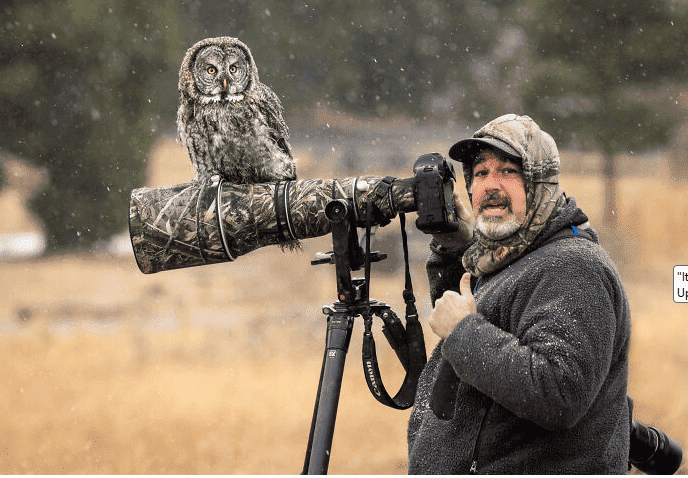
https://www.beautyofplanet.com/it-s...ueT3I6GyO4wu8n9oAVPgi2erLsykbVR9ltSmIVahDrNJQ
LOL, nice camo, dude!
https://www.beautyofplanet.com/it-s...ueT3I6GyO4wu8n9oAVPgi2erLsykbVR9ltSmIVahDrNJQ
LOL, nice camo, dude!
Science Advisor
Gold Member
- 2,856
- 12,709
Interesting thought.berkeman said:After studying the beautiful photo more, do you all think that the photographer had the foresight to set up a fill flash tripod several feet to his/her left for this shot? The lighting on the bird is stunning, with the Sun backlight and the artistic front/left highlights. The fill flash highlights look too far off axis to the left to be from a flash mounted on the camera -- more likely mounted on a tripod a meter or two to the left, IMO.
Its hard to tell without knowing more about the bird and location, however I'm inclinded to think that the bird's underside and bottom of the bird's right wing are highly illuminated by reflection of the sun'ss light from snow (very highly reflective). The top of the bird's other wing is not so well illuminated (facing away from the sun, not so much light would bounce back toward the sun in that dircetion. However, its not easy to tell if that is a good comparison without knowing what it looks like in comparison with the rest of the bird in even lighting.
It could be luck without a set-up, just using the reflected light,berkeman said:And how did the photographer know to set up on this scene? Maybe the owl regularly hunts this area, so the setup had a good chance? Amazing all around.
or the only reasonable way to decide to do such a set-up would be if the bird was expected to be there. Perhaps a regular hunting circuit, maybe with some bait. Even having bait would not guarantee the bird would approach from the right direction.
pinball1970
Gold Member
2025 Award
- 3,883
- 6,216
Is that a real image? No adjustments?BillTre said:
pinball1970
Gold Member
2025 Award
- 3,883
- 6,216
Incredible. Not just the the colour but the stop start so the prey would not be alerted.BillTre said:
Same in the Savannah but this looks more striking.
Amazing image and a nod to the engine of natural selection.
Science Advisor
Gold Member
- 2,856
- 12,709
A winner in Nikon’s annual Small World photography contest that I like:

This is a bunch of fluorescently labeled cortical neurons. This labeling based on some cool molecular tricks produces many different colors,letting different neurons be distinguished color. Without the different coloring, these neurons would just make a big confusing tangle (visually speaking) of cells and processes and would be much less informative.
The clouds of neurons in large vertebrate nervous systems is a distinctive feature of large vertebrate nervous systems. Many invertebrate (and some vertebrate) nervous systems have way fewer neurons. Some (like crayfish) have one motor neuron (per motoneuron type (activator and inhibitor)) per muscle.
The large populations of largely equivalent neurons in large vertebrates nervous systems present different neuro-computational possibilities.
This is a bunch of fluorescently labeled cortical neurons. This labeling based on some cool molecular tricks produces many different colors,letting different neurons be distinguished color. Without the different coloring, these neurons would just make a big confusing tangle (visually speaking) of cells and processes and would be much less informative.
The clouds of neurons in large vertebrate nervous systems is a distinctive feature of large vertebrate nervous systems. Many invertebrate (and some vertebrate) nervous systems have way fewer neurons. Some (like crayfish) have one motor neuron (per motoneuron type (activator and inhibitor)) per muscle.
The large populations of largely equivalent neurons in large vertebrates nervous systems present different neuro-computational possibilities.
- 20,819
- 28,467
Uh! Here they are!BillTre said:This is a bunch of fluorescently labeled cortical neurons.
pinball1970
Gold Member
2025 Award
- 3,883
- 6,216
That's horrible!BillTre said:
pinball1970
Gold Member
2025 Award
- 3,883
- 6,216
That's beautiful!BillTre said:A winner in Nikon’s annual Small World photography contest that I like:
View attachment 315435
This is a bunch of fluorescently labeled cortical neurons. This labeling based on some cool molecular tricks produces many different colors,letting different neurons be distinguished color. Without the different coloring, these neurons would just make a big confusing tangle (visually speaking) of cells and processes and would be much less informative.
The clouds of neurons in large vertebrate nervous systems is a distinctive feature of large vertebrate nervous systems. Many invertebrate (and some vertebrate) nervous systems have way fewer neurons. Some (like crayfish) have one motor neuron (per motoneuron type (activator and inhibitor)) per muscle.
The large populations of largely equivalent neurons in large vertebrates nervous systems present different neuro-computational possibilities.