Shaye
- 20
- 7
- Homework Statement
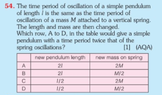
- The time period of oscillation of a simple pendulum of length l is the same as the time period of oscillation of a mass M attached to a vertical spring. The length and mass are then changed. Which row, A to D (see attachment), in the table would give a simple pendulum with a time period twice that of the spring oscillations?
- Relevant Equations
- T = 2π√(l/g): Mass on a pendulum
T = 2π√(m/k): Mass on a spring
I have only be able to write something like:
2x(2π√(l/g)) = 2π√(m/k)
2π is a constant therefore; 2x(√(l/g)) = √(m/k)
You could square both sides; 2^2x(l/g) = (m/k)
But now I'm lost as to how to proceed.
PS- Book answer is B
Thanks
2x(2π√(l/g)) = 2π√(m/k)
2π is a constant therefore; 2x(√(l/g)) = √(m/k)
You could square both sides; 2^2x(l/g) = (m/k)
But now I'm lost as to how to proceed.
PS- Book answer is B
Thanks
Attachments