Shouldn't the shape of a semiconductor laser be planar instead of conical?

Click For Summary
SUMMARY

The shape of a semiconductor laser beam is conical with a dispersion angle of approximately 50 degrees, contrary to common rectangular illustrations. The elliptical spatial profile of the emitted beam results from diffraction effects, where the beam is confined by a narrow junction of about one micrometer in width. This confinement leads to a wider spread in the perpendicular direction, creating a fan-shaped, astigmatic beam. Understanding these characteristics is crucial for applications involving semiconductor lasers.

PREREQUISITES
  • Understanding of semiconductor laser physics
  • Familiarity with diffraction principles
  • Knowledge of beam profiling techniques
  • Basic concepts of astigmatism in optics
NEXT STEPS
  • Research the principles of diffraction in optics
  • Explore beam profiling methods for lasers
  • Learn about astigmatism in laser beams
  • Investigate semiconductor laser design and junction characteristics
USEFUL FOR

Optical engineers, physicists, and anyone involved in the design or application of semiconductor lasers will benefit from this discussion.

Ted goldmund lee
Messages
3
Reaction score
0
TL;DR
It feels like the shape of the blasting laser have to be planar because the gain medium itself looks like rectangular.
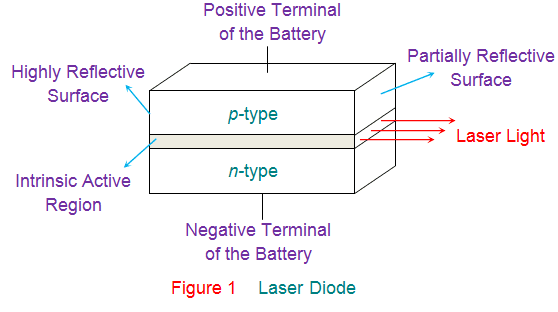
I read about semiconductor laser and its beam shape is conical with 50' of dispersion angle.
1565705065843.png

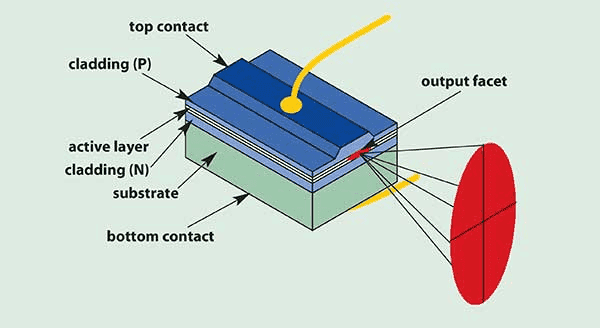
But for me, it is hard to accept that it is conical because every single drawing I see is rectangular and the plan that laser going out is also a plain, not a hole.
1565705155655.png


And this is the picture I saw earlier.

Please help me..
 
Physics news on Phys.org
See Fig. 6 in https://pe2bz.philpem.me.uk/Lights/.../C04-M06-DiodeLaserPowerSupplies/mod04_06.htm

"The beam emitted from a semiconductor laser typically has an elliptical spatial profile, as illustrated in Figure 6. The profile is caused by diffraction. In the direction perpendicular to the junction, the beam is confined by the narrow junction, typically of width around one micrometer. The beam in that direction is spread by diffraction to an angle often as large as several tens of degrees. In the direction parallel to the junction, the beam is not confined so stringently and spreads less, perhaps to around ten degrees or so. The result is a fan-shaped beam, as indicated in the figure. The beam is said to be astigmatic. "
 

Similar threads

  • · Replies 13 ·
Replies
13
Views
8K
Replies
8
Views
5K
  • · Replies 3 ·
Replies
3
Views
7K
  • · Replies 8 ·
Replies
8
Views
5K
  • · Replies 2 ·
Replies
2
Views
4K
  • · Replies 15 ·
Replies
15
Views
6K
  • · Replies 5 ·
Replies
5
Views
3K
  • · Replies 5 ·
Replies
5
Views
3K
  • · Replies 1 ·
Replies
1
Views
10K
  • · Replies 1 ·
Replies
1
Views
4K