Is the Operator Hermitian?

Click For Summary
SUMMARY

The discussion revolves around proving the Hermitian nature of the operator defined by the expression ##\mathcal{L} = -x\frac{d^2}{dx^2} + (x-1)\frac{d}{dx}##. Participants shared various identities and properties of inner products, specifically ##\bigl< f,xg \bigr>=\bigl< xf,g \bigr>## and ##\bigl< f, \frac{d}{dx}g \bigr>=-\overline{f(0)} g(0)+\bigl< f,g \bigr>-\bigl< \frac{d}{dx}f,g \bigr>##, to manipulate terms and simplify the proof. The final result demonstrates that the operator is indeed Hermitian, confirming that ##\langle L f, g \rangle = \langle f, L g \rangle## holds true.

PREREQUISITES
  • Understanding of inner product spaces and their properties
  • Familiarity with differential operators, specifically ##\frac{d}{dx}## and ##\frac{d^2}{dx^2}##
  • Knowledge of integration by parts and its application in proofs
  • Experience with complex conjugates and their role in inner products
NEXT STEPS
  • Study the properties of Hermitian operators in functional analysis
  • Learn about the application of integration by parts in proving operator properties
  • Explore the implications of Hermitian operators in quantum mechanics
  • Investigate the role of boundary conditions in the context of differential operators
USEFUL FOR

Mathematicians, physicists, and students studying quantum mechanics or functional analysis who are interested in operator theory and the properties of differential operators.

Lambda96
Messages
233
Reaction score
77
Homework Statement
##\bigl\langle f,\cal L g \bigr\rangle=\bigl\langle \cal L f,\ g \bigr\rangle##
Relevant Equations
none
Hi,

unfortunately, I have problems with the following task
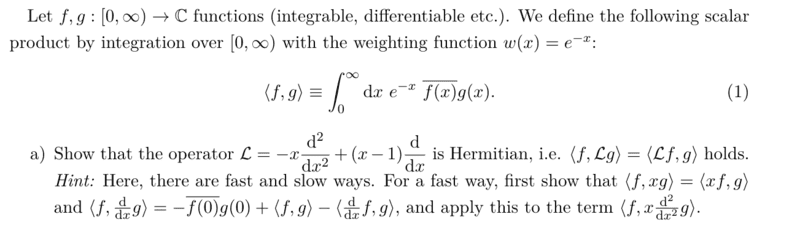
Bildschirmfoto 2023-06-22 um 12.37.30.png

I tried the fast way, unfortunately I have problems with it

I have already proved the following properties, ##\bigl< f,xg \bigr>=\bigl< xf,g \bigr>## and ##\bigl< f, \frac{d}{dx}g \bigr>=-\overline{f(0)} g(0)+\bigl< f,g \bigr>-\bigl< \frac{d}{dx}f,g \bigr>## and then proceeded as follows:

$$\bigl< f,\cal L g \bigr>$$
$$\bigl< f,(-x\frac{d^2}{dx^2}+(x-1)\frac{d}{dx})g \bigr>$$
$$\bigl< f,-x \frac{d^2}{dx^2}g+x \frac{d}{dx}g-\frac{d}{dx}g \bigr>$$
$$\bigl< f,-x \frac{d^2}{dx^2}g \bigr>+\bigl< f,x \frac{d}{dx}g \bigr>-\bigl< f,\frac{d}{dx}g \bigr>$$

Then for the last term, I used the above identity ##\bigl< f,\frac{d}{dx}g \bigr>=-\overline{f(0)} g(0)+\bigl< f,g \bigr>-\bigl< \frac{d}{dx}f,g \bigr>## and obtained the following:

$$\bigl< f,-x \frac{d^2}{dx^2}g \bigr>+\bigl< f,x \frac{d}{dx}g \bigr>+\overline{f(0)} g(0)- \bigl< f,g \bigr>+\bigl< \frac{d}{dx}f,g \bigr>$$

Unfortunately now I'm stuck because I don't know what to do with the first two terms, in the hint it says to apply the above identities to ##\bigl< f,-x \frac{d^2}{dx^2}g \bigr>## but unfortunately I don't know how.
 
Physics news on Phys.org
Note that ##\frac{d^2}{dx^2} =\frac{d}{dx}\frac{d}{dx}##
 
  • Like
Likes   Reactions: Lambda96
For the second term, use the first property to move the ##x## onto ##f##. That is, you can say that
$$\langle f, x\frac{d}{dx}g \rangle = \langle xf, \frac{d}{dx}g\rangle = \langle h, \frac{d}{dx}g\rangle,$$ where ##h(x) = x f(x)##. Use the second property to move the ##d/dx## over onto ##h##. And so on.
 
  • Like
Likes   Reactions: Lambda96
Thanks PeroK and vela for your help 👍👍

I tried to apply your tips and got the following:

$$\bigl< f,-x \frac{d^2}{dx^2}g \bigr>+\bigl< f,x \frac{d}{dx}g \bigr>+\overline{f(0)} g(0)- \bigl< f,g \bigr>+\bigl< \frac{d}{dx}f,g \bigr>$$.
$$\bigl< f,-x \frac{d^2}{dx^2}g \bigr>+\bigl< xf, \frac{d}{dx}g \bigr>+\overline{f(0)} g(0)- \bigl< f,g \bigr>+\bigl< \frac{d}{dx}f,g \bigr>$$
$$\bigl< f,-x \frac{d^2}{dx^2}g \bigr>+\bigl< h, \frac{d}{dx}g \bigr>+\overline{f(0)} g(0)- \bigl< f,g \bigr>+\bigl< \frac{d}{dx}f,g \bigr>$$
$$\bigl< f,-x \frac{d^2}{dx^2}g \bigr>+\bigl< h,g \bigr>-\bigl< \frac{d}{dx}h,g \bigr>+\overline{f(0)} g(0)- \bigl< f,g \bigr>+\bigl< \frac{d}{dx}f,g \bigr>$$

I then tried to rewrite the term ##\bigl< f,-x \frac{d^2}{dx^2}g \bigr>## as follows ##-\bigl< h, \frac{d}{dx} \frac{d}{dx}g \bigr>## but I am not sure if I can now apply the second identity from the hint to it and get the following

$$-\bigl< h, \frac{d}{dx} \frac{d}{dx}g \bigr>=-\bigl< \frac{d}{dx}h,g \bigr>+\bigl< \frac{d^2}{dx^2}h,g \bigr>$$
 
First, it's a good idea to write down what you are aiming for:
$$\langle L f,\ g \rangle =- \langle (x\frac{d^2}{dx^2}) f, g \rangle + \langle (x\frac{d}{dx}) f, g \rangle - \langle \frac{d}{dx} f, g \rangle$$Now$$\langle f,\ Lg \rangle =- \langle f, \ (x\frac{d^2}{dx^2})g \rangle + \langle f, \ (x\frac{d}{dx})g \rangle - \langle f, \ \frac{d}{dx}g \rangle$$You need to apply the "##x##" rule to the first and second terms and the ##\frac d {dx}## rule to the third term. Then apply the ##\frac d {dx}## rule twice to the new first term and once to the middle term. And see what you get.
 
  • Like
Likes   Reactions: Lambda96
Actually, if you just process the first term, things should cancel out. And things fall out in 5-6 lines.
 
  • Like
Likes   Reactions: Lambda96
vela said:
For the second term, use the first property to move the ##x## onto ##f##. That is, you can say that
$$\langle f, x\frac{d}{dx}g \rangle = \langle xf, \frac{d}{dx}g\rangle = \langle h, \frac{d}{dx}g\rangle,$$ where ##h(x) = x f(x)##. Use the second property to move the ##d/dx## over onto ##h##. And so on.
Actually, it turns out to be simpler to leave the second and third terms alone and watch them vanish!
 
  • Like
Likes   Reactions: vela and Lambda96
Thanks PeroK for your help 👍, I have now tried to rewrite only the first term using the two identities in the hint, unfortunately I have some difficulties with this

$$\bigl< f,-x \frac{d^2}{dx^2}g \bigr>$$
$$-\bigl< xf, \frac{d^2}{dx^2}g \bigr>$$
$$-\bigl< xf, \frac{d}{dx}\frac{d}{dx}g \bigr>$$
$$-\bigl< xf, \frac{d}{dx}g \bigr>+\bigl< x\frac{d}{dx}f, \frac{d}{dx}g \bigr>$$
$$-\bigl< xf, g \bigr>+\bigl< x\frac{d}{dx}f, g \bigr>+\bigl< x\frac{d}{dx}f, g \bigr>-\bigl< x\frac{d^2}{dx^2}f, g \bigr>$$

If I now combine this expression with the other two terms, i.e. ##\bigl< f,x \frac{d}{dx}g \bigr>## and ##\bigl< f, \frac{d}{dx}g \bigr>##, I unfortunately do not get the final result, which is why I assume that I have applied the rule ##\frac{d}{dx}## twice incorrectly on the first term
 
Lambda96 said:
Thanks PeroK for your help 👍, I have now tried to rewrite only the first term using the two identities in the hint, unfortunately I have some difficulties with this

$$\bigl< f,-x \frac{d^2}{dx^2}g \bigr>$$
$$-\bigl< xf, \frac{d^2}{dx^2}g \bigr>$$
$$-\bigl< xf, \frac{d}{dx}\frac{d}{dx}g \bigr>$$
$$-\bigl< xf, \frac{d}{dx}g \bigr>+\bigl< x\frac{d}{dx}f, \frac{d}{dx}g \bigr>$$
This is not right. It should be:
$$-\bigl< xf, \frac{d}{dx}g \bigr>+\bigl< \frac{d}{dx}(xf), \frac{d}{dx}g \bigr>$$
 
  • Like
Likes   Reactions: Lambda96
  • #10
Lambda96 said:
$$-\bigl< xf, \frac{d}{dx}g \bigr>+\bigl< x\frac{d}{dx}f, \frac{d}{dx}g \bigr>$$
The reason I introduced the function ##h=xf## earlier was in hopes of you avoiding the mistake you made. In terms of ##h##, you should get
$$-\langle xf, \frac{d}{dx}g' \rangle = -\langle h, \frac{d}{dx}g' \rangle = \overline{h(0)}g'(0) - \langle h,g' \rangle + \langle \frac{d}{dx}h,g'\rangle.$$ Then if you substitute back in ##xf## for ##h##, you'll end up with what @PeroK did in the previous post.
 
  • Like
Likes   Reactions: Lambda96, SammyS and PeroK
  • #11
Thanks PeroK and vela for your help 👍👍

I have now continued the notation with ##h=xf## and got the following.

$$-\bigl< h, \frac{d^2}{dx^2}g \bigr>=-\bigl< h, \frac{d}{dx}g \bigr>+\bigl< \frac{d}{dx}h, \frac{d}{dx}g \bigr>$$

I then substituted ##h=xf## in the second term and applied the product rule

$$=-\bigl< h, \frac{d}{dx}g \bigr>+\bigl< x\frac{d}{dx}f, \frac{d}{dx}g \bigr>+\bigl< f, \frac{d}{dx}g \bigr>$$

I then applied the ##\frac{d}{dx}## rule from the hint again for the second term

$$=-\bigl< h, \frac{d}{dx}g \bigr>+\bigl<x\frac{d}{dx}f,g \bigr>-\bigl<\frac{d}{dx} \bigl(x \frac{d}{dx}f\bigr),g \bigr>+\bigl<f, \frac{d}{dx}g \bigr>$$.

Then applied the product rule for the third term

$$=-\bigl< h, \frac{d}{dx}g \bigr>+\bigl<x\frac{d}{dx}f,g \bigr>-\bigl\langle x \frac{d^2}{dx^2}f,g \bigr\rangle -\bigl\langle \frac{d}{dx} f ,g \bigr\rangle +\bigl< f, \frac{d}{dx}g \bigr>$$

Then I applied ##h=xf## for the first term and applied the x rule from the hint again

$$=-\bigl< f, x\frac{d}{dx}g \bigr>+\bigl<x\frac{d}{dx}f,g \bigr>-\bigl\langle x \frac{d^2}{dx^2}f,g \bigr\rangle -\bigl\langle \frac{d}{dx} f ,g \bigr\rangle +\bigl< f, \frac{d}{dx}g \bigr>$$

If I now add the two unchanged terms to this, I get the following.

$$=-\bigl< f, x\frac{d}{dx}g \bigr>+\bigl<x\frac{d}{dx}f,g \bigr>-\bigl\langle x \frac{d^2}{dx^2}f,g \bigr\rangle -\bigl\langle \frac{d}{dx} f , g \bigr\rangle +\bigl< f, \frac{d}{dx}g \bigr>+\bigl< f,x \frac{d}{dx}g \bigr>-\bigl< f,\frac{d}{dx}g \bigr>$$

$$-\bigl\langle x \frac{d^2}{dx^2}f,g \bigr\rangle+\bigl<x\frac{d}{dx}f,g \bigr>-\bigl\langle \frac{d}{dx} f ,g \bigr\rangle=\bigl\langle \cal L f,x \bigr\rangle$$
 
  • Like
Likes   Reactions: vela and PeroK
  • #12
Thanks PeroK and vela for your help and for looking over my calculation 👍👍
 

Similar threads

Replies
3
Views
2K
  • · Replies 2 ·
Replies
2
Views
2K
Replies
19
Views
3K
  • · Replies 13 ·
Replies
13
Views
5K
  • · Replies 5 ·
Replies
5
Views
1K
Replies
2
Views
2K
  • · Replies 7 ·
Replies
7
Views
3K
Replies
1
Views
2K
Replies
1
Views
2K
Replies
6
Views
1K