Showing That the Modified Bessel Function of the First Kind is a Solution

Click For Summary
The discussion focuses on demonstrating that the modified Bessel function of the first kind, I_v(x), is a solution to the modified Bessel equation. The user initially differentiates the function and substitutes it into the equation but expresses skepticism about the correctness of their results, particularly regarding a change of index. They encounter an issue with an undefined term when k=0, questioning whether it should be assumed to be zero. After further analysis, the user realizes an error in their index change, leading to a series that ultimately converges to zero. The conversation highlights the complexities involved in verifying solutions to differential equations using special functions.
womfalcs3
Messages
60
Reaction score
5
Hello,

I am in the process of showing that the modified Bessel function, I_v(x), is a solution to the modified Bessel equation,

x^2*y''+x*y'-(x^2+v^2)*y=0

I have differentiated the MBF twice and plugged it into show that the left hand side is in fact 0.

After a good amount of work, I've come to the following left hand side:
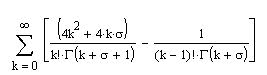
10shj0o.jpg


Where sigma=v.


Is that right? The math seems straight forward, and I only did one change of index that looks correct to me. I'm skeptical about the end result though.
 
Physics news on Phys.org
Sorry, the actual left hand side I have are those two terms inside the sum multiplied by (x/2)^2k+v.

All inside the sum.
 
womfalcs3 said:
Hello,


10shj0o.jpg


Is that right? The math seems straight forward, and I only did one change of index that looks correct to me. I'm skeptical about the end result though.

Not sure either. But the second term is undefined when k=0 , i.e. (-1)! = Γ(0) is undefined. Or do we assume the second term to be zero?
 
matematikawan said:
Not sure either. But the second term is undefined when k=0 , i.e. (-1)! = Γ(0) is undefined. Or do we assume the second term to be zero?

Thank you for the response.

I just realized I made a mistake by changing the index, resulting in that denomintor. I eventually obtained a series that converged to 0.

Thank you again.
 

Similar threads

  • · Replies 1 ·
Replies
1
Views
406
  • · Replies 2 ·
Replies
2
Views
2K
  • · Replies 2 ·
Replies
2
Views
2K
Replies
1
Views
11K
  • · Replies 6 ·
Replies
6
Views
3K
  • · Replies 7 ·
Replies
7
Views
3K
  • · Replies 2 ·
Replies
2
Views
3K
  • · Replies 1 ·
Replies
1
Views
3K
  • · Replies 5 ·
Replies
5
Views
2K
Replies
4
Views
3K