Showing That the Modified Bessel Function of the First Kind is a Solution

Click For Summary
SUMMARY

The discussion centers on demonstrating that the modified Bessel function of the first kind, I_v(x), satisfies the modified Bessel equation: x²y'' + xy' - (x² + v²)y = 0. The participant differentiated the function twice and substituted it into the equation, initially expressing skepticism about the correctness of their result. They later identified an error in changing the index, which led to an undefined term when k=0, ultimately realizing that the series converged to 0.

PREREQUISITES
  • Understanding of modified Bessel functions, specifically I_v(x)
  • Familiarity with differential equations, particularly the modified Bessel equation
  • Knowledge of series convergence and factorial definitions
  • Proficiency in mathematical differentiation techniques
NEXT STEPS
  • Study the properties and applications of modified Bessel functions
  • Learn about series solutions to differential equations
  • Explore the implications of undefined terms in mathematical series
  • Investigate the convergence criteria for power series
USEFUL FOR

Mathematicians, students studying differential equations, and researchers working with special functions will benefit from this discussion.

womfalcs3
Messages
60
Reaction score
5
Hello,

I am in the process of showing that the modified Bessel function, I_v(x), is a solution to the modified Bessel equation,

x^2*y''+x*y'-(x^2+v^2)*y=0

I have differentiated the MBF twice and plugged it into show that the left hand side is in fact 0.

After a good amount of work, I've come to the following left hand side:
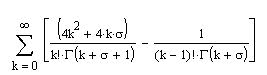
10shj0o.jpg


Where sigma=v.


Is that right? The math seems straight forward, and I only did one change of index that looks correct to me. I'm skeptical about the end result though.
 
Physics news on Phys.org
Sorry, the actual left hand side I have are those two terms inside the sum multiplied by (x/2)^2k+v.

All inside the sum.
 
womfalcs3 said:
Hello,


10shj0o.jpg


Is that right? The math seems straight forward, and I only did one change of index that looks correct to me. I'm skeptical about the end result though.

Not sure either. But the second term is undefined when k=0 , i.e. (-1)! = Γ(0) is undefined. Or do we assume the second term to be zero?
 
matematikawan said:
Not sure either. But the second term is undefined when k=0 , i.e. (-1)! = Γ(0) is undefined. Or do we assume the second term to be zero?

Thank you for the response.

I just realized I made a mistake by changing the index, resulting in that denomintor. I eventually obtained a series that converged to 0.

Thank you again.
 

Similar threads

  • · Replies 1 ·
Replies
1
Views
455
  • · Replies 2 ·
Replies
2
Views
2K
  • · Replies 2 ·
Replies
2
Views
2K
Replies
1
Views
11K
  • · Replies 6 ·
Replies
6
Views
3K
  • · Replies 7 ·
Replies
7
Views
3K
  • · Replies 2 ·
Replies
2
Views
3K
  • · Replies 1 ·
Replies
1
Views
3K
  • · Replies 5 ·
Replies
5
Views
2K
Replies
4
Views
3K