MHB Sigma Algebras .... Axler Page 26 ....

  • Thread starter Thread starter Math Amateur
  • Start date Start date
  • Tags Tags
    Sigma
Click For Summary
The discussion centers on the definition of a σ-algebra as presented in Sheldon Axler's "Measure, Integration & Real Analysis." Participants clarify that while the set of all subsets of ℝ technically qualifies as a σ-algebra, it lacks utility in measure theory. The key issue is that this σ-algebra does not allow for the construction of a meaningful measure, as it includes too many sets, leading to contradictions with measure properties. The conversation seeks to understand which specific conditions of a σ-algebra are not satisfied in practical applications. Ultimately, the set of all subsets of ℝ is recognized as theoretically valid but practically ineffective in measure theory contexts.
Math Amateur
Gold Member
MHB
Messages
3,920
Reaction score
48
I am reading Sheldon Axler's book: Measure, Integration & Real Analysis ... and I am focused on Chapter 2: Measures ...

I need help in order to fully understand the implications of Axler's definition of a $\sigma$-algebra ... ...

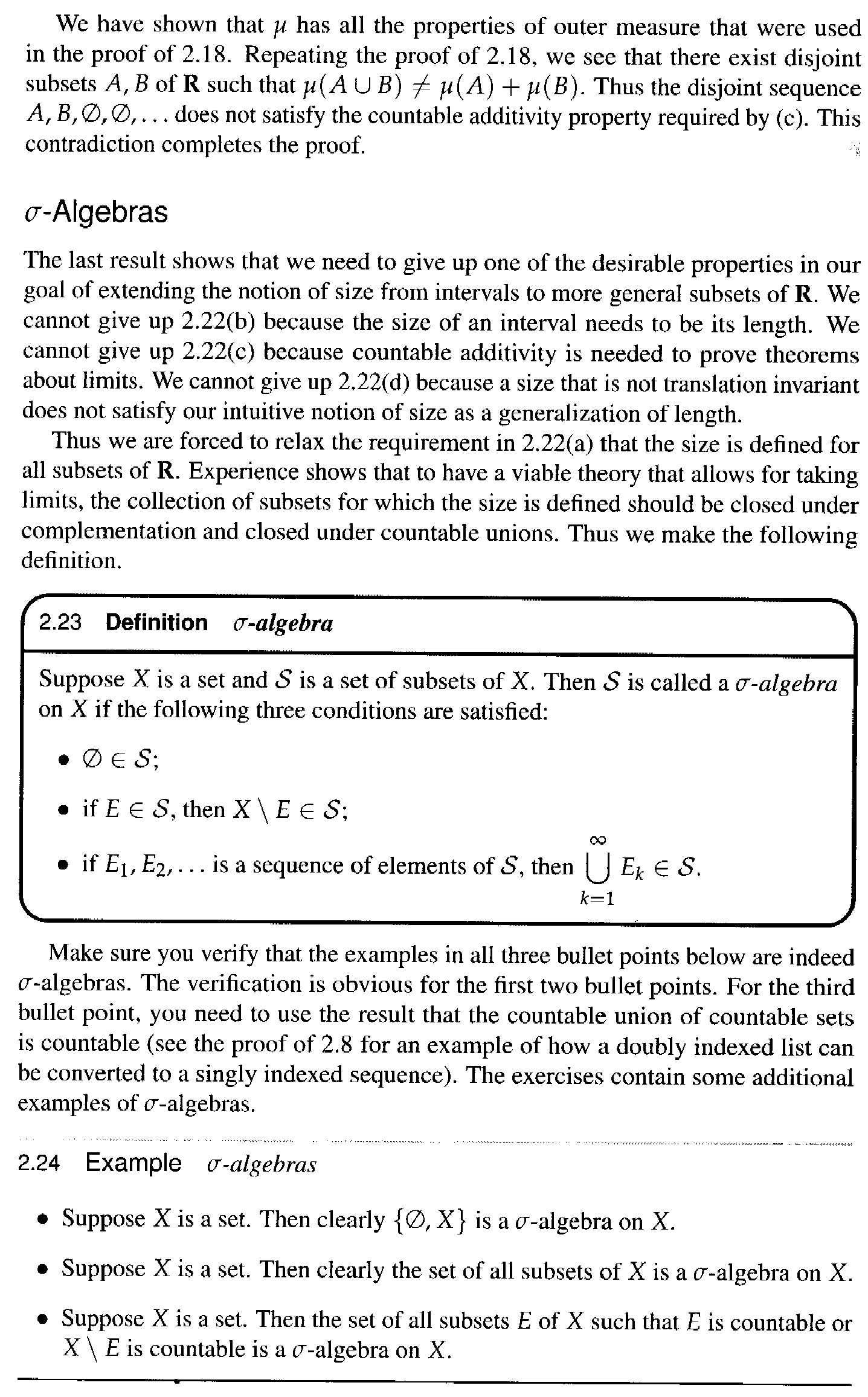
The relevant text reads as follows:
Axler - Sigma Algebres ... Page 26 .png
Now in the above text Axler implies that the set of all subsets of $\mathbb{R}$ is not a $\sigma$-algebra ... ...

... BUT ... which of the three bullet points of the definition of a $\sigma$-algebra is violated by the set of all subsets of $\mathbb{R}$ ... and how/why is it violated ...
Help will be much appreciated ...

Peter
 
Physics news on Phys.org
The set of all subsets of $\Bbb{R}$ is a $\sigma$-algebra (but it is not a useful $\sigma$-algebra in the context of measure theory).
 
Opalg said:
The set of all subsets of $\Bbb{R}$ is a $\sigma$-algebra (but it is not a useful $\sigma$-algebra in the context of measure theory).
Thanks for the help Opalg ... but can you help further ...

... can you explain what you mean by your statement that the set of all subsets of $\Bbb{R}$ is not a useful $\sigma$-algebra in the context of measure theory ...

Peter
 
We all know the definition of n-dimensional topological manifold uses open sets and homeomorphisms onto the image as open set in ##\mathbb R^n##. It should be possible to reformulate the definition of n-dimensional topological manifold using closed sets on the manifold's topology and on ##\mathbb R^n## ? I'm positive for this. Perhaps the definition of smooth manifold would be problematic, though.

Similar threads

  • · Replies 3 ·
Replies
3
Views
2K
  • · Replies 5 ·
Replies
5
Views
4K
  • · Replies 5 ·
Replies
5
Views
2K
  • · Replies 2 ·
Replies
2
Views
4K
  • · Replies 2 ·
Replies
2
Views
2K
  • · Replies 8 ·
Replies
8
Views
4K
  • · Replies 2 ·
Replies
2
Views
3K
  • · Replies 3 ·
Replies
3
Views
1K
  • · Replies 4 ·
Replies
4
Views
2K
  • · Replies 2 ·
Replies
2
Views
1K