Simulated voltage gain in Multisim differs very much from calculated

  • Thread starter Thread starter georgefrenk
  • Start date Start date
  • Tags Tags
    Simulation
Click For Summary
SUMMARY

The discussion centers on discrepancies between calculated voltage gain and simulation results in Multisim for a common emitter amplifier using a 2N2222A transistor. The calculated voltage gain (Av) is -478.8 mV, while the simulation shows -990 mV. Key factors influencing the results include the transistor's beta value and the circuit's biasing conditions. The participants suggest verifying resistor values and understanding the implications of transistor saturation on amplifier behavior.

PREREQUISITES
  • Understanding of common emitter amplifier configurations
  • Familiarity with transistor parameters, specifically beta values
  • Knowledge of Multisim software for circuit simulation
  • Basic principles of AC and DC analysis in electronic circuits
NEXT STEPS
  • Explore the impact of varying beta values on transistor performance in simulations
  • Learn about biasing techniques for BJTs to avoid saturation
  • Study the differences between AC and DC analysis in amplifier circuits
  • Investigate the use of T-models for transistors in circuit simulations
USEFUL FOR

Electronics students, circuit designers, and engineers working with BJTs and simulation software like Multisim who seek to understand amplifier design and performance discrepancies.

georgefrenk
Messages
2
Reaction score
0
I am using Multisim software and I am comparing my calculated voltage gain with the one, done by Multisim.

Why is calculated Av ( -478.8 mV) much different from the one in simulation ( -990 mV) ?
I see the calculated is approx. half size of simulated.

I tried using virtual transistor instead of 2N2222A, but Ic and voltage gain inside Multisim stays almost the same.
And tried also moving PR2 voltage probe directly on 4 V power source.Ic is seen as measured on schematic
Rc is seen on schematic
Vt is default 25 mV at room temparature
gm represents transconductancegm = Ic / Vt = Ic / 25 mV
gm = 1.71 mA / 25 mV
gm = (0.0684 / 1000) S (Siemens)
gm = 0.0000684 S (Siemens)

Av = Rc * -gm
Av = 7000 ohm * -0.0000684 S
Av = -0.4788 V (volts)
Av = -478.8 mV
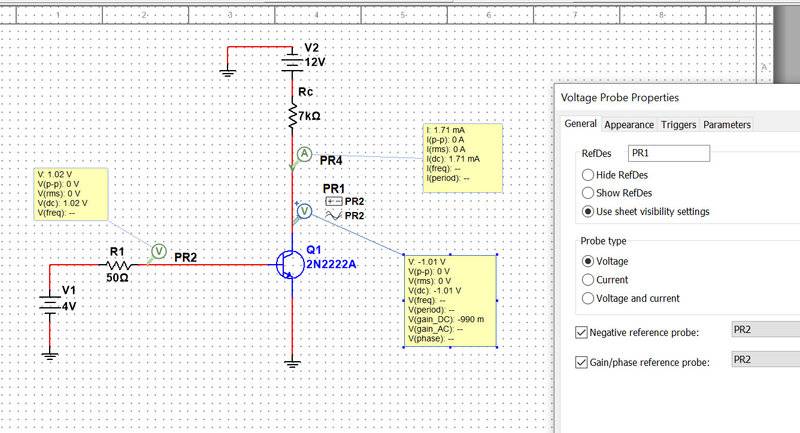
multisim_problem_v2.jpg
 
Engineering news on Phys.org
The gain of that your circuit will be highly dependent on the current gain assumed for the 2N2222A. What value of beta is being used ?

Where does that circuit come from ?
Will it be compared to another, more predictable circuit ?
 
I tried different beta values, like 50, 100, 200, 300 via transistor parameter BF (Ideal maximum forward beta).
But it doesn't change the results. I am using equations for common emitter amplifier from newly released book Electronic Circuits Fundamentals with MathCad Examples (author A-Imam Al-Sammak).
 
I would suggest substituting a simple T-model for the transistor with parameters you can directly set. Do the analysis on paper and compare with the simulator's answers. If that all makes sense then move up in model complexity. This will separate the nature of the problem you have, i.e. simulator problems, your basic understanding of the circuit, BJT model issues, etc.
 
A few things caught my attention:
1) Multisim shows the Collector voltage as -1.01V, pretty good trick with only Positive supplies
2) I calculate the Base current somewhere between 60mA and 66mA

What would you expect the Collector current to be with 60mA base current? Is that current possible with the Vcc supply and the load resistor?
How does the calculated Collector current compare to the maximum rating of the transistor?

Me thinks that circuit got Multisim very confused! :eek:

Cheers,
Tom
 
georgefrenk said:
But it doesn't change the results.
Base bias current is ( 4V - 0.7V ) / 50R = 3.3 / 50 = 66. mA ;
Multiply by beta (assumed 100), gives Ic = 6.6 amp ;
That transistor, ( with Rc = 7k ), is saturated.

I think you have your resistor values swapped.
R1 is 50R, maybe it should be 7k.
Rc is 7K, maybe it should be 50R .

Then Ib = 3.3V / 7k = 470. uA ;
470 uA * (Beta=100) = 47 mA ;
Rc = 50R ; Vrc = 2.36V, which is less than 12V, so BJT is in the linear range.

Now the BJT is biased, you can evaluate the AC gain.
I believe this is part of a lesson, in how NOT to design an amplifier.
 
  • Like
Likes   Reactions: DaveE
This is about as predictable of a circuit as you can get with a 2N2222. Even the most horrible beta will put the collector voltage next thing to zero. However, it won't go negative. So much for my faith in that software. It is an amplifier, just not a linear one. I don't think there ever was a claim that it was.
 
Tom.G said:
Multisim shows the Collector voltage as -1.01V, pretty good trick with only Positive supplies
Not if your reference is the base voltage, which is what that Microsim widow is telling you. BJT collectors in saturation can absolutely be below the base voltage when driven hard into saturation.

Tom.G said:
What would you expect the Collector current to be with 60mA base current?
For this circuit? Saturated. It has little to do with the amount of base current, you know, once you have way too much.

Tom.G said:
Me thinks that circuit got Multisim very confused!
This isn't Multisim's first rodeo. Your best first guess is that the simulator is doing exactly what you asked it to do.

BJT amplifiers normally have separate functional bits in the schematic for DC bias and the AC signal. You have biased this device into saturation and it's no longer an amplifier.

Maybe you should try something like this:
1703486161454.png
Oops! Mistook your reply for the OP. You don't need to try this, LOL!

1703487145989.png
 
Last edited:
  • Haha
Likes   Reactions: Tom.G
Where was it established in this thread that the op wanted an amplifier that behaves like a voltage divider based amp with a stable Q point?
-
The circuit was posted, the results that the simulation gave were questioned, that's it. I missed the part about the reference being base voltage. Makes sense now. If the op struggles understanding the circuit in the first post I can't see how we can expect everything to make sense throwing a voltage divider based amp at them.
 
  • Like
Likes   Reactions: DaveE

Similar threads

  • · Replies 10 ·
Replies
10
Views
3K
  • · Replies 5 ·
Replies
5
Views
2K
  • · Replies 49 ·
2
Replies
49
Views
8K
Replies
2
Views
1K