Sketch a qualitatively accurate graph of the entropy of a substance

Click For Summary
The discussion centers on sketching a qualitative graph of entropy as a function of temperature at constant pressure, highlighting the phases of solid, liquid, and gas. Participants analyze the relationship between internal energy, pressure, and entropy, using equations to derive insights into the behavior of substances across different states. The graph's features are explained, with specific focus on the approximations for degrees of freedom in solids, liquids, and gases. While the liquid and gas regions are generally agreed upon, there is uncertainty regarding the solid phase representation. Overall, the conversation emphasizes the importance of understanding entropy changes across different states of matter.
LCSphysicist
Messages
644
Reaction score
162
Homework Statement
All below
Relevant Equations
All below
Sketch a qualitatively accurate graph of the entropy of a substance
as a function of temperature, at fixed pressure. Indicate where the
substance is solid, liquid, and gas . Explain each feature of the graph briefly.

What you think about?:

dU = -P*dV + Q*dS (1)
V = C*T => dV = C*dT
Nfk*dT/2 + P*C*dT = Q*dS

Nfk/2 + P*C = Q*(dS/dT)

For a solid, i assumed f = 3, for a liquid f = 5 and for the gas, f > 5 (i think is not necessary say the obvious this is a rough approximation)
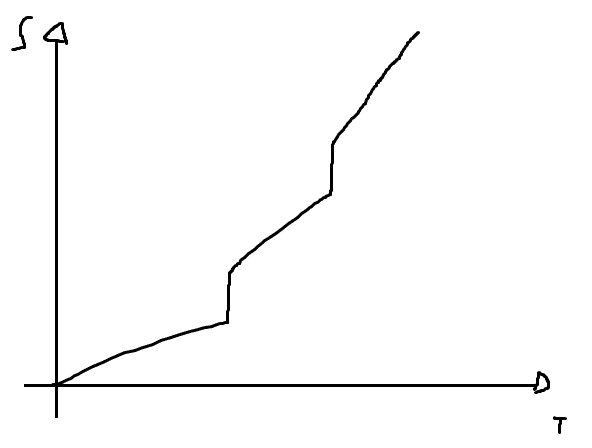
1596418979115.png
That would be the result.
 
Physics news on Phys.org
LCSphysicist said:
View attachment 267215That would be the result.

The liquid and gas phases look about right to me (not 100% sure about the solid region). Usually, I see plots of T vs s for liquids and vapours, so I don't want to comment on that (solid) region as I am not too knowledgeable.
 
The book claims the answer is that all the magnitudes are the same because "the gravitational force on the penguin is the same". I'm having trouble understanding this. I thought the buoyant force was equal to the weight of the fluid displaced. Weight depends on mass which depends on density. Therefore, due to the differing densities the buoyant force will be different in each case? Is this incorrect?

Similar threads

Replies
3
Views
2K
  • · Replies 6 ·
Replies
6
Views
3K
  • · Replies 1 ·
Replies
1
Views
2K
  • · Replies 5 ·
Replies
5
Views
2K
  • · Replies 1 ·
Replies
1
Views
1K
  • · Replies 2 ·
Replies
2
Views
7K
  • · Replies 2 ·
Replies
2
Views
4K
  • · Replies 19 ·
Replies
19
Views
3K
  • · Replies 2 ·
Replies
2
Views
4K
  • · Replies 2 ·
Replies
2
Views
2K