Small Reduced Chi Squared interpretation

Click For Summary

Discussion Overview

The discussion revolves around the interpretation of a small reduced chi squared value in the context of fitting measured data with an exponential function. Participants explore the implications of this value for statistical analysis and model fitting, particularly in relation to error bars and measurement precision.

Discussion Character

  • Technical explanation
  • Debate/contested

Main Points Raised

  • One participant seeks clarification on why their reduced chi squared value is small despite a seemingly good fit, noting that it is typically expected to be around 1 for a good fit.
  • Multiple participants emphasize the importance of including error bars on data points for an appropriate chi squared calculation, suggesting that the absence of these may lead to misleading interpretations.
  • One participant mentions that the software may default to a standard error value if none are provided, which could affect the statistical meaning of the reduced chi squared.
  • Another participant discusses the relationship between measurement errors and the reduced chi squared, indicating that fitting data too well may suggest issues with how errors are accounted for.

Areas of Agreement / Disagreement

Participants generally agree on the necessity of including error bars for meaningful statistical analysis, but there is no consensus on the implications of the small reduced chi squared value itself or how to interpret it without those error bars.

Contextual Notes

Participants note that the interpretation of the reduced chi squared is dependent on the correct specification of measurement errors, which may not have been provided in the initial analysis.

Jakub
Messages
5
Reaction score
0
Hello everyone,
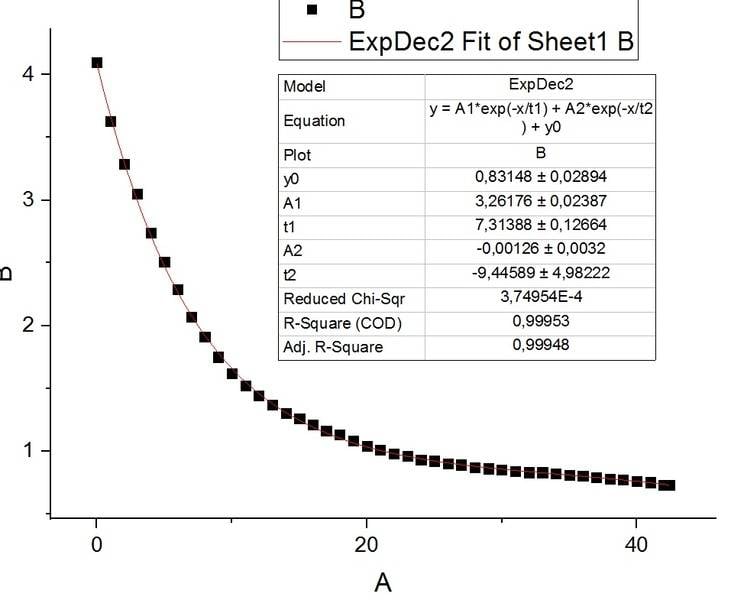
I would be happy if someone explained the small reduced chi squared value to me. I have fitted a set of measured data with an exponential function, which I need for some sw calculations. The fit seams great, the origin sw also provides the reduced chi squared, but it is very small in this case. I thought it was supposed to be around 1 in the case of good fit. See the picture.
Thanks in advance for any help.
chi.jpg
 

Attachments

  • chi.jpg
    chi.jpg
    37.8 KB · Views: 2,140
Physics news on Phys.org
Where are your error bars on the data points? You cannot appropriately compute a chi square function without the correct error bars.
 
Orodruin said:
Where are your error bars on the data points? You cannot appropriately compute a chi square function without the correct error bars.

The Origin SW does it all ... just by looking at the fitted plot, I can't understand the small reduced chi sq
residual_plot_of_expdec2.png
 

Attachments

  • residual_plot_of_expdec1.png
    residual_plot_of_expdec1.png
    35.7 KB · Views: 779
  • residual_plot_of_expdec2.png
    residual_plot_of_expdec2.png
    27.4 KB · Views: 1,514
Jakub said:
The Origin SW does it all ... just by looking at the fitted plot, I can't understand the small reduced chi sq
View attachment 223453
This is generally a bad excuse. If you want to understand what is going on you need to understand what goes on inside the black box. If you have not provided the software with a set of errors, it will likely just assume that the errors in each data point is some default value (like one). In that case you cannot interpret the reduced chi square statistically. The measure of how good your fit is will have no statistical meaning unless you provide the software with the error bars in the data points.
 
Orodruin said:
This is generally a bad excuse. If you want to understand what is going on you need to understand what goes on inside the black box. If you have not provided the software with a set of errors, it will likely just assume that the errors in each data point is some default value (like one). In that case you cannot interpret the reduced chi square statistically. The measure of how good your fit is will have no statistical meaning unless you provide the software with the error bars in the data points.
Thanks for the explanation. I am working with tapered optical fibers. For a sw simulation I need to approximate them with a function. My idea was that the SW would do the best fit possible, and the error would be the fit minus the actual measured value (input value). I thought this is where was the reduced chi sq calculated from.
 
The error is something related to your measurement. Your instrument will typically have some intrinsic precision. This is the error that should go into the analysis. If you have (intending to do so or not) put the measurement errors to one, what you have is indeed something that fits the prediction way better than expected.

Fun fact: As a teacher you can check if your students are ”massaging” the data in a lab by looking to see if their data fits the prediction too well.
 
  • Like
Likes   Reactions: Jakub

Similar threads

  • · Replies 11 ·
Replies
11
Views
3K
  • · Replies 7 ·
Replies
7
Views
3K
  • · Replies 1 ·
Replies
1
Views
2K
  • · Replies 20 ·
Replies
20
Views
4K
  • · Replies 4 ·
Replies
4
Views
2K
  • · Replies 7 ·
Replies
7
Views
2K
  • · Replies 3 ·
Replies
3
Views
4K
  • · Replies 5 ·
Replies
5
Views
4K
  • · Replies 5 ·
Replies
5
Views
2K
  • · Replies 5 ·
Replies
5
Views
9K