So basic question about Charge density on the surface of the conductor

Click For Summary

Homework Help Overview

The discussion revolves around the surface charge density on conductors, particularly questioning whether it is uniform across different points on the surface of a conductor with a specific shape. Participants explore the implications of conductor properties and external electric fields on charge distribution.

Discussion Character

  • Conceptual clarification, Assumption checking

Approaches and Questions Raised

  • Participants question whether surface charge density is the same at different points on a conductor and discuss how it may vary based on the shape and curvature of the conductor. Comparisons are made to spherical conductors.

Discussion Status

There is an ongoing exploration of the relationship between surface charge density and the geometry of the conductor. Some participants suggest that surface charge density may not be uniform, while others provide insights into how charge distribution is influenced by the conductor's shape and external conditions. No consensus has been reached yet.

Contextual Notes

Participants are considering the effects of external electric fields and the characteristics of ideal conductors, including the absence of potential differences on the surface. The discussion also touches on the implications of curvature on charge density.

baby_1
Messages
159
Reaction score
16
Hello
I want to know surface charge density of the conductor in all part of that is same or not?
for example in this shape ?
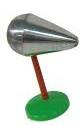
3065864600_1403087286.jpg

if isn't why and how the surface charge density spread?
Thanks
 
Physics news on Phys.org
What are your thoughts? Compare the given shape to, say, a sphere. What is the difference?
 
Thanks dear CAF123
you mean surface charge density at different point of a conductor are the same? point 1 and 2 have same surface charge density?
7272210400_1403158339.jpg

if yes? why surface charge density should be same?
if no?how can find surface charge density at different point and different shape?
 
Dear baby,

Just for my information: is there an external electric field ?

A (ideal) conductor is characterized by the fact that there are no potential differences between points on the surface. If there were, the charge would move until there are no more.

In the absence of an external field that means all electric field lines are perpendicular to the surface and equipotential lines parallel to it. Hence evenly distributed surface charge...
 
BvU said:
Dear baby,

Just for my information: is there an external electric field ?

A (ideal) conductor is characterized by the fact that there are no potential differences between points on the surface. If there were, the charge would move until there are no more.

In the absence of an external field that means all electric field lines are perpendicular to the surface and equipotential lines parallel to it. Hence evenly distributed surface charge...
Actually, it has a unevenly distributed surface charge.

For an isolated conducting sphere, the potential at the surface is given by [itex]\displaystyle V(R)=\frac{Q}{4\pi\epsilon_0 R}= \frac{\sigma R}{\epsilon_0}[/itex]

Consider each end of the conductor you show in the figure.

attachment.php?attachmentid=70728&stc=1&d=1403238050.jpg


The left end appears to be a section of a sphere with a relatively large radius. The right end a section of a sphere with much smaller radius.

It's clear that the surface charge density, σ, depends upon the radius of curvature.
 

Attachments

  • 7272210400_1403158339.jpg
    7272210400_1403158339.jpg
    2.1 KB · Views: 535
  • Like
Likes   Reactions: 1 person
BvU said:
Dear baby,

Just for my information: is there an external electric field ?

A (ideal) conductor is characterized by the fact that there are no potential differences between points on the surface. If there were, the charge would move until there are no more.

In the absence of an external field that means all electric field lines are perpendicular to the surface and equipotential lines parallel to it. Hence evenly distributed surface charge...

I disagree. See SammyS' post.

Surface charge density is governed by equation :

σ1r12r2

when you connect two conductors. From here surface charge density is inversely related to the radius of conductor.

So at peaks charge density is maximum and it's unevenly distributed.
 
  • Like
Likes   Reactions: 1 person
I stand corrected for my last sentence! My "Hence evenly distributed surface charge... " wasn't thought through. Too many simple spherically symmetric exercises...

I hope the stuff before can stay standing, though ?
 
BvU said:
I stand corrected for my last sentence! My "Hence evenly distributed surface charge... " wasn't thought through. Too many simple spherically symmetric exercises...

I hope the stuff before can stay standing, though ?

Yup.

The potential is uniform throughout the conductor (under electrostatic conditions).
 

Similar threads

  • · Replies 17 ·
Replies
17
Views
3K
Replies
11
Views
4K
  • · Replies 13 ·
Replies
13
Views
3K
Replies
9
Views
2K
  • · Replies 26 ·
Replies
26
Views
3K
  • · Replies 19 ·
Replies
19
Views
2K
Replies
44
Views
4K
  • · Replies 2 ·
Replies
2
Views
1K
  • · Replies 15 ·
Replies
15
Views
5K
  • · Replies 4 ·
Replies
4
Views
2K