Homework Helper
Gold Member
- 2,843
- 2,566
If I may chip in...rudransh verma said:Why is the question telling us that field inside to be uniform. Is there a field inside the shell. How do we calculate that?
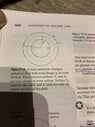
The question is asking “What value of ‘A’ makes the field (between r=a and r=b) ‘uniform’?
Note, the term ‘uniform’ is wrong. For a field to be uniform, both its magnitude and direction must be the same everywhere in the field. Pictorially we represent this by parallel, evenly spaced, field lines. We don’t have a uniform field in this question.
The question should say ‘What value of A makes the magnitude of the field (between r=a and r=b) uniform?” This has already been noted by @haruspex in Post #2.
_____________
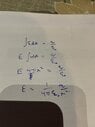
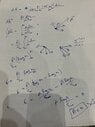
Yes there is a field inside the shell (between r=a and r=b). The formula for it is the one you give in your image in Post #14. The formula becomes very simple after you substitute ##A= \frac {Q}{2\pi a^2}##
____________
A few points about'A' that seem to be a source of confusion...
‘A’ may, or may not, have a physical meaning. Even if it does, you don’t need to know it to answer the question.
‘A’ is simply a number you are being asked to find. It is the value which makes in the magnitude of the field (everywhere between r=a and r=b) the same. That's because in the equation for E, for the correct value of A, the term containing 'r' disappears.
I imagine that if A is too big, the field going from from r=a to r=b increases. And if A is too small, the field going from r=a to r=b decreases.
A = charge-density x r so is is easy to see that A has units of C/m². A is clearly is not an area.