So confused by these multi-step questions, free fall related:

Click For Summary
SUMMARY

This discussion centers on understanding projectile motion in a first-year college physics course, specifically calculating distance and velocity based on initial conditions. The participant struggles with the concepts due to a lack of foundational knowledge in physics, having not studied the subject for over eight years. Key insights include the necessity of grasping the equations of motion in two dimensions and the importance of simpler problems to build confidence. The discussion emphasizes the calculation of vertical and horizontal components of motion using initial velocity and time.

PREREQUISITES
  • Understanding of basic physics concepts, including velocity and acceleration.
  • Familiarity with projectile motion equations, specifically in two dimensions.
  • Knowledge of initial conditions in motion problems, such as initial velocity and time.
  • Basic algebra skills for manipulating equations of motion.
NEXT STEPS
  • Study the equations of motion for projectile motion, focusing on vertical and horizontal components.
  • Practice solving simpler projectile motion problems to build foundational skills.
  • Watch educational videos on projectile motion to reinforce understanding of key concepts.
  • Review examples of problems involving objects projected off cliffs to see practical applications of the equations.
USEFUL FOR

This discussion is beneficial for first-year college students studying physics, particularly those struggling with projectile motion concepts, as well as educators and tutors seeking to support students in foundational physics topics.

ConfusedStudentx10E9
Messages
11
Reaction score
0
Homework Statement
You throw a ball off a cliff with an initial velocity of 25.0 m/s. You start a stopwatch as you throw the ball: the ball rises then falls, and passes your level again after t=0.752 s has elapsed. Sadly, you lose sight of the ball as it falls, and therefore cannot time when the ball hits the ground. Later you find that the ball landed 112 m from the base of the cliff. Assuming that the ball did not "bounce" after landing on the sand, how high up was the cliff? Assume that the ball started exactly 1.60 m above the edge of the cliff.
Relevant Equations
I have no idea and thats the problem.
Tried making many squiggles, I don't understand the concept of finding a distance or position based on a time for part of the flight. I have 2 other similar questions and I haven't been able to make any progress on any of them.

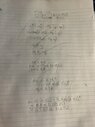
I attached a photo of my scribbles, which are all obviously useless and I'm sure I'm literally just making stuff up to try and make an equation work.

Any help is much appreciated!

** note we assume no friction or resistance. I know acceleration is just gravity.
 

Attachments

  • IMG-6084.jpg
    IMG-6084.jpg
    36.4 KB · Views: 139
Physics news on Phys.org
Let's focus on the first part of the problem. You know the initial velocity and the time to fall back to the initial level. Which quantities does this allow you to calculate?
 
  • Like
Likes   Reactions: topsquark
Note: this is a two dimensional problem.
 
PeroK said:
Let's focus on the first part of the problem. You know the initial velocity and the time to fall back to the initial level. Which quantities does this allow you to calculate?
i could calculate the velocity at the time given, but that's not helpful.

I could calculate its distance on the x-axis at the given time?

I'm honestly not sure.
 
ConfusedStudentx10E9 said:
i could calculate the velocity at the time given, but that's not helpful.

I could calculate its distance on the x-axis at the given time?

I'm honestly not sure.
just think about the vertical aspect of the motion. Given the time to return to the original height, what can you determine?
 
  • Like
Likes   Reactions: SammyS and topsquark
ConfusedStudentx10E9 said:
i could calculate the velocity at the time given, but that's not helpful.

I could calculate its distance on the x-axis at the given time?

I'm honestly not sure.
Okay, but the full problem is a fairly advanced projectile motion problem. You should have built up experience and knowledge from previous problems.

Have you done any projectile motion problems before?
 
  • Like
Likes   Reactions: topsquark
PeroK said:
Okay, but the full problem is a fairly advanced projectile motion problem. You should have built up experience and knowledge from previous problems.

Have you done any projectile motion problems before?
Honestly no, this is a first-year college course I'm taking and I haven't taken high school physics in over 8 years so I do not remember anything. this is chapter 2 of this course, the first chapter was just terminology, sig figs, and vectors. I'm totally lost and don't even know where to start to try and catch up. I have the first quiz on Monday, I've hired a tutor, and I've spent hours trying to catch up watching videos on youtube but I feel so lost.
 
ConfusedStudentx10E9 said:
Honestly no, this is a first-year college course I'm taking and I haven't taken high school physics in over 8 years so I do not remember anything. this is chapter 2 of this course, the first chapter was just terminology, sig figs, and vectors. I'm totally lost and don't even know where to start to try and catch up. I have the first quiz on Monday, I've hired a tutor, and I've spent hours trying to catch up watching videos on youtube but I feel so lost.
That's an honest answer. Unfortunately, this medium is not suitable for teaching you a subject from the ground up.

I think you need access to simpler problems to get you started.

That said, if we have initial velocity and time to fall back, then we can calculate: the vertical component of velocity, hence the horizontal component, hence the max height ( if needed) and the horizontal range.

You first need to understand how to use the equations of projectile motion to do that.
 
  • Like
Likes   Reactions: topsquark
Problems that involve projecting an object off a cliff are the next step.
 
  • #10
PeroK said:
That's an honest answer. Unfortunately, this medium is not suitable for teaching you a subject from the ground up.

I think you need access to simpler problems to get you started.

That said, if we have initial velocity and time to fall back, then we can calculate: the vertical component of velocity, hence the horizontal component, hence the max height ( if needed) and the horizontal range.

You first need to understand how to use the equations of projectile motion to do that.
Would you still be able to go over this particular example, even just the steps and equations used? Obviously, I'm backtracking with the tutor to try and understand everything but I have the first quiz on Monday, while I don't expect to do well I can at least hope to get partial marks for being able to come up with something. I do learn best from examples, and part of the reason I'm struggling with this is because even the instructor for this class has not done an example like this. All of her examples have had the total time as a known.

I understand I'm going to have to work extremely hard to understand this material, but I would still really appreciate a previous problem to refer to if possible.
 
  • #11
For 2D motion under gravity you have equations of motion in the two directions:
$$y = y_0 + u_yt - \frac 1 2g t^2$$$$x = x_0 + u_xt$$Note that gravity affects only the ## y## component of velocity, so the ##x ## component of velocity is constant:$$v_y = u_y - gt$$$$v_x = u_x$$
 
  • Like
Likes   Reactions: ConfusedStudentx10E9 and topsquark
  • #12
Hi @ConfusedStudentx10E9

You might find the following 3 videos I made some time ago useful. They are an introduction to projectile motion - starting from the basics. They include exercises to try for yourself during the video and the worked solutions.


  • Like
Likes   Reactions: ConfusedStudentx10E9, topsquark and PeroK

Similar threads

  • · Replies 1 ·
Replies
1
Views
2K
  • · Replies 11 ·
Replies
11
Views
3K
  • · Replies 1 ·
Replies
1
Views
2K
  • · Replies 16 ·
Replies
16
Views
1K
  • · Replies 7 ·
Replies
7
Views
4K
  • · Replies 2 ·
Replies
2
Views
1K
  • · Replies 5 ·
Replies
5
Views
2K
  • · Replies 20 ·
Replies
20
Views
3K
  • · Replies 3 ·
Replies
3
Views
6K
  • · Replies 1 ·
Replies
1
Views
2K