Solar anomaly and the Antikythera Mechanism

Click For Summary

Discussion Overview

The discussion revolves around the Antikythera Mechanism, specifically focusing on the concept of the Solar Anomaly and its implications for the device's design and functionality. Participants explore the historical context, mathematical underpinnings, and mechanical arrangements related to the mechanism's representation of celestial motions, particularly the sun's position relative to the mean sun.

Discussion Character

  • Exploratory
  • Technical explanation
  • Conceptual clarification
  • Debate/contested

Main Points Raised

  • One participant describes their efforts to replicate the Antikythera Mechanism and expresses confusion regarding the Solar Anomaly as referenced in literature, particularly its calculation and representation.
  • Another participant explains the concept of "anomaly" in celestial mechanics, relating it to the angular distance of a planet from its perihelion and suggests that the term may not align with the anomaly discussed in the context of the Antikythera Mechanism.
  • A participant proposes that the Greeks may have aimed to illustrate the effect of the equation of time rather than precise values, noting that a 2-degree variation would be difficult to observe on a 365-day dial.
  • Discussion includes the relationship between the equation of time, eccentricity, and obliquity, with one participant suggesting that the Greeks might have used a peak-to-trough difference of around 30 minutes, equating to 7.5 degrees.
  • Participants express admiration for the engineering capabilities of the ancient Greeks, particularly in the context of the complexity of the gears used in the mechanism.

Areas of Agreement / Disagreement

Participants exhibit a mix of agreement and uncertainty regarding the interpretation of the Solar Anomaly and its implications for the Antikythera Mechanism. While some participants align on the general understanding of the equation of time and its components, others question the exact values and their visibility on the mechanism.

Contextual Notes

There are limitations regarding the assumptions made about the Greeks' intentions and the precise mathematical relationships involved in the Solar Anomaly. The discussion reflects varying interpretations of the anomaly's significance and the mechanical representation within the Antikythera Mechanism.

Who May Find This Useful

This discussion may be of interest to those studying ancient engineering, celestial mechanics, or the historical development of astronomical devices.

Bobhare
Messages
3
Reaction score
1
I'm building a replica of the Antikythera Mechanism; a device that was conceived and manufactured around 50BC.

it is an orrery and amongst other things it shows the motion of the five known planets, the sun and the moon when viewed from the earth.
I've managed to calculate the motion of the planets and the mechanism I have built follows the theory.

However, according to the many publications on the subject, particularly "The Cosmos in the Antikythera Mechanism -
Tony Freeth and Alexander Jones" there is a set of gears to allow for The Solar Anomaly. This I just don't understand despite many hours of searching.

This anomaly, if appendix 4.1 information is used, causes the observed sun to vary from the mean sun by around 5 degrees on a one year calendar disk equivalent to about 5 days.
The only anomaly I'm aware of is that from the equation of time which is in minutes rather than days and would not show on a one year calendar ring.

All the publications refer to this anomaly but none of them give the logic or maths that develops it. In the Antikythera mechanism the anomaly is generated by a pin and slot arrangement.
I've attached an image of Sun, Mercury and Venus Assembly showing the arrangement of the sun bottom left.

I may have the same problem with the moon but I'd like so solve the sun issue.
Any help would be much appreciated.
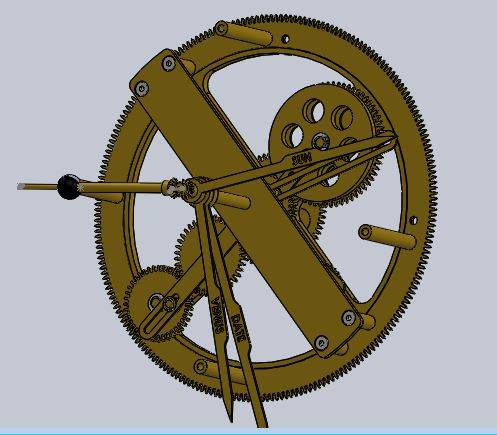
Sun Anomaly.JPG
 
Last edited by a moderator:
Astronomy news on Phys.org
In celestial mechanics "anomaly" usually refers to the angular distance of a planet from its perihelion, as seen from the sun: $$
v \approx M + 2e \sin M + \frac 5 4 e^2 \sin 2 M+ \dots
$$ where ## e ## is the eccentricity of the orbit and ## M = { 2 \pi \over T } t ## the mean anomaly (which increases linearly with time).

For Earth we have ## e = 0.0168 ##, which would lead to a variation of up to about 2 degrees. So I'm not quite sure if it refers to the same quantity as in your book. It is the reason why the seasons don't have the same length. The maximum deviation would occur near the beginning of April and the beginning of October.
 
  • Informative
Likes   Reactions: hutchphd and berkeman
Thanks for the reply.
I'm beginning to think that the Greeks merely wanted to show the effect of the equation of time rather than the exact values and the value of 2 degrees you quote would hardly be visible on a 365 day dial.
I'm sure the anomaly referred to in the book is the maximum angular difference between the actual sun's position and that resulting from the sun moving in a circular orbit.
From further reading this seems to tie in with your 2 degrees.
I'll modify the gear arrangement to get as closed as possible to your number.
 
Bobhare said:
I'm beginning to think that the Greeks merely wanted to show the effect of the equation of time rather than the exact values and the value of 2 degrees you quote would hardly be visible on a 365 day dial.
The equation of time is connected to the anomaly (eccentricity of Earth's orbit), but has another effect superimposed on it due to the tilt of Earth's axis with respect to the orbit plane. That can amount to 4 degrees, or 16 minutes in the diurnal motion. But I doubt that the Greeks worried about the unevenness of the time displayed by a sundial.

I was quite impressed by the Wikipedia article:
Due to advances in imaging and X-ray technology, it is now possible to know the precise number of teeth and size of the gears within the located fragments. Thus the basic operation of the device is no longer a mystery and has been replicated accurately. The major unknown remains the question of the presence and nature of any planet indicators.

Bobhare said:
I'll modify the gear arrangement to get as closed as possible to your number.
Good luck!
 
The image of the gear arrangement in Wikipedia was invaluable and gives the number of teeth on all the gears but nothing related to pin positions in the pin and slot arrangements.
My understanding of the equation of time is that it is made up of two elements, eccentricity and obliquity. Both are sinusoidal but with a phase shift one to the other. The difference in peak to trough is around 30 minutes which is 7.5 degrees.
Perhaps this is the angle that the Greeks were using?
I've managed to modify the design to produce a difference in angle between mean and true sun of 9.5 degrees which is sufficiently close.
I'm an engineer with a reasonable understanding of physics and I'm amazed that the Greeks could conceive the design and equally amazed that they could make it. For example one of the gears has 223 teeth, a prime number, and is only 110mm diameter. That was after they had understood the motion of the heavenly bodies.
 
  • Like
Likes   Reactions: Nik_2213
Bobhare said:
My understanding of the equation of time is that it is made up of two elements, eccentricity and obliquity. Both are sinusoidal but with a phase shift one to the other. The difference in peak to trough is around 30 minutes which is 7.5 degrees.
Yes, that's my understanding, too.
Bobhare said:
Perhaps this is the angle that the Greeks were using?
I have no idea.
Bobhare said:
I'm an engineer with a reasonable understanding of physics and I'm amazed that the Greeks could conceive the design and equally amazed that they could make it. For example one of the gears has 223 teeth, a prime number, and is only 110mm diameter. That was after they had understood the motion of the heavenly bodies.
Yeah, it is amazing. And it was made long before Ptolemy. (He is most famous for his astronomy "textbook", but there must have been excellent astronomers before him.)
 
  • Like
Likes   Reactions: Nik_2213
A short digression into the raving crackpottery of Immanuel Velikovsky has been removed from this thread. All posters are reminded that the forum does not host discussions of pseudo-science, not even to debunk it. Please, if you see it, report it instead of engaging.
 
  • Like
Likes   Reactions: berkeman

Similar threads

  • · Replies 2 ·
Replies
2
Views
3K
  • · Replies 27 ·
Replies
27
Views
4K
  • · Replies 142 ·
5
Replies
142
Views
136K
  • · Replies 86 ·
3
Replies
86
Views
8K
  • · Replies 7 ·
Replies
7
Views
5K
  • · Replies 21 ·
Replies
21
Views
5K
  • · Replies 16 ·
Replies
16
Views
4K
  • · Replies 16 ·
Replies
16
Views
2K
  • · Replies 1 ·
Replies
1
Views
3K
  • · Replies 14 ·
Replies
14
Views
5K